Fluid force on a triangular plate
Fluid force on a triangular plate
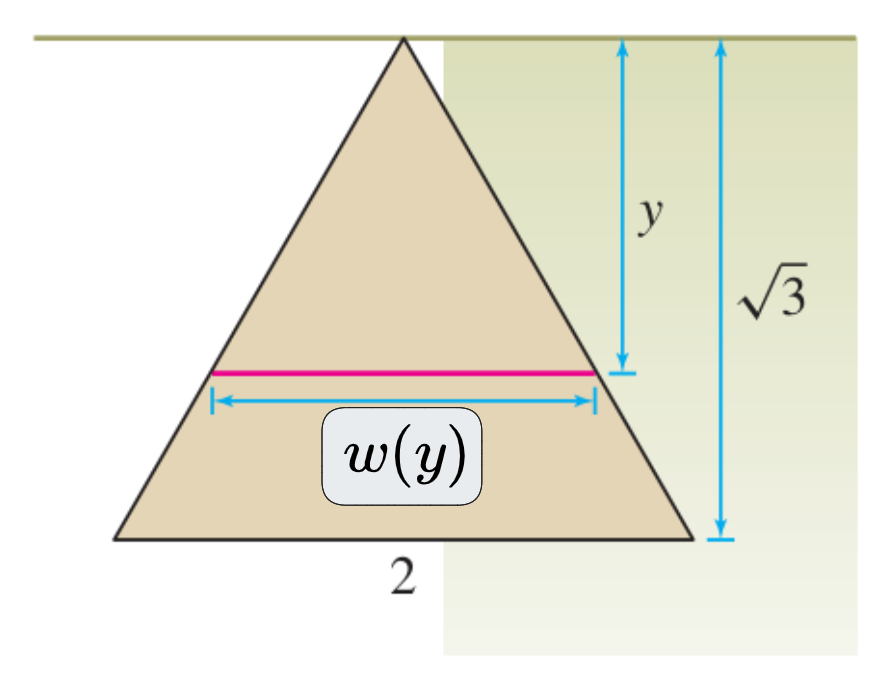
Find the total force on the submerged vertical plate with the following shape: Equilateral triangle, sides , top vertex at the surface, liquid is oil with density .
Solution
(1) Write the width function:
Establish coordinate system: at water line (also the vertex), and increases going down.
Method 1: Geometry of similar triangles
Top triangle with base at is similar to total triangle with base .
Therefore, corresponding parts have the same ratios.
Therefore:
Method 2: Quick linear interpolation function
Generalized “quick linear interpolation function”
Generalization:
where:
- is edge 1 and is edge 2 (increasing order of )
- is when comes earlier (smaller ), and if it comes later
- is created to force the quantity to equal for the given value at
(2) Compute integral using width function:
Bounds:
- (shallow)
- (deep)
Integral formula:
Link to original
Weight of water on a dam
Weight of water on angled dam
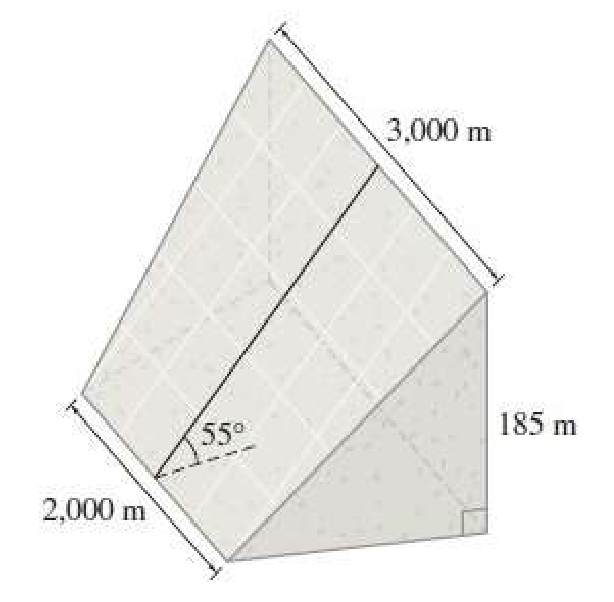
Find the total hydrostatic force on an angled dam with the following geometric description: Tilted trapezoid. Base , Top , and vertical height . The base is tilted at an angle of .
Solution
(1) Write the width function:
Establish coordinate system: at water line (also the top edge), and increases going down.
“Quick linear interpolation function”:
(2) Incorporate angle of incline in strip thickness:
So the area of a strip is:
(3) Compute total force using integral formula.
Plug data into formula:
Link to original
Pumping water from spherical tank
Pumping water from spherical tank
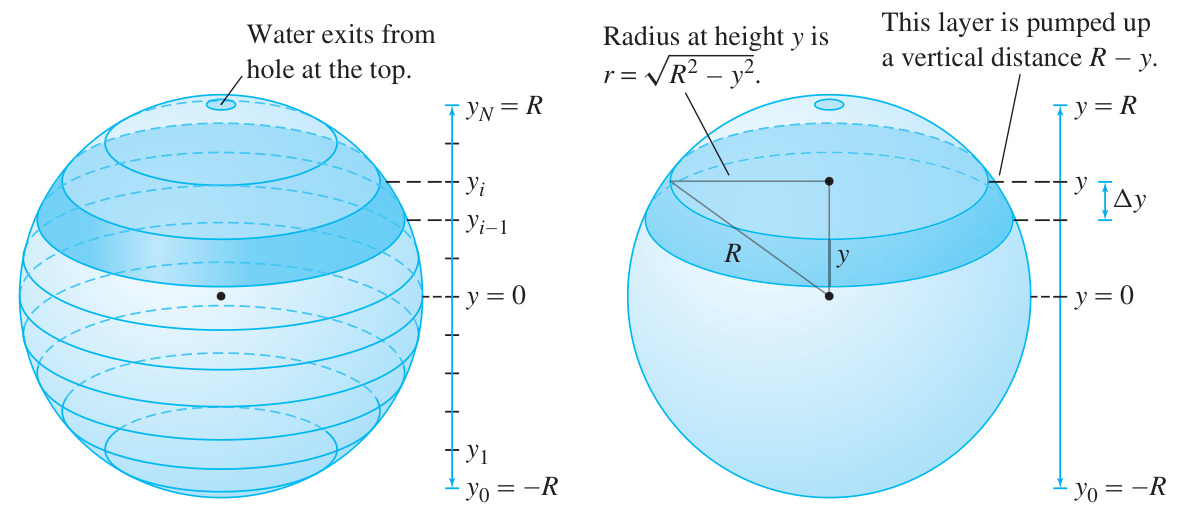
Calculate the work done pumping water out of a spherical tank of radius .
Solution
(1) Slice the tank of water into horizontal layers:
Coordinate is at the center of the sphere, increasing upwards.
(2) Calculate weight of single slice:
(3) Work to lift out single slice:
Distance to raise a slice:
Then:
(4) Total work by integrating over all slices:
Note A: The integration runs over all slices, which start at (bottom of tank), and end at (top of tank).
Extra question: what if the spigot sits above the tank?
Extra question: what if the tank starts at just of water depth?
Link to original
Water pumped from a frustum
Water pumped from a frustum
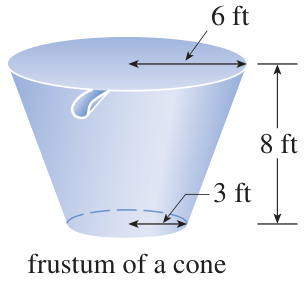
Find the work required to pump water out of the frustum in the figure. Assume the weight of water is .
Solution
(1) Find weight of a horizontal slice.
Coordinate at top, increasing downwards.
Use for radius of cross-section circle.
Linear decrease in from to :
Area is :
:
(2) Find work to pump out a horizontal layer.
Layer at is raised a distance of .
Work to raise layer at :
(3) Integrate over all layers.
Integrate from top to bottom of frustum:
Link to original
Raising a building
Raising a building
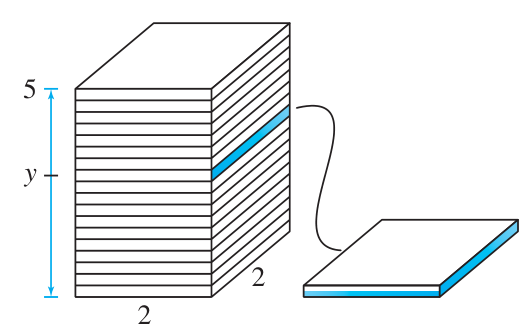
Find the work done to raise a cement columnar building of height and square base per side. Cement has a density of .
Solution
(1) Weight of each layer:
(2) Work to lift layer into place:
(3) Find total work as integral over the layers:
Link to original
Raising a chain
Raising a chain
An chain is suspended from the top of a building. Suppose the chain has weight density . What is the total work required to reel in the chain?
Solution
(1) Compute weight of a ‘link’ (vertical slice of the chain):
(2) Work to raise link to top:
Each link (slice) is raised from height to height 80:
Then:
(3) Integrate over the chain for total work:
Link to original
Raising a leaky bucket
Raising a leaky bucket
Suppose a bucket is hoisted by a cable up an tower. The bucket is lifted at a constant rate of and is leaking water weight at a constant rate of . The initial weight of water is . What is the total work performed against gravity in lifting the water? (Ignore the bucket itself and the cable.)
Solution
(1) Compute total force from water :
Choose coordinate at base, at top.
Rate of water weight loss per unit height:
Total water weight at height :
(2) Work to raise bucket by :
(3) Total work by integrating :
Link to originalChange of method and integral formula!
For this example, we use the formula rather than the formula used in the earlier examples.
- This integral sums over the work to lift macroscopic material through each microscopic as if in sequence, and thus represents distance lifted.
- Earlier examples summed over the work to lift microscopic material through the macroscope (all the way up).