Parametric lines
Parametric lines
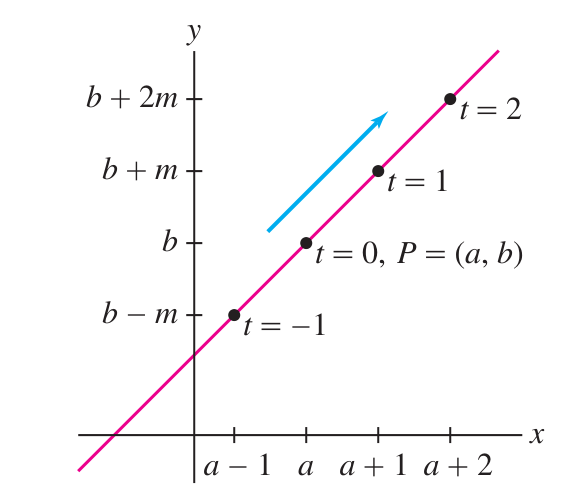
(1) Parametric coordinate functions for a line:
Compare this to the graph of linear function:
Vertical lines cannot be described as the graph of a function. We must use .
(2) Parametric lines can describe all lines equally well, including horizontal and vertical lines.
A vertical line is achieved by setting and .
A horizontal line is achieved by setting and .
A non-vertical line may be achieved by setting and , and .
(3) Assuming that , the parametric coordinate functions describe a line satisfying:
and therefore the slope is and the -intercept is .
(4) The point-slope construction of a line has a parametric analogue:
Link to original
Parametric ellipses
Parametric ellipses
The general equation of an ellipse centered at with half-axes and is:
This equation represents a stretched unit circle:
- by in the -axis
- by in the -axis
Parametric coordinate functions for the general ellipse:
Link to original
Parametric cycloids
Parametric cycloids
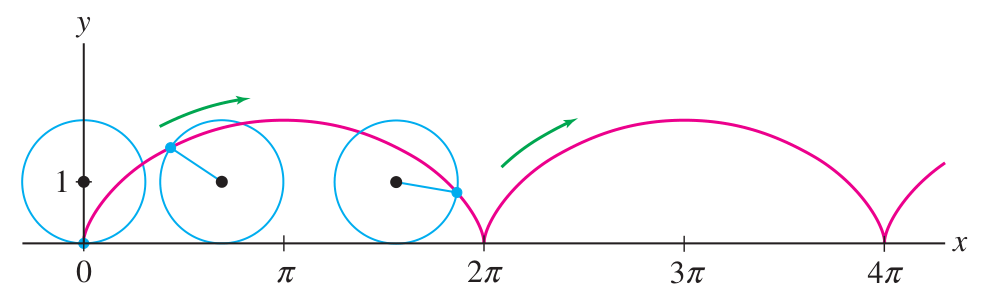
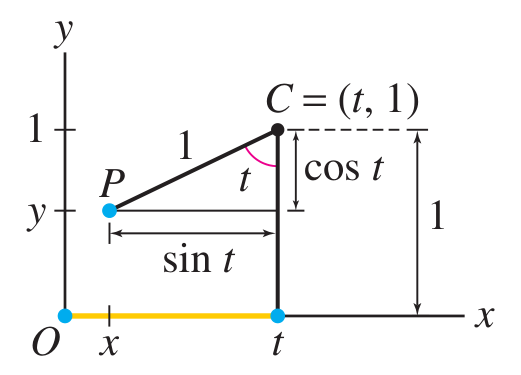
The cycloid is the curve traced by a pen attached to the rim of a wheel as it rolls.
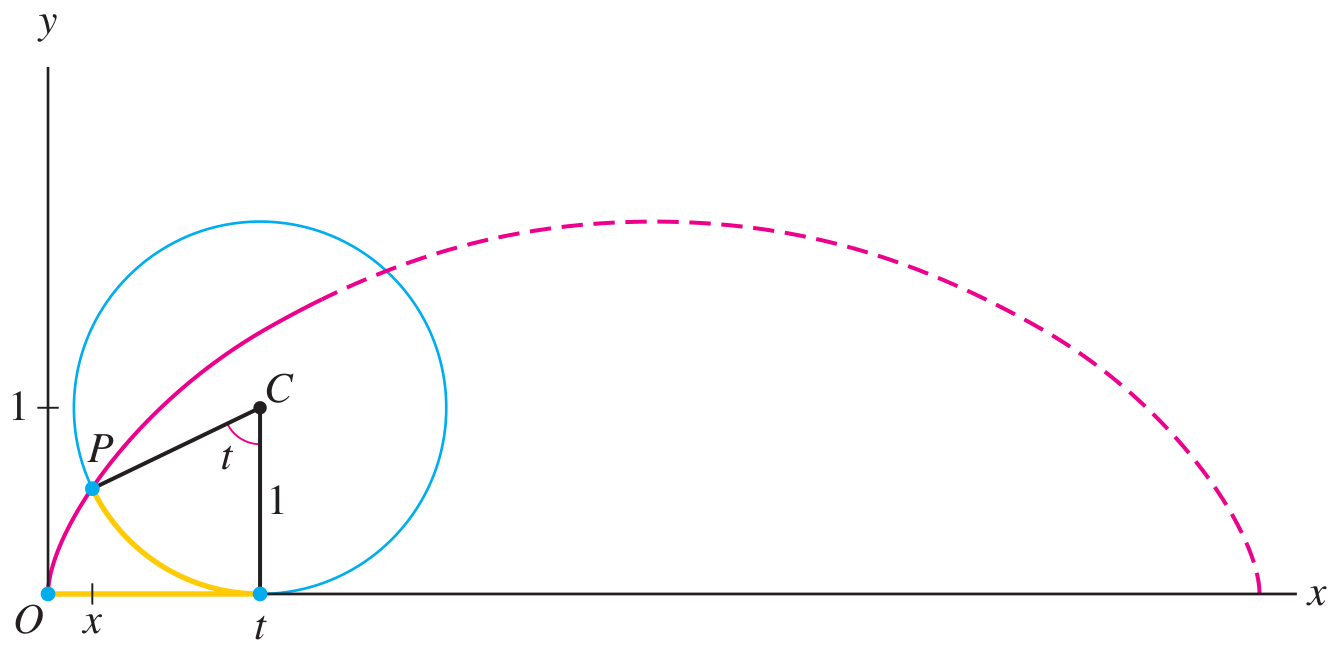
It is easy to describe the cycloid parametrically. Consider the geometry of the situation:
The center of the wheel is moving rightwards at a constant speed of , so its position is . The angle is revolving at the same constant rate of (in radians) because the radius is .
The triangle shown has base , so the coordinate is . The coordinate is .
So the coordinates of the point are given parametrically by:
If the circle has another radius, say , then the parametric formulas change to:
Link to original
Tangent to a cycloid
Tangent to a cycloid
Find the tangent line (described parametrically) to the cycloid when .
Solution
(1) Compute and .
Find and :
(2) Plug in :
(3) Apply formula: :
Calculate at :
So:
This is the slope for our line.
(4) Need the point for our line. Find at .
Plug into parametric formulas:
(5) Point-slope formulation of tangent line:
Inserting data:
Link to original
Vertical and horizontal tangents of the circle
Vertical and horizontal tangents of the circle
Consider the circle parametrized by and . Find the points where the tangent lines are vertical or horizontal.
Solution
(1) For the points with vertical tangent line, we find where the moving point has (purely vertical motion):
The moving point is at when , and at when .
(2) For the points with horizontal tangent line, we find where the moving point has (purely horizontal motion):
The moving point is at when , and at when .
Link to original
Finding the point with specified slope
Finding the point with specified slope
Consider the parametric curve given by . Find the point where the slope of the tangent line to this curve equals 5.
Solution
(1) Compute the derivatives:
Therefore the slope of the tangent line, in terms of :
(2) Set up equation:
(3) Find the point:
Link to original
Perimeter of a circle
Perimeter of a circle
(1) The perimeter of the circle is easily found. We have , and therefore:
(2) Integrate around the circle:
Link to original
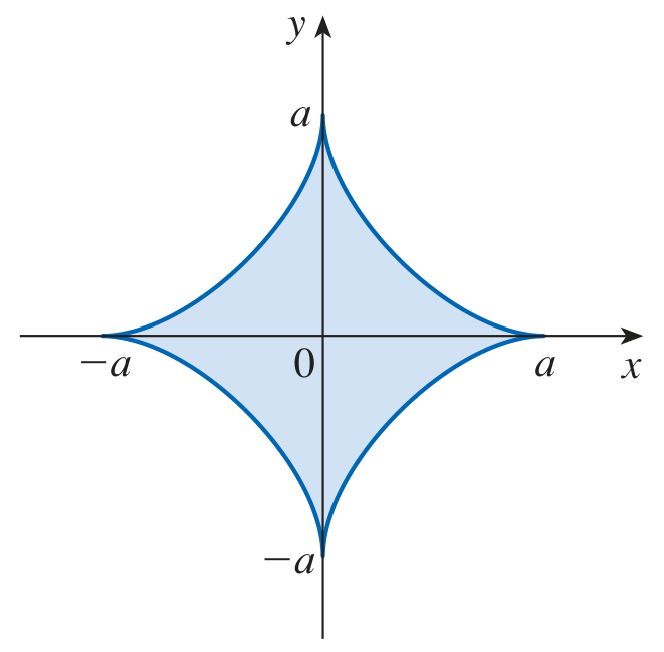
Perimeter of an asteroid
Perimeter of an asteroid
Find the perimeter length of the ‘asteroid’ given parametrically by for .
Solution
(1) Notice: Throughout this problem we use the parameter instead of . This does not mean we are using polar coordinates!
Compute the derivatives in :
(2) Compute the infinitesimal arc element.
Plug into the arc element, simplify:
(3) Bounds of integration?
Easiest to use . This covers one edge of the asteroid. Then multiply by 4 for the final answer.
On the interval , the factor is positive. So we can drop the absolute value and integrate directly.
Absolute values matter!
If we tried to integrate on the whole range , then really does change sign.
To perform integration properly with these absolute values, we’d need to convert to a piecewise function by adding appropriate minus signs.
(4) Integrate the arc element:
Finally, multiply by 4 to get the total perimeter:
Link to original