Integration by substitution (review only)
Videos
Review Videos
[Note: this section is non-examinable. It is included for comparison to IBP.]
Link to original
- Integration by Substitution 1:
- Integration by Substitution 2:
- Integration by Substitution 3:
- Integration by Substitution 4:
- Integration by Substitution 5:
- Integration by Substitution: Definite integrals, various examples
Theory
Theory 1
The method of -substitution is applicable when the integrand is a product, with one factor a composite whose inner function’s derivative is the other factor.
Substitution
Suppose the integral has this format, for some functions and :
Then the rule says we may convert the integral into terms of considered as a variable, like this:
The technique of -substitution comes from the chain rule for derivatives:
Here we let . Thus for some .
Now, if we integrate both sides of this equation, we find:
And of course .
Link to originalExtra - Full explanation of -substitution
(1) Chain rule for derivatives:
Let be a function and its derivative. Let be another function.
Using primes:
Using differentials:
(2) Integrate both sides:
(3) Introduce ‘variable’ from the -format of the integral:
Treating as a variable, the definition of gives:
Set the ‘variable’ to the ‘function’ output:
Combine these:
(4) Substitute for :
This is “-substitution” in final form.
Integration by parts
Videos
Review Videos
Videos:
Link to original
- Integration by Parts 1: and
- Integration by Parts 2: and
- Integration by Parts 3: Definite integrals
- Example: , two methods:
- Integration by Parts 6:
Theory
Theory 1
The method of integration by parts (abbreviated IBP) is applicable when the integrand is a product for which one factor is easily integrated while the other becomes simpler when differentiated.
Integration by parts
Suppose the integral has this format, for some functions and :
Then the rule says we may convert the integral like this:
This technique comes from the product rule for derivatives:
Now, if we integrate both sides of this equation, we find:
and the IBP rule follows by algebra.
Extra - Full explanation of integration by parts
(1) Product rule for derivatives:
(2) Integrate both sides:
Definite IBP
Definite version of FTC:
Link to originalChoosing factors well
IBP is symmetrical. How do we know which factor to choose for and which for ?
Here is a trick: the acronym “LIATE” spells out the order of choices – to the left for and to the right for :
Illustration
Example - A and T factors
A and T factors
Compute the integral:
Solution
(1) Choose and :
Set because simplifies when differentiated.
(By the trick: is Algebraic, i.e. more “”, and is Trig, more “”.)
Remaining factor must be .
(2) Compute and :
Key chart:
(3) Evaluate IBP formula:
Link to originalWhy IBP?
The rationale of IBP is that is easier to compute than .
Exercise - Hidden A
Hidden A
Compute the integral:
Link to originalSolution
(1) Choose :
Because Log is farthest left in LIATE.
Therefore we must choose .
(2) Compute and :
We have and . Obtain chart:
(3) Evaluate IBP formula:
Perform new integration:
Final answer is:
Trig power products
Videos
Review Videos
Videos, Math Dr. Bob:
Videos, Organic Chemistry Tutor:
Link to original
Theory
Theory 1
Review: trig identities
Trig power product:
A power product has this form:
for some integers and (even negative!).
To compute these integrals, use a sequence of these techniques:
- Swap an even bunch.
- -sub for power-one.
- Power-to-frequency conversion.
Memorize these three techniques!
Examples of trig power products:
Swap an even bunch
If either or is an odd power, use
(maybe repeatedly) to convert an even bunch to the opposite trig type.
An even bunch is all but one from the odd power.
For example:
-sub for power-one
If or , perform -substitution to do the integral.
The other trig power becomes a power; the power-one becomes .
For example, using and thus we can do:
By combining these tricks you can do any power product with at least one odd power! Make sure to leave a power-one from the odd power when swapping an even bunch.
Notice
Even powers: . So the method works for and similar.
Power-to-frequency conversion
Using these ‘power-to-frequency’ identities (maybe repeatedly):
change an even power (either type) into an odd power of cosine.
For example, consider the power product:
You can substitute appropriate powers of and :
By doing some annoying algebra, this expression can be expanded as a sum of smaller powers of :
Each of these terms can be integrated by repeating the same techniques.
Link to original
Illustration
Example - Power product - odd power
Power product - odd power
Compute the integral:
Solution
(1) Swap over the even bunch:
Max even bunch leaving power-one is .
Apply to in the integrand:
(2) Perform -substitution on the power-one integrand:
Set . Hence . Recognize this in the integrand and convert:
(3) Integrate using power rule:
Insert definition :
Link to original
Theory
Theory 2
Trig power product: or
A power product has this form:
A power product has this form:
To integrate these, swap an even bunch using:
OR:
Or do -substitution using:
OR:
Note
There is no simple “power-to-frequency conversion” for tan / sec !
We can modify the power-one technique to solve some of these. We need to swap over an even bunch from the odd power so that exactly the factor is left behind.
Considering all the possibilities, one sees that this method works when:
- is an odd power (with some secants present!)
- is an even power
Quite a few cases escape this method:
- Any with no power of
- Any for even and odd
These tricks don’t work for or or , among others.
Special integrals: tan and sec
We have:
Note
These integrals should be memorized individually.
Link to originalExtra - Deriving special integrals: tan and sec
The first formula can be found by -substitution, considering that .
The second formula can be derived by multiplying by a special “”, computing instead by expanding the numerator and doing -sub on the denominator.
Illustration
Example - Power product - tan and sec
Power product - tan and sec
Compute the integral:
Solution
(1) Try :
Factor out of the integrand:
We then must swap over remaining into the type.
Cannot do this because has odd power. Need even to swap.
(2) Try again: :
Factor out of the integrand:
Swap remaining into type:
Substitute and :
(3) Integrate in and convert back to :
Link to original
Trig substitution
Videos
Review Videos
Videos, Math Dr. Bob:
Link to original
- Trig sub 1: Basics and and and
- Trig sub 2:
- Trig sub 3:
- Trig sub 4:
- Trig sub 5:
Theory
Theory 1
Certain algebraic expressions have a secret meaning that comes from the Pythagorean Theorem. This meaning has a very simple expression in terms of trig functions of a certain angle.
For example, consider the integral:
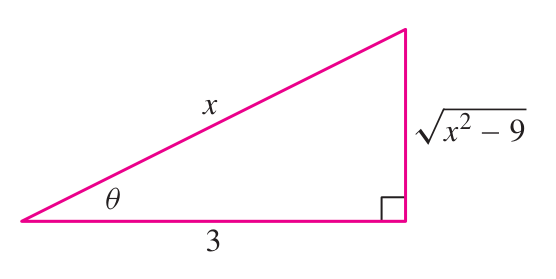
Now consider this triangle:
The triangle determines the relation , and it implies .
Now plug these into the integrand above:
Considering that , we obtain a very reasonable trig integral:
We must rewrite this in terms of using to finish the problem. We need to find assuming that . To do this, refer back to the triangle to see that . Plug this in for our final value of the integral:
Here is the moral of the story:
Pythagorean expressions
Re-express the Pythagorean expression using a triangle and a trig substitution.
In this way, we are able to eliminate square roots of quadratics.
There are always three steps for these trig sub problems:
- (1) Identify the trig sub: find the sides of a triangle and relevant angle .
- (2) Solve a trig integral (often a power product).
- (3) Refer back to the triangle to convert the answer back to .
To speed up your solution process for these problems, memorize these three transformations:
(1)
(2)
(3)
For a more complex quadratic with linear and constant terms, you will need to first complete the square for the quadratic and then do the trig substitution.
Link to original
Illustration
Example - Trig sub in quadratic: completing the square
Trig sub in quadratic - completing the square
Compute the integral:
Solution
(1) Complete the square to obtain Pythagorean form:
Add and subtract to get desired constant term:
(2) Perform shift substitution:
Set as inside the square:
Infer . Plug into integrand:
(3) Trig sub with :
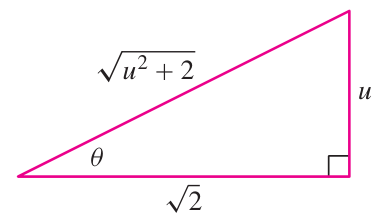
Use substitution . (From triangle or memorized tip.)
Infer . Plug in data:
(4) Integrate using ad hoc memorized formula:
(5) Convert trig back to :
First in terms of , referring to the triangle:
Then in terms of using . Plug everything in:
(6) Simplify using log rules:
The common denominator can be pulled outside as .
The new term can be “absorbed into the constant” (redefine ).
So we write our final answer thus:
Link to original
Partial fractions
Videos
Review Videos
Videos, Math Dr. Bob:
Link to original
- Partial Fractions 01 - Distinct Linear Factors
- Partial Fractions 02 - Repeated Linear Factors
- Partial Fractions 03 - Distinct Mixed Factors
- Partial Fractions 04 - Repeated Quadratic Factors
- Partial Fractions 05 - Composition with
Theory
Theory 1
A rational function is a ratio of polynomials, for example:
Partial fraction decomposition
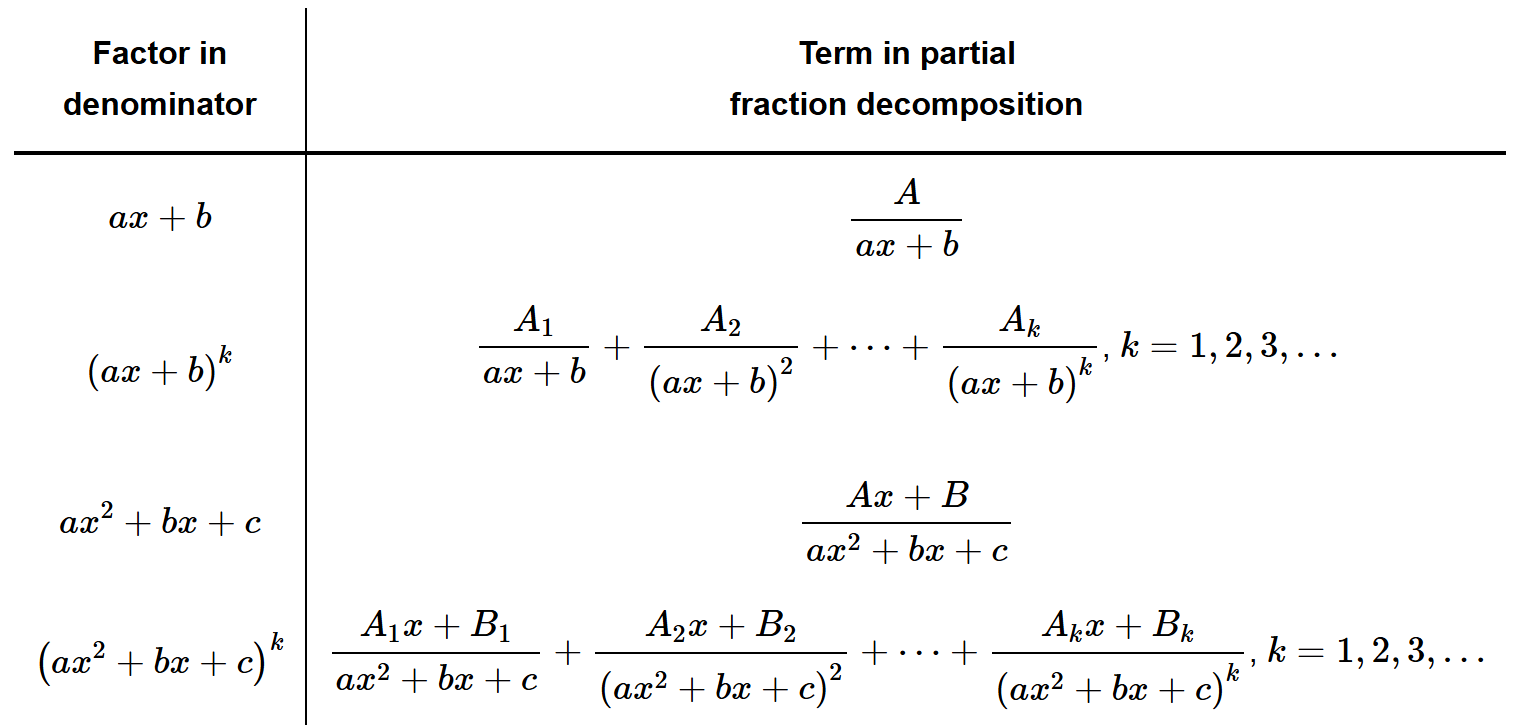
The partial fraction decomposition of a rational function is a way of writing it as a sum of simple terms, like this:
Allowed denominators:
- Linear, e.g. , or linear power, e.g.
- Quadratic, e.g. , or quadratic power, e.g.
- Condition: quadratics must be irreducible. (No roots, i.e. .)
Allowed numerators: constant (over linear power) or linear (over quadratic power)
These are allowed as simple terms in partial fraction decompositions:
These are not allowed:
These are allowed, showing irreducible quadratic and higher powers:
In this example the numerator is linear and the denominator is quadratic and irreducible.
To create a partial fraction decomposition, follow these steps:
- Check denominator degree is higher
- Else do long division
- Factor denominator completely (even using irrational roots)
- Write the generic sum of partial fraction terms with their constants
Repeated factors – special treatment – incrementing powers
Link to original
- Solve for constants
Illustration
Partial fractions with repeated factor
Partial fractions with repeated factor
Find the partial fraction decomposition:
Solution
(1) Check that denominator degree is lower.
(2) Factor denominator:
Rational Roots Theorem: check for roots at and and .
Discover that is a root. Therefore divide by :
Factor again:
Final factored form:
(3) Write the generic PFD:
(4) Solve for , , and :
Multiply across by the common denominator:
For , set , obtain:
For , set , obtain:
For , insert prior results and solve.
Plug in and :
Now plug in another convenient , say :
(4) Plug in , , for the final answer:
Link to original
Theory
Theory 2
Partial fractions can be integrated using just a few techniques. Consider these terms:
Linear power bottom
In order to integrate terms like this:
If then use log:
If then use power rule:
Quadratic bottom, constant top
Formula for simple irreducible quadratics:
Memorize this formula!
Quadratic bottom, linear top
In order to integrate terms like this:
Break into separate terms:
Then:
First term with in top:
Second term lacking in top:
Link to originalExtra - Completing the square when “no real roots”
To integrate terms with more general quadratics, like this:
we need , i.e. “no real roots” of the quadratic. If that holds, then we can complete the square and substitute as follows.
Look what happens when completing the square:
Notice that is equivalent to the condition . Create a new label . So this condition means and we can safely define .
Then a -substitution simplifies the equation like this:
The quadratic formula shows that the condition is equivalent to the condition “no real roots.” (In our case . If we had , we could divide out this and change the others.)
So we see that “no real roots” is equivalent to the condition that the denominator can be converted to the format with some constant .
At this point, to compute the integral, do trig sub with and :
Illustration
Example - Repeated quadratic, linear tops
Partial fractions - repeated quadratic, linear tops
Compute the integral:
Solution
(1) Partial fraction decomposition:
- Numerator degree is lower than denominator.
- Factor denominator completely. (No real roots.)
Write generic PFD:
- Notice: repeated factor: use incrementing powers up to 2.
- Notice: linear over quadratic.
Common denominators and solve:
Therefore:
(2) Integrate:
Integrate the first term using substitution :
Break up the second term:
Integrate the first term of RHS:
Integrate the second term of RHS using :
Link to original
Extra - “Rationalize a quotient” - convert into PFD
Extra - “Rationalize a quotient” - convert into PFD
Sometimes an integrand may be converted to a rational function using a substitution.
Consider this integral:
Set , so and :
Now this rational function has a partial fraction decomposition:
It is easy to integrate from there!
Practice exercises:
Link to original
- To compute , try the substitution .
- To compute , try the substitution .
- To compute , try the substitution .
Simpson’s Rule
Videos
Review Videos
Videos, Math Dr. Bob:
Videos, Organic Chemistry Tutor:
Link to original
Theory - review
Theory 1
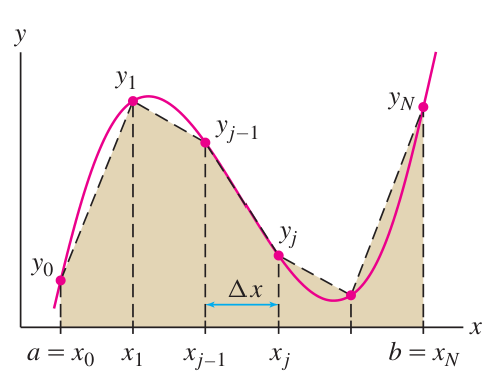
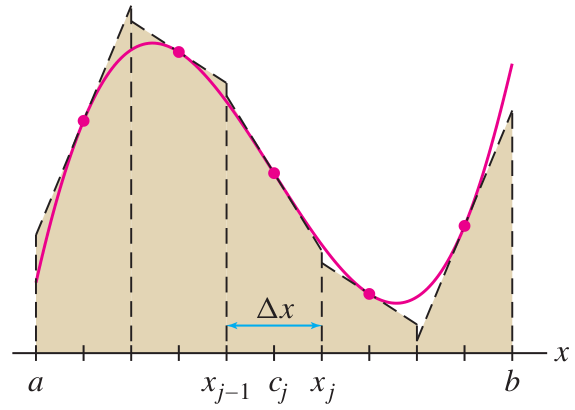
The Trapezoid Rule is a technique to approximate the area under a curve as the sum of areas of thin trapezoids whose top corners lie on the curve.
The tops of the trapezoids are lines that approximate the curve. They are determined as lines that agree with the curve at two points.Trapezoid rule - area formula
Given a function and a partition of the range labeled by (with and ), the Trapezoid Rule determines the area formula:
Notice the pattern in s and see how this formula comes about:
The area of one trapezoid is . All vertical values (excepting the endpoints and ) are represented in two trapezoids, so their contribution is doubled.Extra - Trapezoid rule - error bound
The error of the Trapezoid Rule approximation is bounded by this formula:
Here is any number satisfying for .
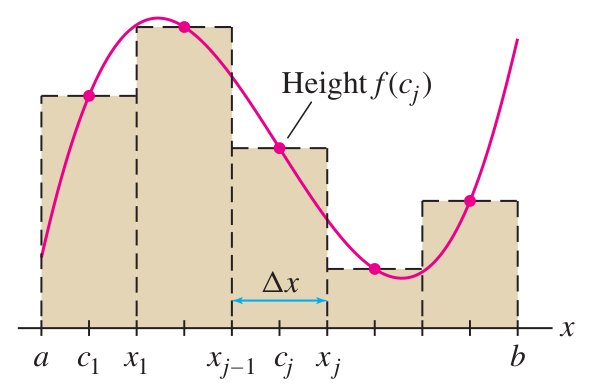
The Midpoint Rule is a technique to approximate the area under a curve as the sum of areas of thin rectangles whose top midpoints lies on the curve.
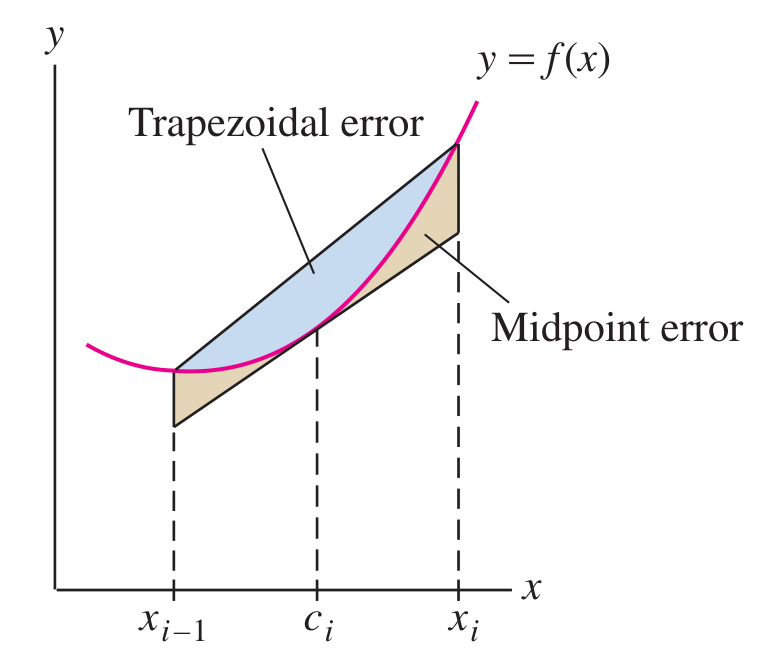
The very same formula also represents the areas of trapezoids whose top midpoints lie on the curve and whose top line is tangent to the curve:
The reason they are equal is simple: when pivoting the top line on the ‘attached’ midpoint, the area of the trapezoid does not change.
Midpoint Rule - area formula
Given a function and a partition of the range labeled by (with and ), the Midpoint Rule determines the area formula:
Here each is the midpoint of the interval . It can be given by the formula .
Extra - Midpoint Rule - error bound
The error of the Midpoint Rule approximation is bounded by this formula:
Here is any number satisfying for .
Notice that has an error bound that is of the bound for . This does not mean that always has a smaller error than . It means that without calculating the error, simply plugging numbers into the error bound formulas, we obtain a smaller bound for than for . This is about our knowledge of the error, not the reality of the error.
Link to original
Theory
Theory 2
It turns out that the Midpoint Rule and the Trapezoid Rule tend to differ from the exact integral in opposite directions, and the Midpoint Rule tends to be twice as accurate. Therefore we may improve on both of them by constructing a weighted average of the formulas. This is called Simpson’s Rule.
Simpson’s Rule - defining formula
Simpson’s Rule is given by the weighted sum of the Trapezoid and Midpoint Rules:
Simpson’s Rule - computing formula
Given a function and a partition of the range labeled by (with and ), Simpson’s Rule determines the area formula:
Simpson’s Coefficient Pattern
Memorize the pattern for Simpson’s Rule:
Simpson’s Rule - error bound
The error of Simpson’s Rule approximation is bounded by this formula:
Here is any number satisfying for .
Link to originalSimpson’s Rule “Parabola Rule”
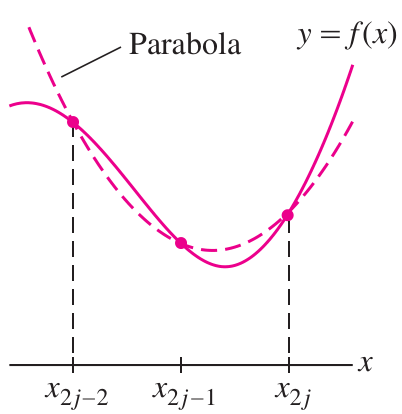
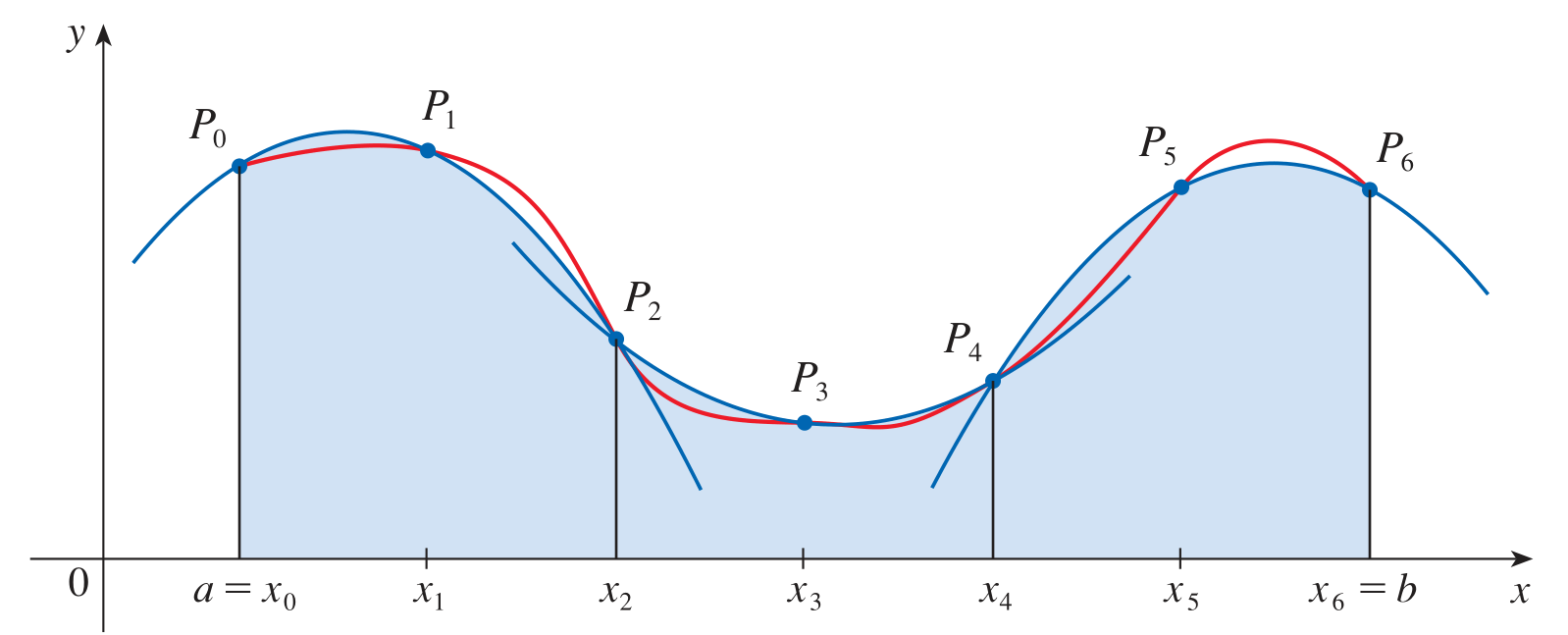
The formula of Simpson’s Rule can also be explained or defined geometrically: it is the formula giving the sum of areas under small parabolas that meet the curve in three points.
There is a unique parabola passing through any three points with differing -values:
These may be pieced together to form an approximation to the curve:
The area under the parabola through , , and is given by this formula:This formula may be verified using basic calculus (area under a parabola) and a lot of algebra. (Ambitious students should derive it.)
The area under the parabola through , , and is given by a similar formula:
The Simpson’s Rule formula is the sum of all these formulas! So the s in Simpson’s come from duplication of endpoint terms as the “rectangular” regions are stacked end-to-end.
Illustration
Example - Simpson’s Rule on the Gaussian Distribution
Simpson’s Rule on the Gaussian distribution
The function is very important for probability and statistics, but it cannot be integrated analytically.
Apply Simpson’s Rule to approximate the integral:
with and . What error bound is guaranteed for this approximation?
Solution
(1) We need a table of values of and :
These can be plugged into the Simpson Rule formula to obtain our desired approximation:
To find the error bound we need to find the smallest number we can manage for .
Take four derivatives and simplify:
On the interval , this function is maximized at . Use that for the optimal :
Finally we plug this into the error bound formula:
Link to original
Improper integrals
Videos
Review Videos
Videos, Math Dr. Bob:
Link to original
- Improper integrals: Infinite limits
- Improper integrals: Vertical asymptote
- Improper integrals:
- Improper integrals:
Theory
Theory 1
Improper integrals are those for which either a bound or the integrand itself become infinite somewhere on the interval of integration.
Examples:
(a) the upper bound is
(b) the integrand goes to as
(c) the integrand is at the pointThe limit interpretation of (a) is this:
The limit interpretation of (b) is this:
The limit interpretation of (c) is this:
These limits are evaluated using the usual methods.
An improper integral is said to be convergent or divergent according to whether it may be assigned a finite value through the appropriate limit interpretation.
For example, converges while diverges.
Link to original
Illustration
Example - Improper integral - infinite bound
Improper integral - infinite bound
Show that the improper integral converges. What is its value?
Solution
(1) Improper integral definition:
(2) Replace infinity with a new symbol :
(3) Take limit as :
Link to original
Improper integral - infinite integrand
Improper integral - infinite integrand
Show that the improper integral converges. What is its value?
Solution
(1) Improper integral definition:
(2) Switch to and integrate:
(3) Take limit as :
Link to original
Example - Improper integral - infinity inside the interval
Example - Improper integral - infinity inside the interval
Does the integral converge or diverge?
Solution
WRONG APPROACH:
It is tempting to compute the integral incorrectly, like this:
But this is wrong! There is an infinite integrand at . We must break it into parts!
RIGHT APPROACH:
(1) Break apart at discontinuity:
(2) Improper integral definition, both terms separately:
(3) Integrate:
(4) Limits:
Neither limit is finite. For to exist we’d need both of these limits to be finite. So the original integral diverges.
Link to original
Theory
Theory 2
Two tools allow us to determine convergence of a large variety of integrals. They are the comparison test and the -integral cases.
Comparison test - integrals
The comparison test says:
- When an improper integral converges, every smaller integral converges.
- When an improper integral diverges, every bigger integral diverges.
Here, smaller and bigger are comparisons of the integrand at all values (accounting properly for signs), and the bounds are assumed to be the same.
For example, converges, and implies (when ), therefore the comparison test implies that converges.
-integral cases
Assume and . We have:
Proving the -integral cases
It is easy to prove the convergence / divergence of each -integral case using the limit interpretation and the power rule for integrals. (Or for , using .)
Additional improper integral types
The improper integral also has a limit interpretation:
The double improper integral has this limit interpretation:
Where is any finite number. This double integral does not exist if either limit does not exist for any value of .
Link to originalDouble improper is not simultaneous!
Watch out! This may happen:
This simultaneous limit might exist only because of internal cancellation in a case where the separate individual limits do not exist! We do not say ‘convergent’ in these cases!
Illustration
Example - Comparison to -integrals
Comparison to p-integrals
Determine whether the integral converges:
(a)
(b)
Solution
(a)
(1) Observe large tendency:Consider large values. Notice the integrand tends toward for large .
(2) Try comparison to :
Validate. Notice and when .
(3) Apply comparison test:
We know:
We conclude:
(b)
(1) Observe large tendency:Consider large values. Notice the integrand tends toward for large .
(2) Try comparison to :
Validate. Notice and when .
(3) Apply comparison test:
We know:
We conclude:
Link to original