Volume using cylindrical shells
Videos
Review Videos
Review
- Volume using cross-sectional area
- Disk/washer method - 01
- Disk/washer method - 02
- Disk/washer method - 03
Shells
Link to original
Theory
Theory 1
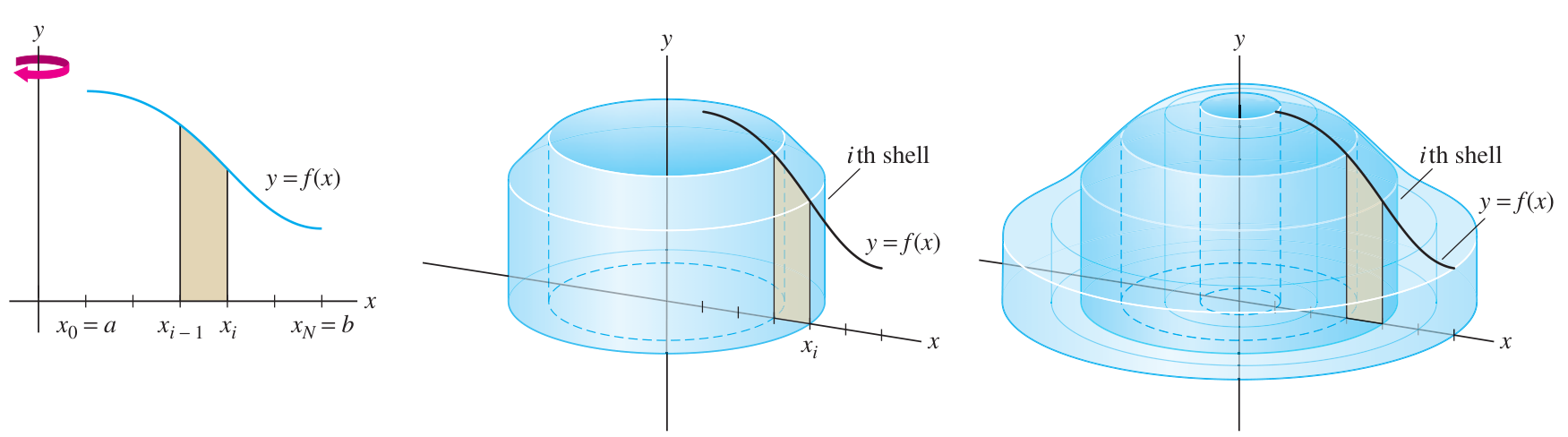
Take a graph in the first quadrant of the -plane. Rotate this about the -axis. The resulting 3D body is symmetric around the axis. We can find the volume of this body by using an integral to add up the volumes of infinitesimal shells, where each shell is a thin cylinder.
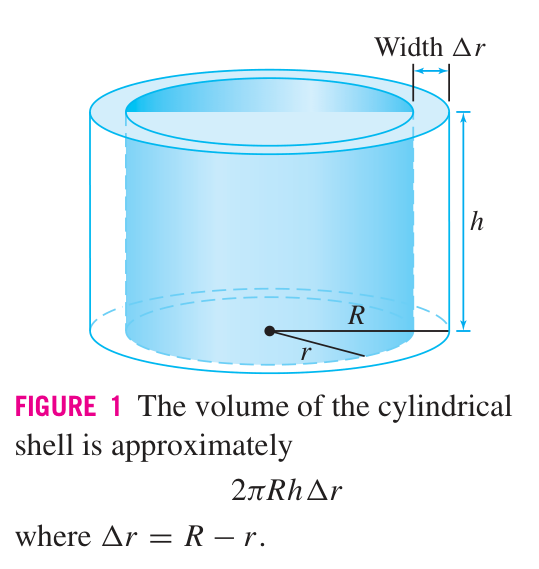
The volume of each cylindrical shell is :
In the limit as and the number of shells becomes infinite, their total volume is given by an integral.
Volume by shells - general formula
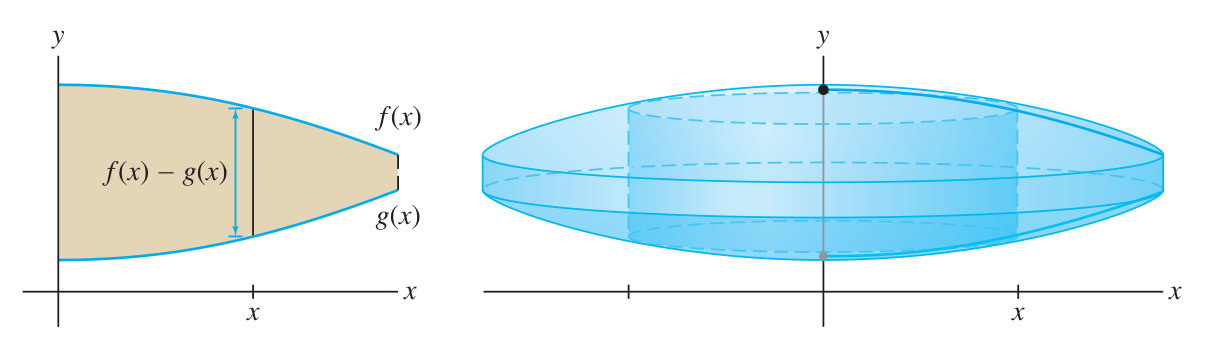
In any concrete volume calculation, we simply interpret each factor, ‘’ and ‘’ and ‘’, and determine and in terms of the variable of integration that is set for .
Link to originalShells vs. washers
Can you see why shells are sometimes easier to use than washers?
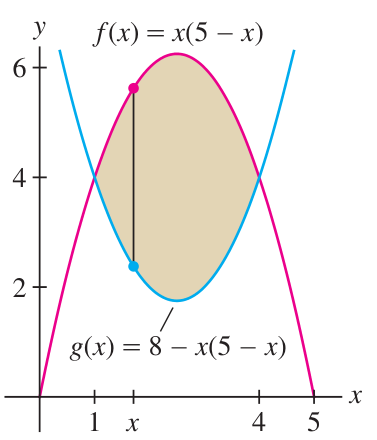
Illustration
Example - Revolution of a triangle
Revolution of a triangle
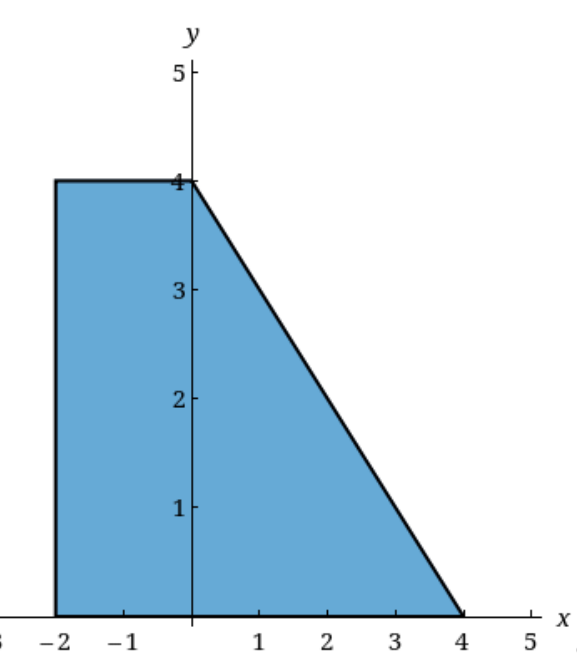
A rotation-symmetric 3D body has cross section given by the region between , , , and is rotated around the -axis. Find the volume of this 3D body.
Solution
(1) Cross-section region:
Bounded above-right by . Bounded below-right by . These intersect at .
Bounded left by .
(2) Set up integral:
Rotated around -axis, therefore use for integration variable (shells!). Formula:
Domain is .
because shell radius is the -distance from to the shell position.
Height:
is limit of which equals here, so .
(3) Evaluate integral:
Link to original
Practice exercise
Revolution of a sinusoid
Consider the region given by revolving the first hump of about the -axis. Set up an integral that gives the volume of this region using the method of shells.
Link to originalSolution
(1) Set up the integral for shells:
Integration variable: , the distance of a shell to the -axis.
Then and , the height of a shell.
Bounds: one hump is given by . Thus:
(2) Perform the integral using IBP:
Choose and since is A and is T.
Then and .
Use IBP formula:
Compute first term:
Compute integral term:
So the answer is .
Arc length
Videos
Review Videos
Videos, Math Dr. Bob:
- Formula for Arc Length 01: Theory and catenary
- Formula for Arc Length 02: Curve given by integral
- Formula for Arc Length 03: Reverse engineering
- Arc Length of Parabola 01: Base case
- Arc Length of Parabola 02: Sinh formula
- Arc Length of Parabola 03: Log formula
Videos, Khan Academy:
Link to original
Theory
Theory 1
The total arc length of a curve is just the length of the curve.
The ‘arc length’ (not “total”) is a quantity measuring the length “as you go along,” usually given as a function of the points on the curve. It measures the length from some starting point ‘up to’ the given point.
We can use calculus to calculate the arc length of many curves. If the curve is the graph of a function, and we know the function and its derivative (whether from a formula or a data table), we can use integration to find the arc length.
Arc-length formula
The arc length of the graph of over is:
(This formula applies when exists and is continuous on .)
The arc length function of the graph of , starting from , is:
Link to originalArc-length formula - explanation
The arc-length integral is the limit of Riemann sums that add the lengths of straight line segments whose endpoints lie on the curve, and which together approximate the curve.
Each tiny line segment is the hypotenuse of a triangle with horizontal and vertical .
We can approximate the vertical using the derivative:
Considering infinitesimals in the limit, we have (horizontal side) and (vertical side). The Pythagorean Theorem gives:
which we can simplify using :
The integral of these infinitesimals gives the arc length:

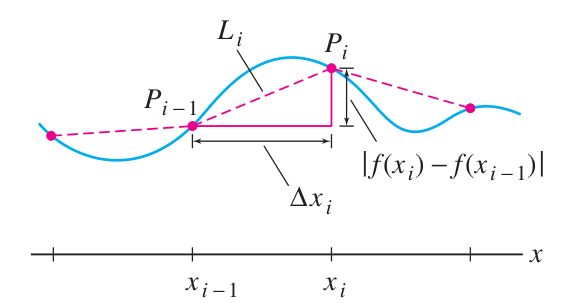
Illustration
Example - Arc length calculation
Arc length of ln x with trig sub
Find the length of the curve for :
Solution
(1) Set up arc length formula:
First note that . Then:
(2) Integrate using trig substitution:
Observe . Choose and therefore .
Link to original
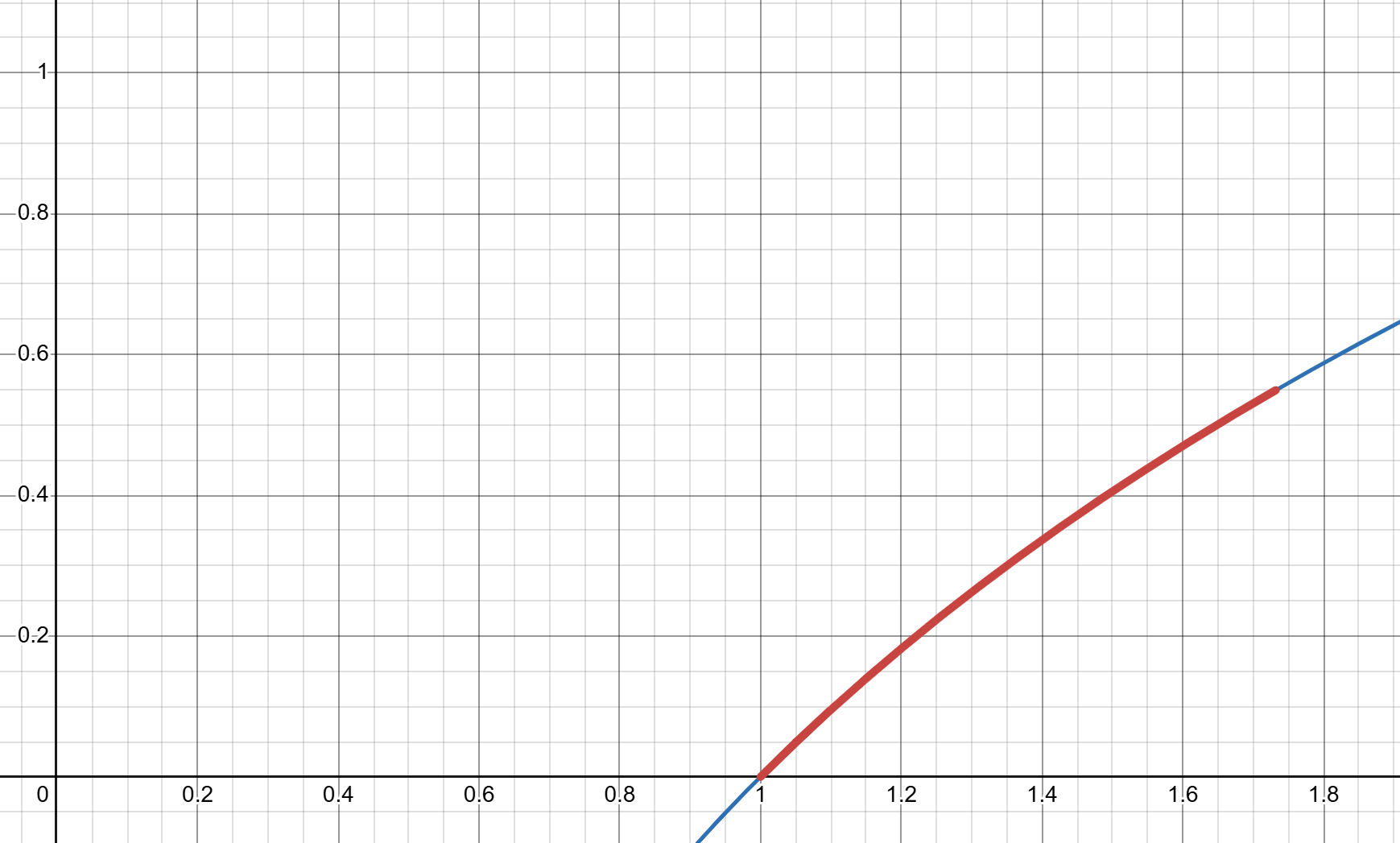
Example - Arc length tricky algebra
02
Link to originalArc length - tricky algebra
Find the arc length of the curve for .
(Hint: expand under the root, then simplify, then factor; now it’s a square and the root disappears.)
Transclude of calculus-ii/homeworks/w04/solutions---0080-02
Example - Hyperbolic Trig - Arc length of hanging chain
Surface areas of revolutions - thin bands
Videos
Review Videos
Videos, Math Dr. Bob
Link to original
- Area of a Surface of Revolution: Derivation, cylinder, cone, sphere
Theory
Theory 1
The infinitesimal of arc length along a curve, , can be used to find the surface area of a surface of revolution. The circumference of an infinitesimal band is and the width of such a band is .
The general formula for the surface area is:
In any given problem we need to find the appropriate expressions for and in terms of the variable of integration. For regions rotated around the -axis, the variable will be ; for regions rotated about the -axis it will be .
Assuming the region is rotated around the -axis, and the cross section in the -plane is the graph of and so , the formula above becomes:
Link to originalArea of revolution formula - thin bands
The surface area of the surface of revolution given by is given by the formula:
In this formula, we assume and is continuous. The surface is the revolution of on around the -axis.
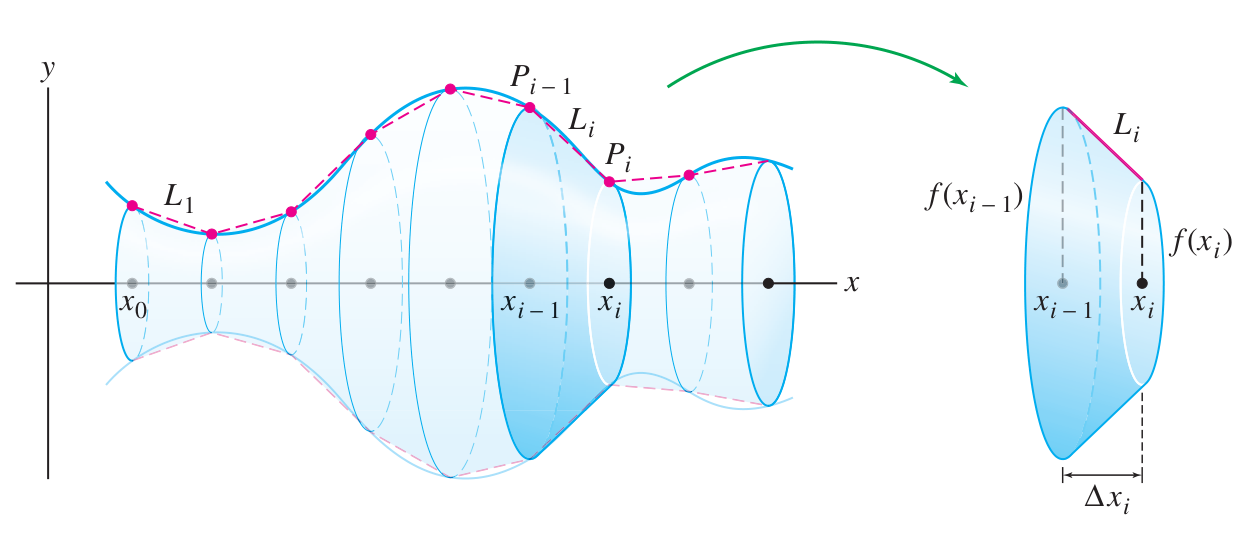
Illustration
Example - Surface area of a sphere
Surface area of a sphere
Using the fact that a sphere is given by revolving a semicircle, verify the formula for the surface area of a sphere.
Solution
(1) Describe sphere as surface of revolution:
Upper semicircle:
As function of :
(2) Surface area formula:
Our bounds are and . Function is :
(3) Work out integrand:
Power rule and chain rule:
Therefore:
Integrand:
(4) Compute integral:
This is the expected surface area formula: .
Link to original
Hydrostatic force
Videos
Review Videos
Videos, Organic Chemistry Tutor
Link to original
Theory
Theory 1
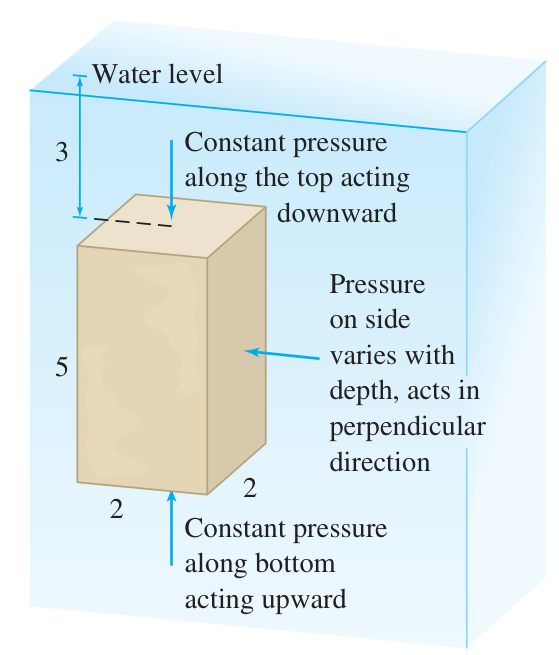
The pressure in a liquid is a function of the depth alone. This is a fundamental fact about liquids.
Pressure function
The fluid pressure in a liquid is a simple multiple of depth :
Constants:
In SI units:
The pressure of a fluid acts upon any surface in the fluid by exerting a force perpendicular to the surface. Force is pressure times area. If the pressure varies across the surface, the total force must be calculated using an integral to add up differing contributions of force on each portion of the surface.
Fluid force on submerged plate
Total fluid force on plate:
Use for top of plate (shallow edge) and for bottom of plate (deep edge).
Use when at the water line, and increases with depth.
(Other are possible. )
Vertical plate
This formula assumes the plate is oriented straight vertically, not slanting.
(Add the factor for a plate tilted by angle .)
Link to original


Illustration
Example - Fluid force on a triangular plate
Fluid force on a triangular plate
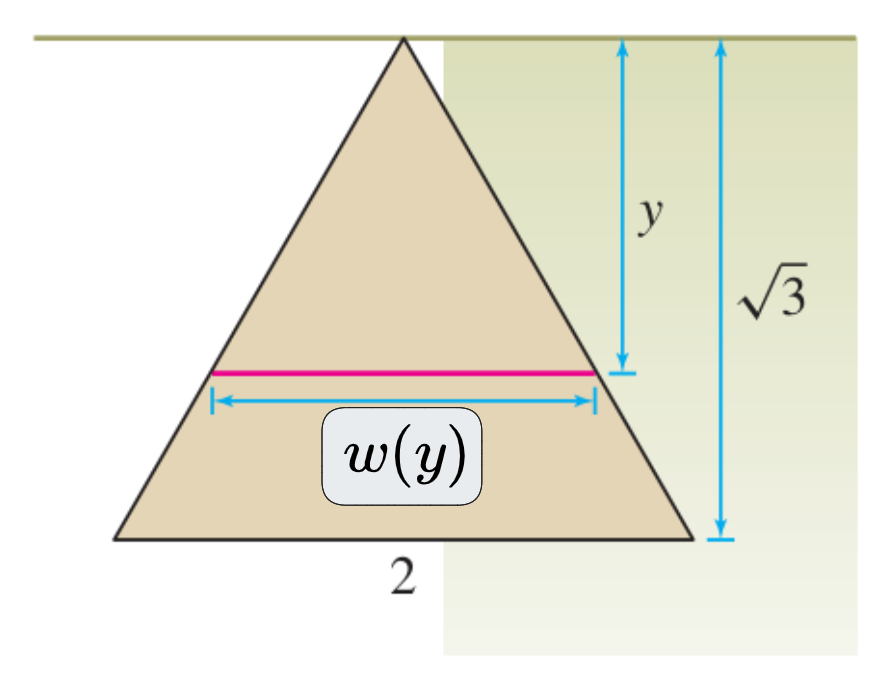
Find the total force on the submerged vertical plate with the following shape: Equilateral triangle, sides , top vertex at the surface, liquid is oil with density .
Solution
(1) Write the width function:
Establish coordinate system: at water line (also the vertex), and increases going down.
Method 1: Geometry of similar triangles
Top triangle with base at is similar to total triangle with base .
Therefore, corresponding parts have the same ratios.
Therefore:
Method 2: Quick linear interpolation function
Generalized “quick linear interpolation function”
Generalization:
where:
- is edge 1 and is edge 2 (increasing order of )
- is when comes earlier (smaller ), and if it comes later
- is created to force the quantity to equal for the given value at
(2) Compute integral using width function:
Bounds:
- (shallow)
- (deep)
Integral formula:
Link to original
Example - Fluid force on deeply submerged triangular plate
Triangular plate deeply submerged
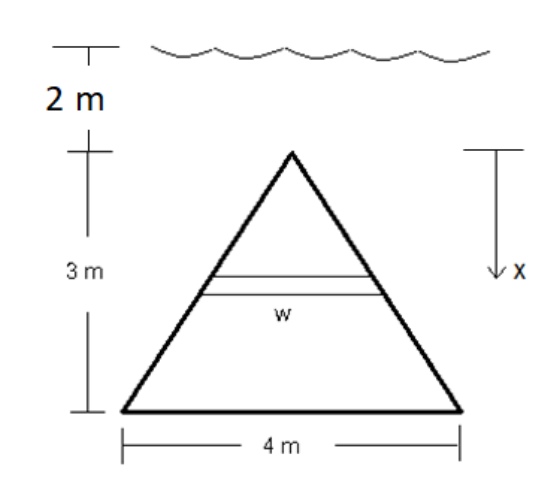
Set up an integral to calculate the fluid force of water on the following plate, using and as appropriate:
Solution
The coordinate system has been established as at the vertex, increasing downwards.
Set at the vertex and at the base of this triangle.
Width function using quick linear interpolation:
Now find such that at : at that edge, , so we must have too. Therefore .
Water depth is since we must have at the water surface where . So the solution is:
Link to original
Fluid force on circular plate
Fluid force on circular disk plate
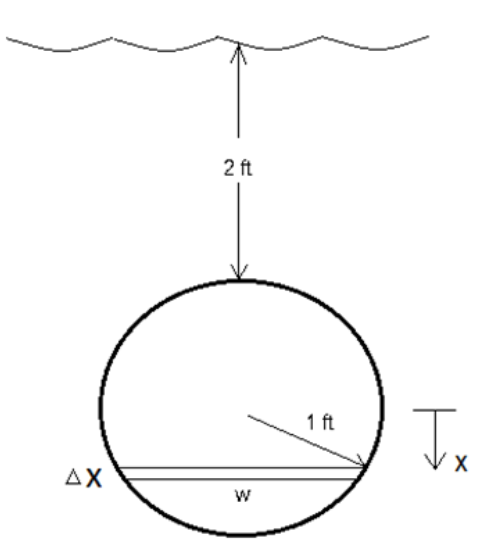
Set up an integral to find the force on the following circular plate suspended deep under water:
Solution
By setting at the center of the circle, we have the equation of the circle:
Solve this to obtain:
So the integral is:
Link to original
Theory
Theory 2
What if the submerged surface is not oriented straight vertically?
The amount of surface for a horizontal strip at a given depth will be increased by a factor of where is the angle of incline of the surface (with corresponding to horizontal and to vertical). Thus:
where is the thickness of a strip.
So the total force formula becomes:
Link to originalFluid force for tilted surface
Total fluid force on tilted plate:
As before, measures depth with at the surface.
Illustration
Example - Weight of water on a dam
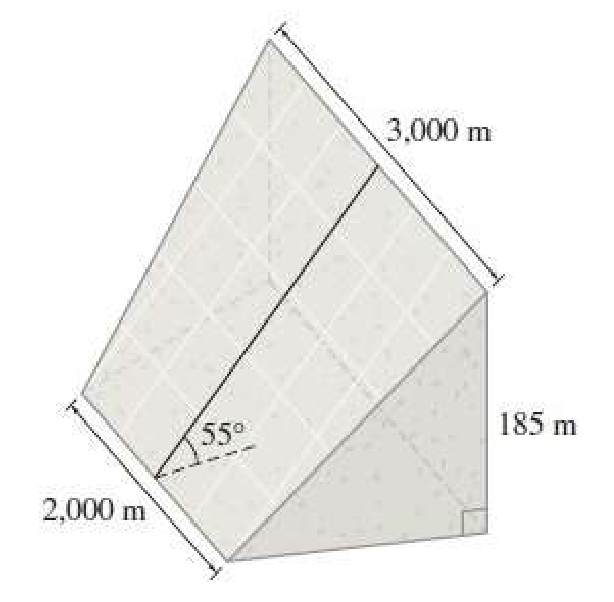
Weight of water on angled dam
Find the total hydrostatic force on an angled dam with the following geometric description: Tilted trapezoid. Base , Top , and vertical height . The base is tilted at an angle of .
Solution
(1) Write the width function:
Establish coordinate system: at water line (also the top edge), and increases going down.
“Quick linear interpolation function”:
(2) Incorporate angle of incline in strip thickness:
So the area of a strip is:
(3) Compute total force using integral formula.
Plug data into formula:
Link to original
Work
Videos
Review Videos
Videos, BlackPenRedPen:
Link to original
- Work performed: pumping water from trough
- Work performed: pumping water from rectangular tank
- Work performed: pumping water from conical tank
- Work performed: pumping water from spherical tank
Theory
Theory 1
Work is a measure of energy expended to achieve some effect. According to physics:
To compute the work performed against gravity while lifting some matter, decompose the matter into horizontal layers at height and thickness . Each layer is lifted some distance. The weight of the layer gives the force applied.
The work performed on each single layer is summed by an integral to determine the total work performed to lift all the layers:
Link to originalWork performed
- for water
Illustration
Example - Pumping water from spherical tank
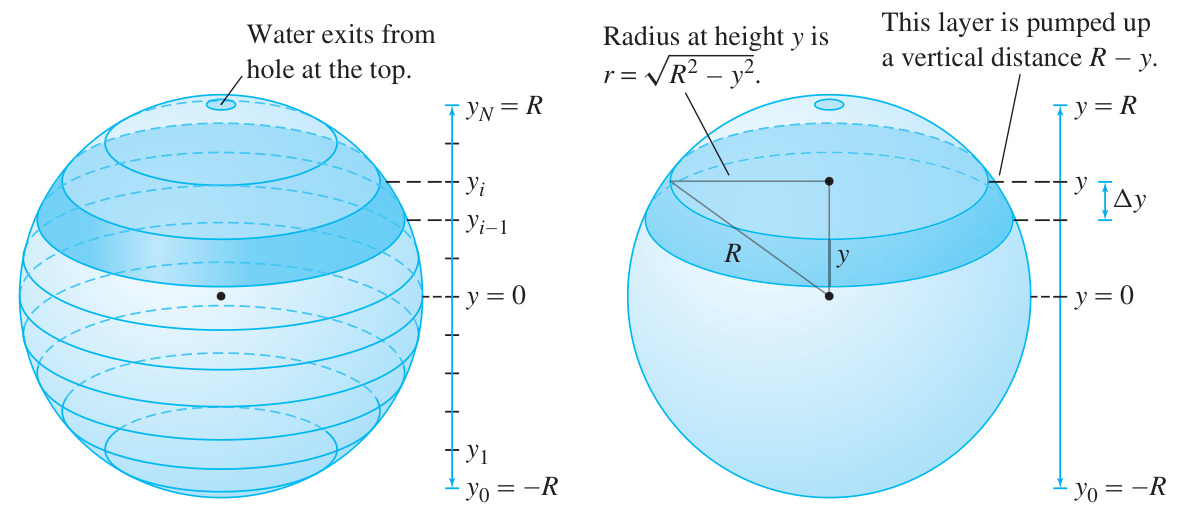
Pumping water from spherical tank
Calculate the work done pumping water out of a spherical tank of radius .
Solution
(1) Slice the tank of water into horizontal layers:
Coordinate is at the center of the sphere, increasing upwards.
(2) Calculate weight of single slice:
(3) Work to lift out single slice:
Distance to raise a slice:
Then:
(4) Total work by integrating over all slices:
Note A: The integration runs over all slices, which start at (bottom of tank), and end at (top of tank).
Extra question: what if the spigot sits above the tank?
Extra question: what if the tank starts at just of water depth?
Link to original
Example - Water pumped from a frustum
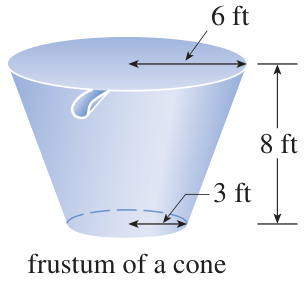
Water pumped from a frustum
Find the work required to pump water out of the frustum in the figure. Assume the weight of water is .
Solution
(1) Find weight of a horizontal slice.
Coordinate at top, increasing downwards.
Use for radius of cross-section circle.
Linear decrease in from to :
Area is :
:
(2) Find work to pump out a horizontal layer.
Layer at is raised a distance of .
Work to raise layer at :
(3) Integrate over all layers.
Integrate from top to bottom of frustum:
Link to original
Example - Raising a building
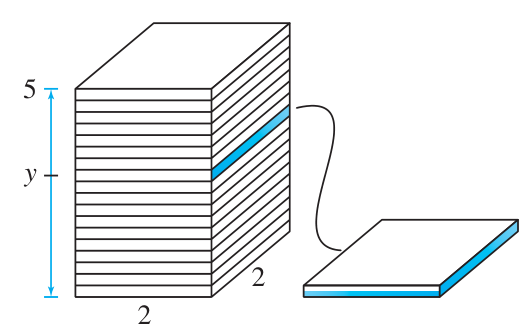
Raising a building
Find the work done to raise a cement columnar building of height and square base per side. Cement has a density of .
Solution
(1) Weight of each layer:
(2) Work to lift layer into place:
(3) Find total work as integral over the layers:
Link to original
Example - Raising a chain
Raising a chain
An chain is suspended from the top of a building. Suppose the chain has weight density . What is the total work required to reel in the chain?
Solution
(1) Compute weight of a ‘link’ (vertical slice of the chain):
(2) Work to raise link to top:
Each link (slice) is raised from height to height 80:
Then:
(3) Integrate over the chain for total work:
Link to original
Example - Raising a leaky bucket
Raising a leaky bucket
Suppose a bucket is hoisted by a cable up an tower. The bucket is lifted at a constant rate of and is leaking water weight at a constant rate of . The initial weight of water is . What is the total work performed against gravity in lifting the water? (Ignore the bucket itself and the cable.)
Solution
(1) Compute total force from water :
Choose coordinate at base, at top.
Rate of water weight loss per unit height:
Total water weight at height :
(2) Work to raise bucket by :
(3) Total work by integrating :
Link to originalChange of method and integral formula!
For this example, we use the formula rather than the formula used in the earlier examples.
- This integral sums over the work to lift macroscopic material through each microscopic as if in sequence, and thus represents distance lifted.
- Earlier examples summed over the work to lift microscopic material through the macroscope (all the way up).
Moments and center of mass
Videos
Review Videos
Videos, Math Dr. Bob:
Link to original
- Moments and CoM 01: Points masses on a line
- Moments and CoM 02: Points masses in the plane
- Moments and CoM 03: Planar lamina of uniform density
- Moments and CoM 04: Integral formula for planar lamina
- Moments and CoM 05: Rod of non-uniform density
Theory
Theory 1
Moment
The moment of a region to an axis is the total (integral) of mass times distance to that axis:
Moment to -axis:
Moment to -axis:
Notice the swap in letters
- integrand has factor
- integrand has factor
Notice the total mass
If you remove or factors from the integrands, the integrals give total mass .
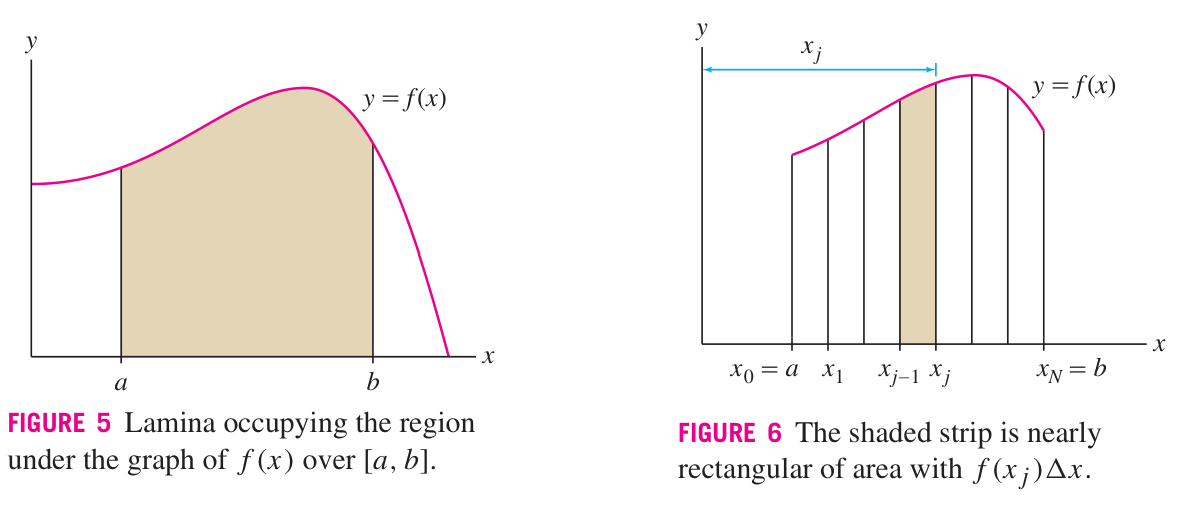
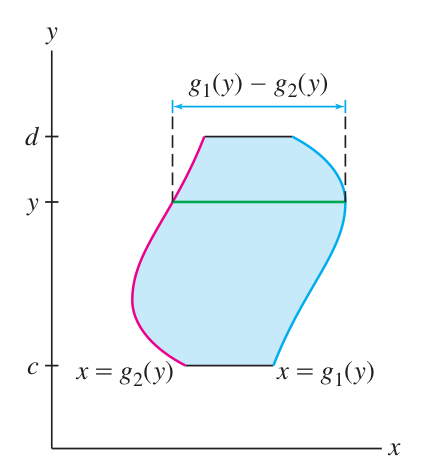
These formulas are obtained by slicing the region into rectangular strips that are parallel to the axis in question.
The area per strip is then:
- — region under
- — region between and
- — region ‘under’
- — region between and
The idea of moment is related to:
- Torque balance and angular inertia
- Center of mass
The center of mass (CoM) of a solid body is a single point with two important properties:
- “average position” of the body
- The average position determines an effective center of dynamics. For example, gravity acting on every bit of mass of a rigid body acts the same as a force on the CoM alone.
- “balance point” of the body
- The net torque (rotational force) about the CoM, generated by a force distributed over the body’s mass, equivalently a force on the CoM, is zero.
Centroid
When the body has uniform density, then the CoM is also called the centroid.
Center of mass from moments
Coordinates of the CoM:
Here is the total mass of the body.
Link to originalCenter of mass from moments - explanation
Notice how these formulas work. The total mass is always . The moment to (for example) is . Dividing these two values:
where .
In other words, through the formula , we find that is the average value of over the region with area .
Illustration
Example - CoM of a parabolic plate
CoM of a parabolic plate
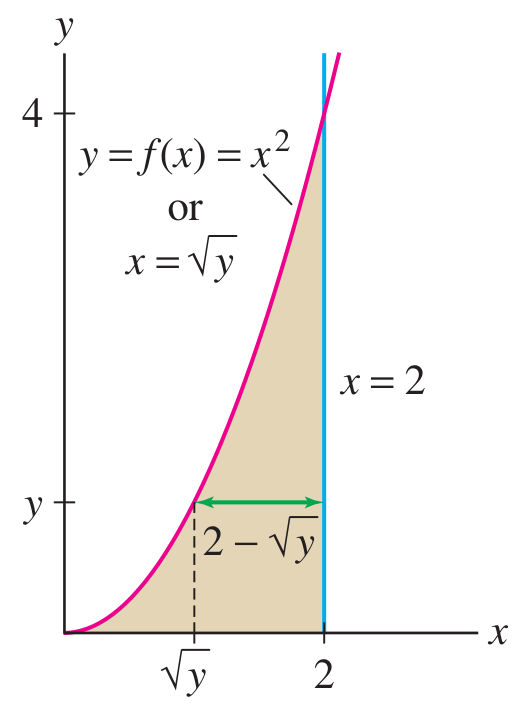
Find the CoM of the region depicted:
Solution
(1) Compute the total mass:
Area under the curve with density factor :
(2) Compute :
Formula:
Interpret and calculate:
(3) Compute :
Formula:
Width of horizontal strips between the curves:
Interpret :
Calculate integral:
(4) Compute CoM coordinates from moments:
CoM formulas:
Insert data:
Link to original
Theory
Theory 2
A downside of the technique above is that to find we needed to convert the region into functions in . This would be hard to do if the region was given as the area under a curve but cannot be found analytically. An alternative formula can help in this situation.
Midpoint of strips for opposite variables
When the region lies between and , we can find with an -integral:
When the region lies between and , we can find with a -integral:
Region under a curve
For the region “under the curve” , just set:
For the region “under the curve” , set:
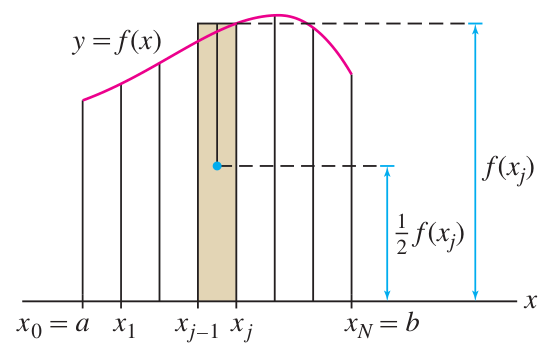
The idea for these formulas is to treat each vertical strip as a point concentrated at the CoM of the vertical strip itself.
The height to this midpoint is , and the area of the strip is , so the integral becomes .
Link to originalMidpoint of strips formula - full explanation
- If the strip is located at some , with values from up to , then:
- The area of the strip is . So the integral formula for can be recast:
- If the vertical strips are between and , then the midpoints of the strips are given by the ‘average’ function:
- The height of each strip is , so .
- Putting this together:
Illustration
Example - Computing CoM using only vertical strips
Computing CoM using only vertical strips
Find the CoM of the region:
Solution
(1) Compute the total mass :
Area under the curve times density :
(2) Compute , using vertical strips and the ‘midpoints’ method:
Plug and into formula:
Integration by ‘power to frequency conversion’:
(3) Compute using vertical strips and the regular method:
Plug into formula:
Integration by parts. Set , and so , :
(4) Compute CoM:
CoM formulas:
Plug in data:
Link to original
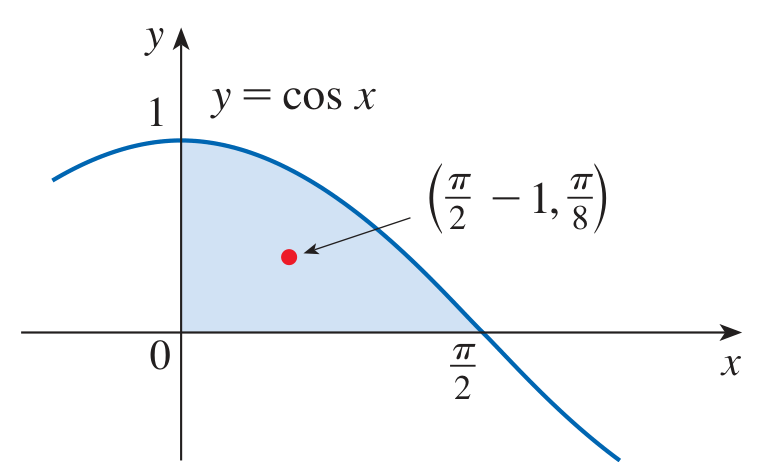
Theory
Theory 4
CoM of a triangle: “ trick”
Given a triangle with edge and altitude (measured along a perpendicular to ), the CoM of the triangle lies on the line parallel to and shifted upwards by .
For example, if the triangle is positioned with base on the -axis, then its CoM will lie on the line .
Link to originalProof of “ trick”
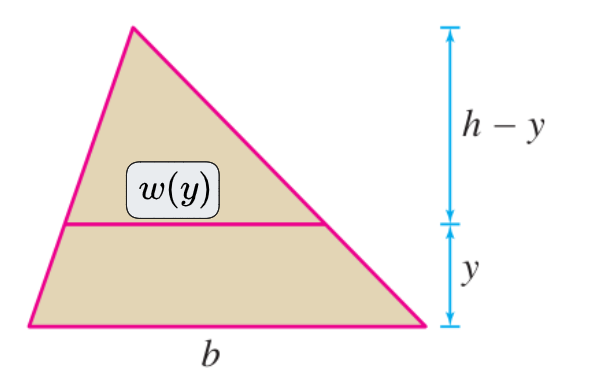
Quick Linear Interpolation Function:
Thus:
Total mass:
Therefore:
Theory
Theory 3
Two useful techniques for calculating moments and (thereby) CoMs:
- Additivity principle
- Symmetry
Additivity says that you can add moments of parts of a region to get the total moment of the region (to a given axis).
A symmetry principle is that if a region is mirror symmetric across some line, then the CoM must lie on that line.
Link to original
Illustration
Example - Center of mass using moments and symmetry
Center of mass using moments and symmetry
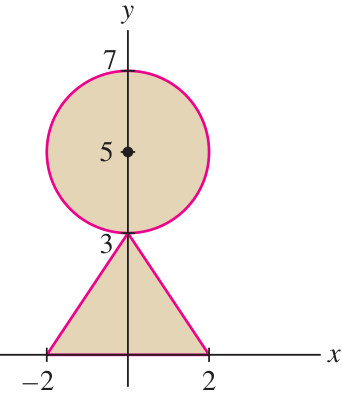
Find the center of mass of the two-part region:
Solution
(1) Symmetry: CoM on -axis
Because the region is symmetric in the -axis, the CoM must lie on that axis. Therefore .
(2) Additivity of moments:
Write for the total -moment (distance measured to the -axis from above).
Write and for the -moments of the triangle and circle.
Additivity of moments equation:
(3) Find moment of the circle using Symmetry:
By symmetry we know .
By symmetry we know .
Area of circle with is , so total mass is .
Centroid-from-moments equation:
Solve the equation for :
(4) Find moment of the triangle using Symmetry and the “ trick”:
By Symmetry, the CoM of the triangle must lie on the vertical line .
By the “ trick,” the CoM of the triangle must lie on the horizontal line at . In this case , so it lies on the line .
Therefore the triangle CoM is:
To get moments, multiply by mass :
(5) Apply additivity:
(6) Total mass of region:
Area of circle is . Area of triangle is . Thus .
(7) Compute center of mass from total and total :
We have and . Plug into formula:
Link to original
Example - Center of mass - two part region
Center of mass - two part region
Find the center of mass of the region which combines a rectangle and triangle (as in the figure) by computing separate moments. What are those separate moments? Assume the mass density is .
Solution
(1) Apply symmetry to rectangle:
By symmetry, the center of mass of the rectangle is located at .
Thus and .
(2) Find moments of the rectangle:
Total mass of rectangle . Thus:
(3) Find moments of the triangle:
CoM of triangle using “ trick:”
From the base on the -axis, we have so the CoM lies on the line .
From the base on the -axis, we have so the CoM lies on the line .
Multiply by the triangle’s mass to get its moment:
Therefore:
(4) Add up total moments:
General formulas: and
Plug in data: and
(5) Find center of mass from moments:
Total mass of triangle .
Total combined mass .
Apply moment relation:
Link to original