Sequences
Videos
Review Videos
Videos, Math Dr. Bob:
Link to original
- Infinite sequences: Definition; Squeeze Theorem
- Extra: Infinite sequences: Various examples, arithmetic and geometric
- Extra: Infinite sequences: Recursive sequences (like Fibonacci)
Theory
Theory 1
A sequence is a rule that defines a term for each natural number :
So a sequence is a function from to .
Geometric sequence
A sequence is called geometric if the ratio of consecutive terms is some constant , independent of :
The defining relation of a geometric sequence is equivalent to .
By plugging into , we have . This plugging can be repeated -times to get a formula for the term:
Therefore , and we have a formula for the general term of the sequence (the term with index ).
Starting point of a sequence
Note that sometimes the index (variable) of a sequence starts somewhere other than . Most common is but any other starting point is allowed, even negative numbers.
Sometimes is used instead of in the formula for the general term of a sequence, thus . The ‘’ notation is useful when the sequence starts from .
Link to originalExtra - Fibonacci sequence
The Fibonacci sequence goes like this:
The pattern is:
This formula is a recursion relation, which means that terms are defined using the values of prior terms.
The Fibonacci sequence is perhaps the most famous sequence of all time. It is related to the Golden Ratio and the Golden Spiral:
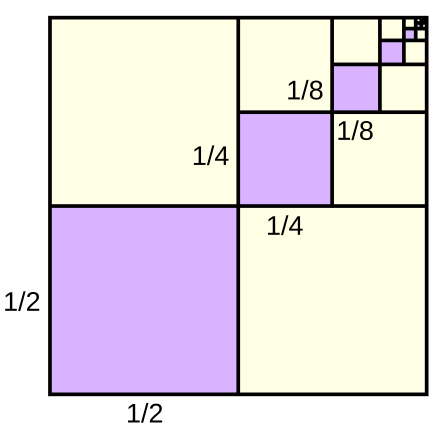
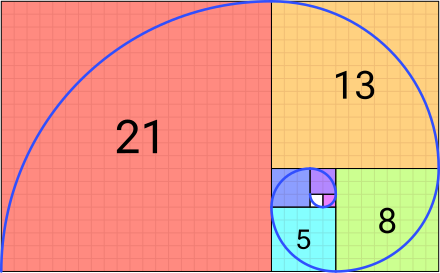
Illustration
Example: Geometric sequence - revealing the format
Geometric sequence: revealing the format
Find and and (written in the geometric sequence format) for the following geometric sequences:
(a)
(b)
(c)Solution
(a)
Plug in to obtain . Notice that and so therefore . Then the ‘general term’ is .
(b)
Rewrite the fraction:
Plug that in and observe . From this format we can read off and .
(c)
Rewrite:
From this format we can read off and .
Link to original
Series
Videos
Review Videos
Videos, Math Dr. Bob:
Link to original
- Infinite series: Definitions, basic examples
- Geometric series and SDT: Geometric series, Simple Divergence Test (aka “Limit Test”)
- Infinite series: Various examples
- Extra: Infinite series convergence: Telescoping series
Theory
Theory 1
A series is an infinite sum that is created by successive additions without end. The terms are not added up “all at once” but rather they are added up “as increases” or “as .”
Three of the most famous series are the Leibniz series and the geometric series:
Link to originalPartial sum sequence of a series
The partial sum sequence of a series is the sequence whose terms are the sums up to the given index:
These terms themselves form a sequence:
Illustration
Example: Geometric series - total sum and partial sums
Geometric series - total sum and partial sums
The geometric series total sum can be calculated using a “shift technique” as follows:
(1) Compare and :(2) Subtract second line from first line, many cancellations:
(3) Solve to find :
Assumes convergence!
Note: this calculation assumes that exists, i.e. that the series converges.
The geometric series partial sums can be calculated similarly, as follows:
(1) Compare and :
(2) Subtract second line from first line, many cancellations:
(3) Solve to find :
(4) The last formula is revealing in its own way. Here is what it means in terms of terms:
Link to original
Convergence
Videos
Review Videos
Videos, Math Dr. Bob:
Link to original
- Infinite sequences convergence: Squeeze; Monotone Bounded
- Infinite sequences convergence: Examples sequences: convergent, monotonic, bounded
Theory
Theory 1
A sequence has a limit if its terms tend toward a specific number, or toward .
When this happens we can write “” with some number or .
We can also write “ as ”.The sequence is said to converge if it has a finite limit .
Some sequences don’t have a limit at all, like :
Or :
These sequences diverge.
In the second case, there is a limit , so we say it diverges to .A sequence may have a limit of but is still said to diverge.
Extra - Convergence definition
The precise meaning of convergence is this. We have as if, given any proposed error , it is possible to find such that for all we have .
When , convergence means that given any , we can find such that for all we have .
Similarly for .
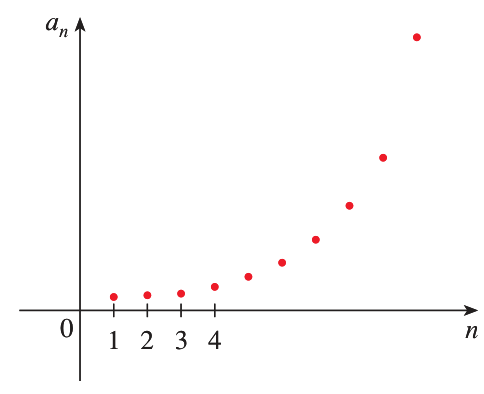
If the general term is a continuous function of , we can replace with the continuous variable and compute the continuous limit instead:
If would be a differentiable function, and we discover an indeterminate form, then we can apply L’Hopital’s Rule to find the limit value. For example, if the indeterminate form is , we can convert it to and apply L’Hopital.
Link to original
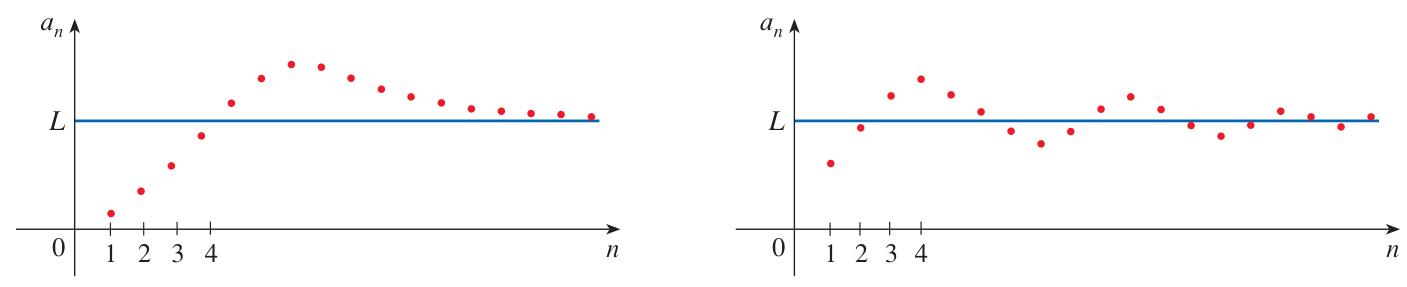
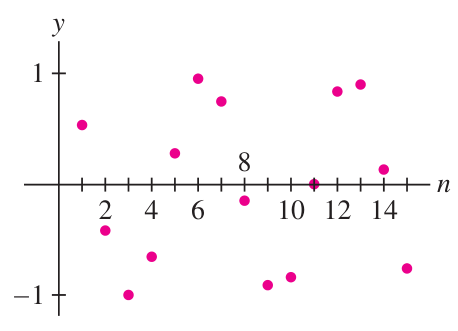
Illustration
Example - L’Hopital’s Rule for sequence limits
L’Hopital’s Rule for sequence limits
(a) What is the limit of ?
(b) What is the limit of ?
(c) What is the limit of ?
(d) What is the limit of ?Solution
(a)
Identify indeterminate form . Change from to and apply L’Hopital:
(b)
Identify indeterminate form . Change from to and apply L’Hopital:
(c)
(1) Identify form and rewrite as :
(2) Change from to and apply L’Hopital:
(3) Simplify:
(4) Consider the limit:
(d)
(1) Identify form and rewrite as :
(2) Change to and apply L’Hopital:
Link to original
Example - Squeeze theorem
Squeeze theorem
Use the squeeze theorem to show that as .
Solution
(1) We will squeeze the given general term above and below a sequence that we must devise:
(2) We need to satisfy and . Let us study .
(3) Now for the trick. Collect factors in the middle bunch:
(4) Each factor in the middle bunch is so the entire middle bunch is . Therefore:
Now we can easily see that as , so we set and we are done.
Link to original
Theory
Theory 2
Monotone sequences
A sequence is called monotone increasing if for every .
A sequence is called monotone decreasing if for every .
In this context, ‘monotone’ just means it preserves the increasing or decreasing modality for all terms.
Monotonicity Theorem
If a sequence is monotone increasing, and bounded above by , then it must converge to some limit , and .
If a sequence is monotone decreasing, and bounded below by , then it must converge to some limit , and .
Terminology:
- Bounded above by means that for every
- Bounded below by means that for every
Link to originalNotice!
The Monotonicity Theorem says that a limit exists, but it does not provide the limit value.
Illustration
Example - Monotonicity Theorem
Monotonicity
Show that converges.
Solution
(1) Observe that for all .
Because , we know .
Therefore
(2) Show is decreasing:
Replace with : considered as a differentiable function.
Take derivative to show decreasing:
Denominator is . Numerator is . So and is monotone decreasing.
Therefore is monotone decreasing as .
(3) Since it is bounded below by . It is monotone decreasing. Conclude that it converges.
Link to original
Theory
Theory 3
Series convergence
We say that a series converges when its partial sum sequence converges:
Let us apply this to the geometric series. Recall our formula for the partial sums:
Rewrite this formula:
Now take the limit as :
So we see that converges exactly when . It converges to .
(If then the denominator is , and if then the factor does not converge.)
Furthermore, we have the limit value:
This result confirms the formula we derived for the total sum of a geometric series. This time we did not start by assuming exists, rather we proved that exists. (Provided that .)
Link to originalExtra - Looking at and
Notice that we always have the rule:
This rule can be viewed as coming from partitioning the full series into a finite part and the remaining infinite part:
We can remove a factor from the infinite part:
The parenthetical expression is equal to , so we have the formula given above.
Simple divergence test
Videos
Review Videos
Videos, Math Dr. Bob
Link to original
- Geometric series and SDT, again: Geometric series, Simple Divergence Test (aka “Limit Test”)
- Integral test: Basics
- Integral test: -series
- Extra: Integral test: Further examples
- Extra: Integral test: Estimations
Theory
Theory 1
Simple Divergence Test (SDT)
Applicability: Any series.
Test Statement:
AKA the “Not Even Close” test
Link to originalThe converse is not valid. For example, diverges even though .
Illustration
Example - Simple Divergence Test: examples
Simple divergence test: examples
(a) Consider:
This diverges by the SDT because and not .
(b) Consider:
This diverges by the SDT because .
We can say the terms “converge to the pattern ,” but that is not a limit value.
Link to original
Positive series
Videos
Review Videos
Link to original
- Direct Comparison Test: Theory and basic examples
- Direct Comparison Test: Series
- Limit Comparison Test: Theory and basic examples
- Limit Comparison Test: Further examples
Theory
Theory 1
Positive series
A series is called positive when its individual terms are positive, i.e. for all .
The partial sum sequence is monotone increasing for a positive series.
By the monotonicity test for convergence of sequences, therefore converges whenever it is bounded above. If is not bounded above, then diverges to .
Another test, called the integral test, studies the terms of a series as if they represent rectangles with upper corner pinned to the graph of a continuous function.
To apply the test, we must convert the integer index variable in into a continuous variable . This is easy when we have a formula for (provided it doesn’t contain factorials or other elements dependent on integrality).
Integral Test (IT)
Applicability: must be:
- Continuous
- Positive
- Monotone decreasing
Test Statement:
Extra - Integral test: explanation
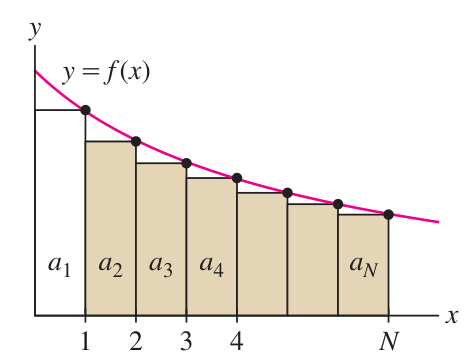
To show that integral convergence implies series convergence, consider the diagram:
This shows that for any . Therefore, if converges, then is bounded (independent of ) and so is bounded by that inequality. But ; so by adding to the bound, we see that itself is bounded, which implies that converges.
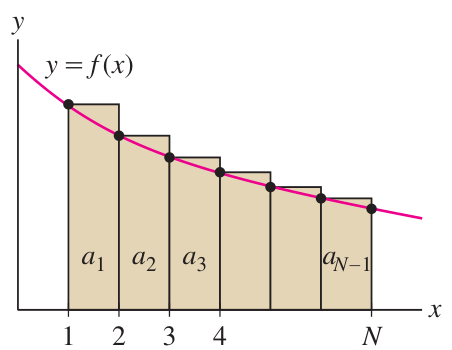
To show that integral divergence implies series divergence, consider a similar diagram:
This shows that for any . Therefore, if diverges, then goes to as , and so goes to as well. So diverges.
Notice: the picture shows entirely above (or below) the rectangles. This depends upon being monotone decreasing, as well as . (This explains the applicability conditions.)
Next we use the integral test to evaluate the family of -series, and later we can use -series in comparison tests without repeating the work of the integral test.
-series
A -series is a series of this form:
Convergence properties:
Link to originalExtra - Proof of -series convergence
(1) To verify the convergence properties of -series, apply the integral test:
Applicability: verify it’s continuous, positive, decreasing.
Convert to to obtain the function .
Indeed is continuous and positive and decreasing as increases.
(2) Apply the integral test.
Integrate, assuming :
When we have
When we have
When , integrate a second time:
Conclude: the integral converges when and diverges when .
We could instead immediately refer to the convergence results for -integrals instead of reproving them here.
Illustration
Example - -series examples
p-series examples
By finding and applying the -series convergence properties:
We see that converges: so
But diverges: so
Link to original
Example - Integral test - pushing the envelope of convergence
Integral test - pushing the envelope of convergence
Does converge?
Does converge?
Notice that grows very slowly with , so is just a little smaller than for large , and similarly is just a little smaller still.
Solution
(1) The two series lead to the two functions and .
Check applicability.
Clearly and are both continuous, positive, decreasing functions on .
(2) Apply the integral test to .
Integrate :
Conclude: diverges.
(3) Apply the integral test to .
Integrate :
Conclude: converges.
Link to original
Theory
Theory 2
Link to originalDirect Comparison Test (DCT)
Applicability: Both series are positive: and .
Test Statement: Suppose for large enough .
(Meaning: for with some given .) Then:
- Smaller pushes up bigger:
- Bigger controls smaller:
Illustration
Example - Direct comparison test: rational functions
Direct comparison test: rational functions
(a)
Choose: and
Check:
Observe: is a convergent geometric series
Therefore: converges by the DCT.
(b)
Choose: and .
Check:
Observe: is a convergent -series
Therefore: converges by the DCT.
(c)
Choose: and
Check: (notice that )
Observe: is a convergent -series
Therefore: converges by the DCT.
(d)
Choose: and
Check:
Observe: is a divergent -series
Therefore: diverges by the DCT.
Link to original
Theory
Theory 3
Some series can be compared using the DCT after applying certain manipulations and tricks.
For example, consider the series . We suspect convergence because for large . But unfortunately, always, so we cannot apply the DCT.
We could make some ad hoc arguments that do use the DCT, eventually:
Trick Method 1:
- Observe that for we have . (Check it!)
- But converges, indeed its value is , which is .
- So the series converges.
Trick Method 2:
- Observe that we can change the letter to by starting the new at .
- Then we have:
- This last series has terms smaller than so the DCT with (a convergent -series) shows that the original series converges too.
These convoluted arguments suggest that a more general version of Comparison is possible.
Indeed, it is sufficient to compare the relative large-n behavior of the two series. We use the termwise ratios to estimate comparative behavior for increasing .
Limit Comparison Test (LCT)
Applicability: Both series are positive: and .
Test Statement: Suppose that . Then:
If , i.e. finite non-zero, then:Extra - LCT edge cases
If or , we can still draw an inference, but only in one direction:
- If :
- If :
Link to originalExtra - Limit Comparison Test explanation
Suppose and . Then for sufficiently large, we know .
Doing some algebra, we get for large.
If converges, then also converges (constant multiple), and then the DCT implies that converges.
Conversely: we also know that , so for all sufficiently large. Thus if converges, also converges, and by the DCT again converges too.
The cases with or are handled similarly.
Illustration
Example - Limit Comparison Test examples
Limit comparison test examples
(a)
Choose: and .
Compare in the limit:
Observe: is a convergent geometric series
Therefore: converges by the LCT.
(b)
Choose: ,
Compare in the limit:
Observe: is a divergent -series
Therefore: diverges by the LCT.
(c)
Choose: and
Compare in the limit:
Observe: is a converging -series
Therefore: converges by the LCT.
Link to original
Alternating series
Videos
Review Videos
Videos, Math Dr. Bob:
Link to original
- Alternating Series Test: Theory and basic examples
- Alternating Series Test: Remainder estimates
- Alternating Series Test: Further remainder estimates
Theory
Theory 1
Consider these series:
The absolute values of terms are the same between these series, only the signs of terms change.
The first is a positive series because there are no negative terms.
The second series is the negation of a positive series – the study of such series is equivalent to that of positive series, just add a negative sign everywhere. These signs can be factored out of the series. (For example .)
The third series is an alternating series because the signs alternate in a strict pattern, every other sign being negative.
The fourth series is not alternating, nor is it positive, nor negative: it has a mysterious or unknown pattern of signs.
A series with any negative signs present, call it , converges absolutely when the positive series of absolute values of terms, namely , converges.
THEOREM: Absolute implies ordinary
If a series converges absolutely, then it also converges as it stands.
A series might converge due to the presence of negative terms and yet not converge absolutely:
A series is said to be converge conditionally when the series converges as it stands, but the series produced by inserting absolute values, namely , diverges.
The alternating harmonic series above, , is therefore conditionally convergent. Let us see why it converges. We can group the terms to create new sequences of pairs, each pair being a positive term. This can be done in two ways. The first creates an increasing sequence, the second a decreasing sequence:
Suppose gives the sequence of partial sums of the original series. Then gives the first sequence of pairs, namely , , , . And gives the second sequence of pairs, namely , , , .
The second sequence shows that is bounded above by , so is monotone increasing and bounded above, so it converges. Similarly is monotone decreasing and bounded below, so it converges too, and of course they must converge to the same thing.
The fact that the terms were decreasing in magnitude was an essential ingredient of the argument for convergence. This fact ensured that the parenthetical pairs were positive numbers.
Alternating Series Test (AST) - “Leibniz Test”
Applicability: Alternating series only: with
Test Statement:
If:
- as (i.e. it passes the SDT: if this fails, conclude diverges)
- are decreasing, so
Then:
“Next Term Bound” rule for error of the partial sums:
Link to originalExtra - Alternating Series Test: Theory
Just as for the alternating harmonic series, we can form positive paired-up series because the terms are decreasing:
The first sequence is monotone increasing from , and the second is decreasing from . The first is therefore also bounded above by . So it converges. Similarly, the second converges. Their difference at any point is which is equal to , and this goes to zero. So the two sequences must converge to the same thing.
By considering these paired-up sequences and the effect of adding each new term one after the other, we obtain the following order relations:
Thus, for any even and any odd :
Now set and subtract from both sides:
Now set and subtract from both sides:
This covers both even cases () and odd cases (). In either case, we have:
Illustration
Example - Alternating Series Test: Basic illustration
Alternating series test: basic illustration
(a) converges by the AST.
Notice that diverges as a -series with .
Therefore the first series converges conditionally.
(b) converges by the AST.
Notice the funny notation: .
This series converges absolutely because , which is a -series with .
Link to original
Example - Approximating
Approximating pi
The Taylor series for is given by:
Using the AST “next term bound,” how many terms are needed to approximate to within ?
Solution
(1) The main idea is to use and thus . Therefore:
and thus:
(2) Write for the error of the approximation, meaning .
By the AST error formula, we have .
We desire such that . Therefore, calculate such that , and then we will know:
(3) The general term is . Plug in in place of to find . Now solve:
We conclude that at least terms are necessary to be confident (by the error formula) that the approximation of is accurate to within .
Link to original
Ratio test and Root test
Videos
Review Videos
Videos, Math Dr. Bob
Link to original
- Ratio test: Basics
- Ratio test: Ratio test + DCT
- Root test: Basics
- Root test: for
Theory
Theory 1
Ratio Test (RaT)
Applicability: Any series with nonzero terms.
Test Statement:
Suppose that as .
Then:
Extra - Ratio Test - a deeper look
To understand the ratio test better, first consider this series:
- The term is created by multiplying the prior term by .
- The term is created by multiplying the prior term by .
- The term is created by multiplying the prior term by .
When , the multiplication factor giving the next term is necessarily less than . Therefore, when , the terms shrink faster than those of a geometric series having . Therefore this series converges.
Similarly, consider this series:
Write for the ratio from the prior term to the current term . For this series, .
This ratio falls below when , after which the terms necessarily shrink faster than those of a geometric series with . Therefore this series converges.
The main point of the discussion can be stated like this:
Whenever this is the case, then eventually the ratios are bounded below some , and the series terms are smaller than those of a converging geometric series.
Link to originalExtra - Ratio Test proof
Let us write for the ratio to the next term from term .
Suppose that as , and that . This means: eventually the ratio of terms is close to ; so eventually it is less than .
More specifically, let us define . This is the point halfway between and . Since , we know that eventually .
Any geometric series with ratio converges. Set for big enough that . Then the terms of our series satisfy , and the series starting from is absolutely convergent by comparison to this geometric series.
(Note that the terms do not affect convergence.)
Illustration
Example - Ratio test
Ratio test examples
(a) Observe that has ratio and thus . Therefore the RaT implies that this series converges.
Simplify the ratio:
Notice this technique! We frequently use these rules:
(To simplify ratios with exponents and factorials.)
(b) has ratio .
Simplify this:
So the series converges absolutely by the ratio test.
(c) Observe that has ratio as .
So the ratio test is inconclusive, even though this series fails the SDT and obviously diverges.
(d) Observe that has ratio as .
So the ratio test is inconclusive, even though the series converges as a -series with .
(e) More generally, the ratio test is usually inconclusive for rational functions; it is more effective to use LCT with a -series.
Link to original
Theory
Theory 2
Root Test (RooT)
Applicability: Any series.
Test Statement:
Suppose that as .
Then:
Link to originalExtra - Root test: explanation
The fact that and implies that eventually for all high enough . Set (the midpoint between and ).
Now, the equation is equivalent to the equation .
Therefore, eventually the terms are each less than the corresponding terms of this convergent geometric series:
Illustration
Example - Root test examples
Root test examples
(a) Observe that has roots of terms:
Because , the RooT shows that the series converges absolutely.
(b) Observe that has roots of terms:
Because , the RooT shows that the series converges absolutely.
Link to original
Example - Ratio test versus root test
Ratio test versus root test
Determine whether the series converges absolutely or conditionally or diverges.
Solution
Before proceeding, rewrite somewhat the general term as .Now we solve the problem first using the ratio test. By plugging in we see that
So for the ratio we have:
Therefore the series converges absolutely by the ratio test.
Now solve the problem again using the root test. We have for :
To compute the limit as we must use logarithmic limits and L’Hopital’s Rule. So, first take the log:
Then for the first term apply L’Hopital’s Rule:
So the first term goes to zero, and the second (constant) term is the value of the limit. So the log limit is , and the limit (before taking logs) must be (inverting the log using ) and this is . Since , the root test also shows that the series converges absolutely.
Link to original
Series tests: strategy tips
Videos
Review Videos
Videos, Math Dr. Bob
- Series test round-up: Part I
- Series test round-up: Part II
- Series test round-up: Part III
Videos, Trefor Bazett
Link to original
Theory
Theory 1
It can help to associate certain “strategy tips” to find convergence tests based on certain patterns.
Matching powers → Simple Divergence Test
Use the SDT because we see the highest power is the same () in numerator and denominator.
Rational or Algebraic → Limit Comparison Test
Use the LCT because we have a rational or algebraic function (positive terms).
Not rational, not factorials → Integral Test
Use the IT because we do not have a rational/algebraic function, and we do not see factorials.
Rational, alternating → AST, and LCT or DCT
Notice large behavior is like or . This converges. Use the LCT to show absolute convergence. Skip the AST because absolute convergence settles the matter. Lesson: check for absolute BEFORE applying AST, even when alternating!
Factorials → Ratio Test
Use the RaT because we see a factorial. (In case of alternating + factorial, use RaT first.)
Link to originalRecognize geometric → LCT or DCT
Use the LCT or DCT comparing to because we see similarity to (recognize geometric).