Complex algebra
Videos
Review Videos
Videos, Organic Chemistry Tutor
Link to original
Theory - Complex arithmetic
Theory 1
The complex numbers are sums of real and imaginary numbers. Every complex number can be written uniquely in ‘Cartesian’ form:
To add, subtract, scale, and multiply complex numbers, treat ‘’ like a constant.
Simplify the result using .
For example:
Complex conjugate
Every complex number has a complex conjugate:
For example:
In general, .
Conjugates are useful mainly because they eliminate imaginary parts:
In general:
Complex division
To divide complex numbers, use the conjugate to eliminate the imaginary part in the denominator.
For example, reciprocals:
More general fractions:
Link to originalMultiplication preserves conjugation
For any :
Therefore, one can take products or conjugates in either order.
Illustration
Example - Complex multiplication
Complex multiplication
Compute the products:
(a) (b)
Solution
(a)
Expand:
Simplify :
(b)
Expand:
Simplify :
Link to original
Example - Complex division
Complex division
Compute the following divisions of complex numbers:
(a) (b) (c) (d)
Solution
(a)
Conjugate is :
Simplify:
(b)
Conjugate is :
(c)
Factor out the :
Use :
(d)
Denominator conjugate is :
Simplify:
Link to original
Complex exponential
Videos
Review Videos
Videos, Khan Academy
Link to original
Theory - Complex plane and polar data
Theory 1
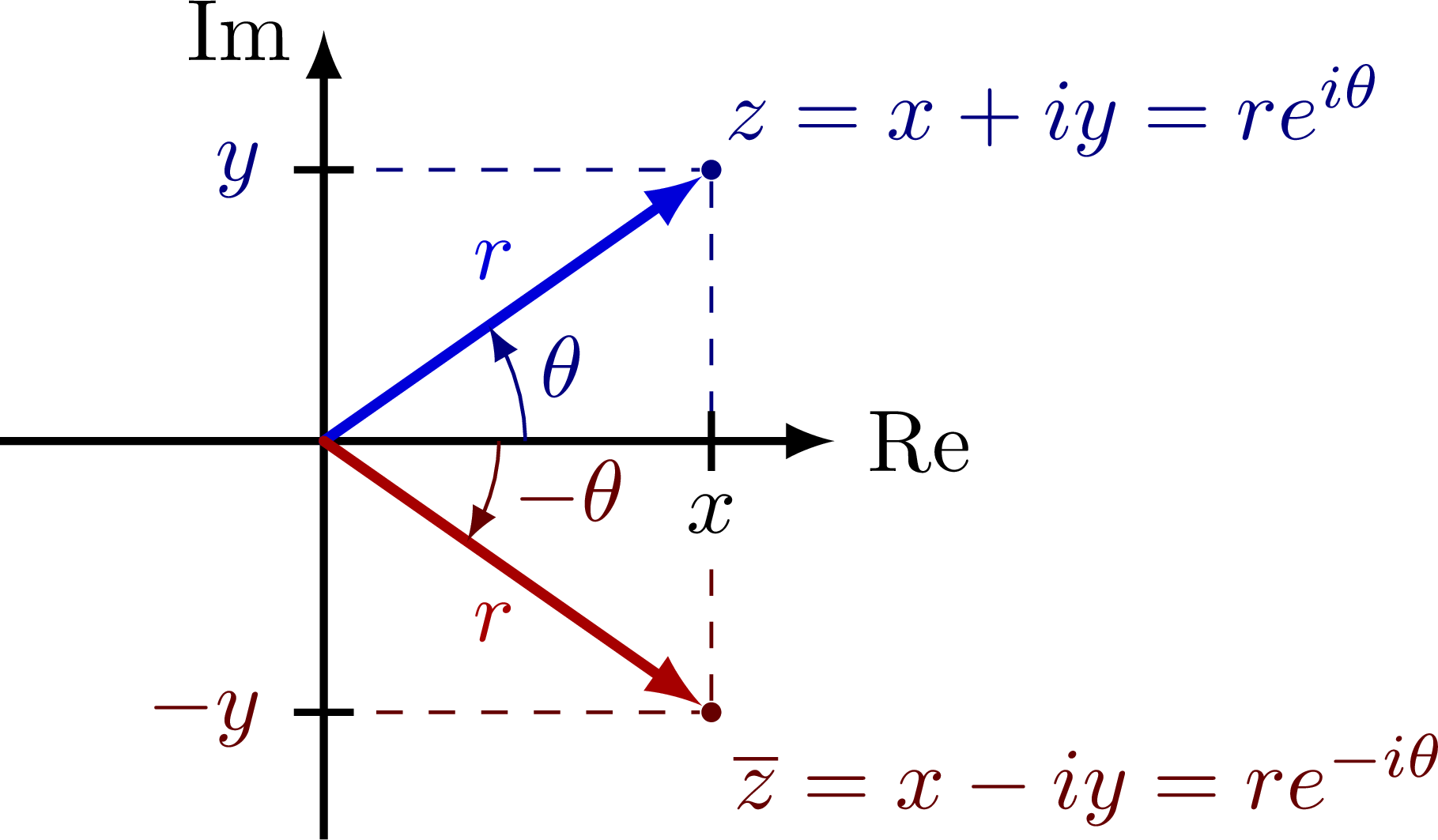
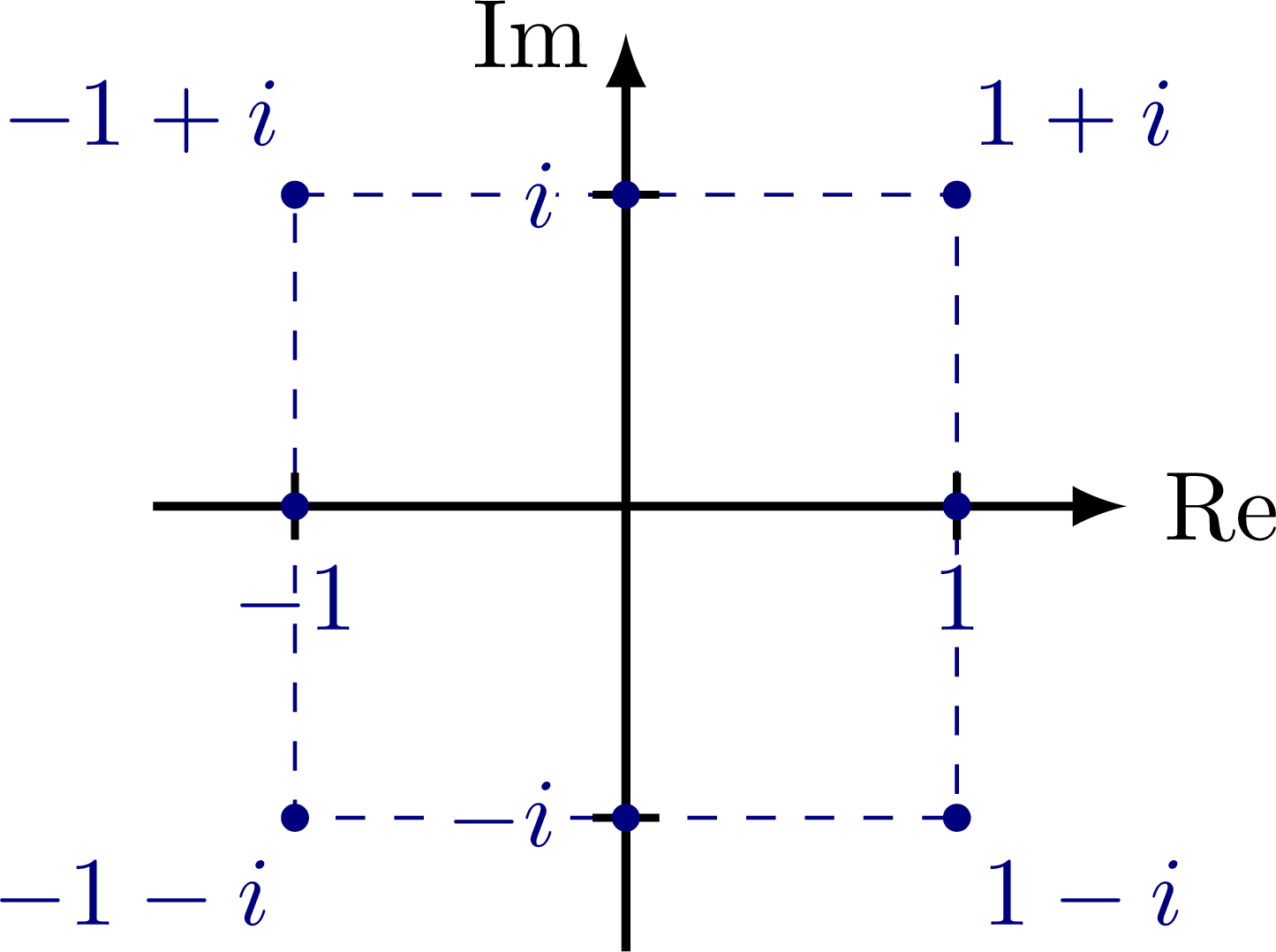
A complex number can be represented in the plane as the point with Cartesian coordinates . The coefficient of “” determines the vertical coordinate, and the coefficient of “” determines the horizontal coordinate.
Let us be given a complex number .
The “real part” and “imaginary part” of can be extracted with designated functions:
The polar data (radius and angle) have special names and notations for complex numbers:
Using this notation, we see that product with the conjugate gives square of modulus:
Link to original
Theory - cis, Euler, products, powers
Theory 1
Multiplication of complex numbers is much easier to understand when the numbers are written using polar form.
There is a shorthand ‘’ notation. Convert to polar coordinates, so and :
The “” stands for . For example:
Euler Formula
General Euler Formula:
On the unit circle :
The form expresses the same data as the form. The principal advantage of the form is that it reveals the rule for multiplication, which comes from exponent laws:
Complex multiplication - Exponential form
In words:
- Multiply radii
- Add angles
Notice:
Notice:
Therefore ‘acts upon’ other numbers by rotating them counterclockwise!
De Moivre’s Theorem - Complex powers
In exponential notation:
In notation:
Expanded notation:
So the power of acts like this:
- Stretch: to
- Rotate: by increments of
Link to originalExtra - Derivation of Euler Formula
Recall the power series for :
Plug in :
Simplify terms:
Separate by -factor. Select out the :
Separate into a series without and a series with :
Identify and . Write trig series:
Therefore .
Illustration
Example - Complex product, quotient, power using Euler
Complex product, quotient, power using Euler
Define:
Product :
Quotient :
Power :
Notice:
Simplify:
Link to original
Example - Complex power from Cartesian
Complex power from Cartesian
Compute .
Solution
First convert to exponential form:
Compute the power:
Link to original
Complex roots
Videos
Review Videos
Videos, Trefor Bazett
- Finding cube roots: Find cube roots of
Videos, Brain Gainz
Link to original
- Finding nth roots: Fourth roots of and cube roots of
Theory - Roots formula
Theory 1
The exponential notation leads to a formula for a complex root of any complex number:
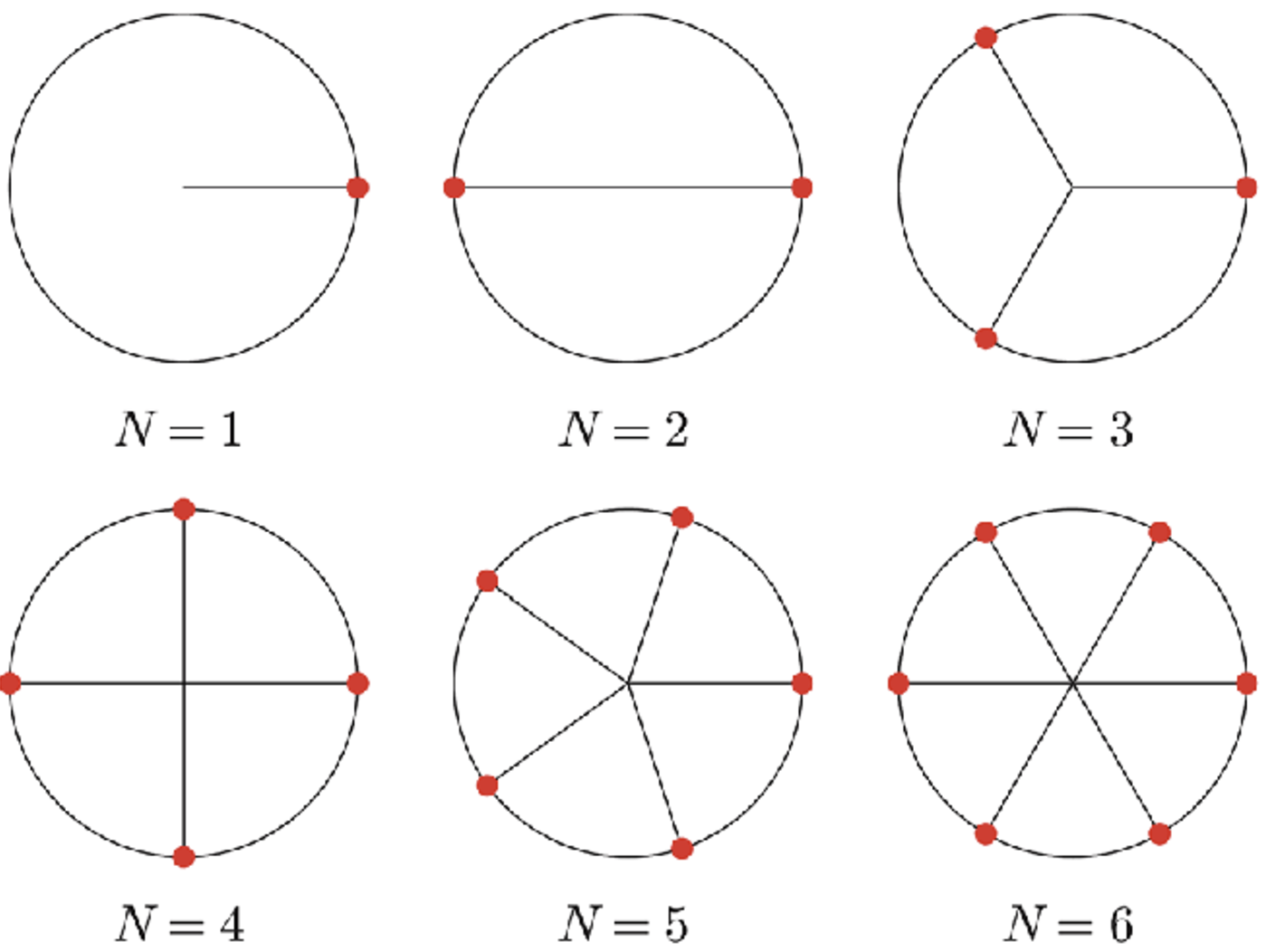
distinct roots
Every complex number actually has distinct roots!
That’s two square roots, three cube roots, four roots, etc.
All complex roots
The complex roots of are given by this formula:
In Cartesian notation:
In words:
- Start with the basic root:
- Rotate by increments of to get all other roots
- After distinct roots, this process repeats itself
Link to originalExtra - Complex roots proof
We must verify that :
Illustration
Example - Finding all roots of
Finding all 4th roots of 16
Compute all the roots of .
Solution
Write .
Evaluate roots formula:
Simplify:
Link to original
Example - Finding roots of
Finding 2nd roots of 2i
Find both roots of .
Solution
Write .
Evaluate roots formula:
Compute the options: :
Convert to rectangular:
Link to original
Example - Some roots of unity
Some roots of unity
Find the and and and and and roots of the number .
Solution
(1)
Write . Evaluate roots formula. There is no possible :
(2)
Write . Evaluate roots formula in terms of :
Compute the two options, :
(3)
Evaluate roots formula in terms of :
Compute the options: :
(4)
Evaluate roots formula:
Compute the options: :
(5)
Evaluate roots formula:
Compute the options: :
Don’t simplify, it’s not feasible.
(6)
Evaluate roots formula:
Compute the options: :
Simplify:
Link to original
Complex numbers for DE
Arithmetic
Arithmetic
A complex number may be written in ‘Cartesian form’ with distinct real and imaginary components, with . For addition (as ) and multiplication by a real number (as ) one operates on and just as the components of a vector. Complex numbers are multiplied by complex numbers using the formula . Thus if and , then we have:
Link to original
Exponents
Exponents
Complex numbers can be used as exponents in virtue of Euler’s Formula:
Deriving Euler’s Formula using power series
Recall the power series formula for :
Plug in , and recall the power series formulas for and :
Other complex exponents can be calculated from Euler’s Formula by using exponent rules:
Link to original
Polar format
Polar format
A complex number can be written in ‘polar form’ as . This translates to ‘Cartesian form’ using the exponential rule:
These forms allow one to graph complex numbers in the plane using the polar coordinates or the corresponding Cartesian coordinates .
The radius is called the modulus and the angle is called the argument of the complex number . The modulus of is the number . It is sometimes written .
If a complex number is graphed in the coordinate plane, and this number is multiplied by another complex number , then the product is given by scaling by , and rotating by (counterclockwise).
Link to original
Conjugate
Conjugate
Complex numbers come in natural pairs. Given , there is a conjugate number . Conjugates correspond to reflection in the real axis.
It is easy to verify a relationship between conjugation and multiplication:
Given , we sometimes write and for the real part and imaginary part. These can be extracted using conjugation:
Conjugation preserves algebraic operations:
Link to original
Division
Division
Division can be taken by complex numbers. The quotient can be calculated using conjugate multiplication. Supposing , then:
Link to original
Roots
Roots
Whole number roots of complex numbers are found using the exponential form:
In polar form, this means the root is taken on the modulus directly, and the angle is divided by the root number.
This procedure gives the analogue of . But of course, as well. For any given , there are exactly distinct complex numbers, , such that . These numbers are given by adding to the angle, for various :
Link to original