Events and outcomes
Theory
Theory 1
Events and outcomes – informally
- An event is a description of something that can happen.
- An outcome is a complete description of something that can happen.
All outcomes are events. An event is usually a partial description. Outcomes are events given with a complete description.
Here ‘complete’ and ‘partial’ are within the context of the probability model.
It can be misleading to say that an ‘outcome’ is an ‘observation’.
- ‘Observations’ occur in the real world, while ‘outcomes’ occur in the model.
- To the extent the model is a good one, and the observation conveys complete information, we can say ‘outcome’ for the observation.
Notice: Because outcomes are complete, no two distinct outcomes could actually happen in a run of the experiment being modeled.
When an event happens, the fact that it has happened constitutes information.
Events and outcomes – mathematically
- The sample space is the set of possible outcomes, so it is the set of the complete descriptions of everything that can happen.
- An event is a subset of the sample space, so it is a collection of outcomes.
For mathematicians: some “wild” subsets are not valid events. Problems with infinity and the continuum…
Notation
Write for the set of possible outcomes, for a single outcome in .
Write or for some events, subsets of .
Write for the collection of all events. This is frequently a huge set!
Write for the cardinality or size of a set , i.e. the number of elements it contains.
Using this notation, we can consider an outcome itself as an event by considering the “singleton” subset which contains that outcome alone.
Link to original
Illustration
Example - Coin flipping
Coin flipping
Flip a fair coin two times and record both results.
Outcomes: sequences, like or .
Sample space: all possible sequences, i.e. the set .
Events: for example:
With this setup, we may combine events in various ways to generate other events:
Complex events: for example: , or in words:
Notice that the last one is a complete description, namely the outcome .
Link to original
, or in words:
Practice exercise
Coin flipping: counting subsets
Flip a fair coin five times and record the results.
How many elements are in the sample space? (How big is ?)
How many events are there? (How big is ?)Link to originalSolution
There are possible sequences, so .
To count the number of possible subsets, consider that we have 32 distinct items, and a subset is uniquely determined by the binary information – for each item – of whether it is in or out. Thus there are possibilities. So .
Theory
Theory 2
New events from old
Given two events and , we can form new events using set operations:
We also use these terms for events and :
They are mutually exclusive when , that is, they have no elements in common.
They are collectively exhaustive , that is, when they jointly cover all possible outcomes.
In probability texts, sometimes is written “” or even (frequently!) “”.
Link to originalRules for sets
Algebraic rules
Associativity: . Analogous to .
Distributivity: . Analogous to .
De Morgan’s Laws
In other words: you can distribute “ ” but must simultaneously do a switch .
Probability models
Theory
Theory 1
Axioms of probability
A probability measure is a function satisfying:
Kolmogorov Axioms:
Axiom 1: for every event
(probabilities are not negative!)Axiom 2:
(probability of “anything” happening is 1)Axiom 3: additivity for any countable collection of mutually exclusive events:
Notation: we write instead of , even though is a function, to emphasize the fact that is a set.
Probability model
A probability model or probability space consists of a triple :
the sample space
the set of valid events, where every satisfies
a probability measure satisfying the Kolmogorov Axioms
Finitely many exclusive events
It is a consequence of the Kolmogorov Axioms that additivity also works for finite collections of mutually exclusive events:
Inferences from Kolmogorov
A probability measure satisfies these rules.
They can be deduced from the Kolmogorov Axioms.
- Negation: Can you find but not ? Use negation:
- Monotonicity: Probabilities grow when outcomes are added:
- Inclusion-Exclusion: A trick for resolving unions:
(even when and are not exclusive!)
Link to originalInclusion-Exclusion
The principle of inclusion-exclusion generalizes to three events:
The same pattern works for any number of events!
The pattern goes: “include singles” then “exclude doubles” then “include triples” then …
Include, exclude, include, exclude, include, …
Illustration
Example - iPhones and iPads
iPhones and iPads
At Mr. Jefferson’s University, 25% of students have an iPhone, 30% have an iPad, and 60% have neither.
What is the probability that a randomly chosen student has some iProduct? (Q1)
What about both? (Q2)
Solution
(1) Set up the probability model:
A student is chosen at random:
Outcomes are chosen students.
The sample space is the set of all students. Events are subsets of .
Write and (regarding the chosen student).
All students are equally likely to be chosen. Therefore for any event . Therefore and .
Furthermore, . This states that 60% have “not iPhone AND not iPad”.
(2) Define the desired event:
Q1:
Q2:
(3) Compute the probabilities:
We do not know that and are exclusive.
We could try inclusion-exclusion:
We know and . So this formula, with given data, RELATES Q1 and Q2. It does not solve either one by itself.
We have not yet used the information that .
To use this, simplify it with De Morgan’s Laws:
Therefore:
We have answered Q1. Recall that inclusion-exclusion relates Q1 and Q2 and solve to answer Q2:
Link to original
Example - Lucia is Host or Player
Lucia is Host or Player
The professor chooses three students at random for a game in a class of 40, one to be Host, one to be Player, one to be Judge. What is the probability that Lucia is either Host or Player?
Solution
(1) Set up the probability model:
Label the students to . Write for Lucia’s number.
Outcomes: assignments such as . These are ordered triples with distinct entries in .
Sample space: is the collection of all such distinct triples
Events: any subset of
Probability measure: assume all outcomes are equally likely, so for all
In total there are triples of distinct numbers.
Therefore for any specific outcome .
Therefore for any event . (Recall is the number of outcomes in .)
(2) Define the desired event:
We want to find . Define and . Thus:
So, in this notation, we seek .
(3) Compute the desired probability:
Importantly, (mutually exclusive). There are no outcomes in in which Lucia is both Host and Player.
By additivity, we infer .
Now compute . There are ways to choose and from the students besides Lucia. Therefore . Therefore:
Now compute . It is similar: .
Finally compute that , so the answer is:
Link to original
Conditional probability
Theory
Theory 1
Conditional probability
The conditional probability of “ given ” is defined by:
This conditional probability represents the probability of event taking place given the assumption that took place. (All within the given probability model.)
By letting the actuality of event be taken as a fixed hypothesis, we can define a conditional probability measure by plugging events into the slot of :
It is possible to verify each of the Kolmogorov axioms for this function, and therefore itself defines a bona fide probability measure.
Conditioning
What does it really mean?
Conceptually, corresponds to creating a new experiment in which we run the old experiment and record data only those times that happened. Or, it corresponds to finding ourselves with knowledge or data that happened, and we seek our best estimates of the likelihoods of other events, based on our existing model and the actuality of .
Mathematically, corresponds to restricting the probability function to outcomes in , and renormalizing the values (dividing by ) so that the total probability of all the outcomes (in ) is now .
The definition of conditional probability can also be turned around and reinterpreted:
Multiplication rule
“The probability of AND equals the probability of times the probability of -given-.”
This principle generalizes to any events in sequence:
Link to originalGeneralized multiplication rule
The generalized rule can be verified like this. First substitute for and for in the original rule. Now repeat, substituting for and for in the original rule, and combine with the first one, and you find the rule for triples. Repeat again with and , combine with the triples, and you get quadruples.
Illustration
Practice exercise
Simplifying conditionals inclusion
Let . Simplify the following values:
Link to originalSolution
- Definition of ‘conditional’:
- The problem assumes that . Therefore .
- Therefore, answer: .
- Definition of ‘conditional’:
- Since , we know .
- Therefore and answer .
- Definition of ‘conditional’:
- Since , we have .
- Therefore, answer .
- Definition of ‘conditional’:
- There is no way to simplify further.
- We could write if desired.
Example - Multiplication: draw two cards
Multiplication: draw two cards
Two cards are drawn from a standard deck (without replacement).
What is the probability that the first is a 3, and the second is a 4?
Solution
This “two-stage” experiment lends itself to a solution using the multiplication rule for conditional probability.
(1) Label events:
- Write for the event that the first card is a 3.
- Write for the event that the second card is a 4.
We seek . We will use the multiplication rule:
(2) Compute probabilities:
We know . (Does not depend on the second draw.)
For the conditional probability, note that if the first is a 3, then there are four remaining 4s and 51 remaining cards. Therefore:
(3) Apply multiplication rule:
Link to original
Example - Flip a coin, then roll dice
Multiplication: flip a coin, then roll dice
Flip a coin. If the outcome is heads, roll two dice and add the numbers. If the outcome is tails, roll a single die and take that number. What is the probability of getting a tails AND a number at least 3?
Solution
(1) This “two-stage” experiment lends itself to a solution using the multiplication rule for conditional probability.
Label the events of interest.
Let and be the events that the coin showed heads and tails, respectively.
Let be the events that the final number is , respectively.
The value we seek is .
(2) Observe known (conditional) probabilities.
We know that and .
We know that , for example, or that .
(3) Apply multiplication rule:
We know and can see by counting that .
Therefore .
Link to original
Example - Coin flipping: at least 2 heads
Coin flipping: at least 2 heads
Flip a fair coin 4 times and record the outcomes as sequences, like HHTH.
Let be the event that there are at least two heads, and the event that there is at least one heads.
First let’s calculate .
Define , the event that there were exactly 2 heads, and , the event of exactly 3, and the event of exactly 4. These events are exclusive, so:
Each term on the right can be calculated by counting:
Therefore, .
Now suppose we find out that “at least one heads definitely came up”. (Meaning that we know .) For example, our friend is running the experiment and tells us this fact about the outcome.
Now what is our estimate of likelihood of ?
The formula for conditioning gives:
Now . (Any outcome with at least two heads automatically has at least one heads.) We already found that . To compute we simply add the probability , which is , to get .
Therefore:
Link to original
Theory
Theory 2
Law of Total Probability: 2 cases
For any events and :
This rule can also be called “Division into Cases.”
Interpretation: event may be divided along the lines of , with some of coming from the part in and the rest from the part in .
Total Probability - Explanation
- First divide itself into parts in and out of :
- These parts are exclusive, so in probability we have:
- Use the Multiplication rule to break up and :
- Now substitute in the prior formula:
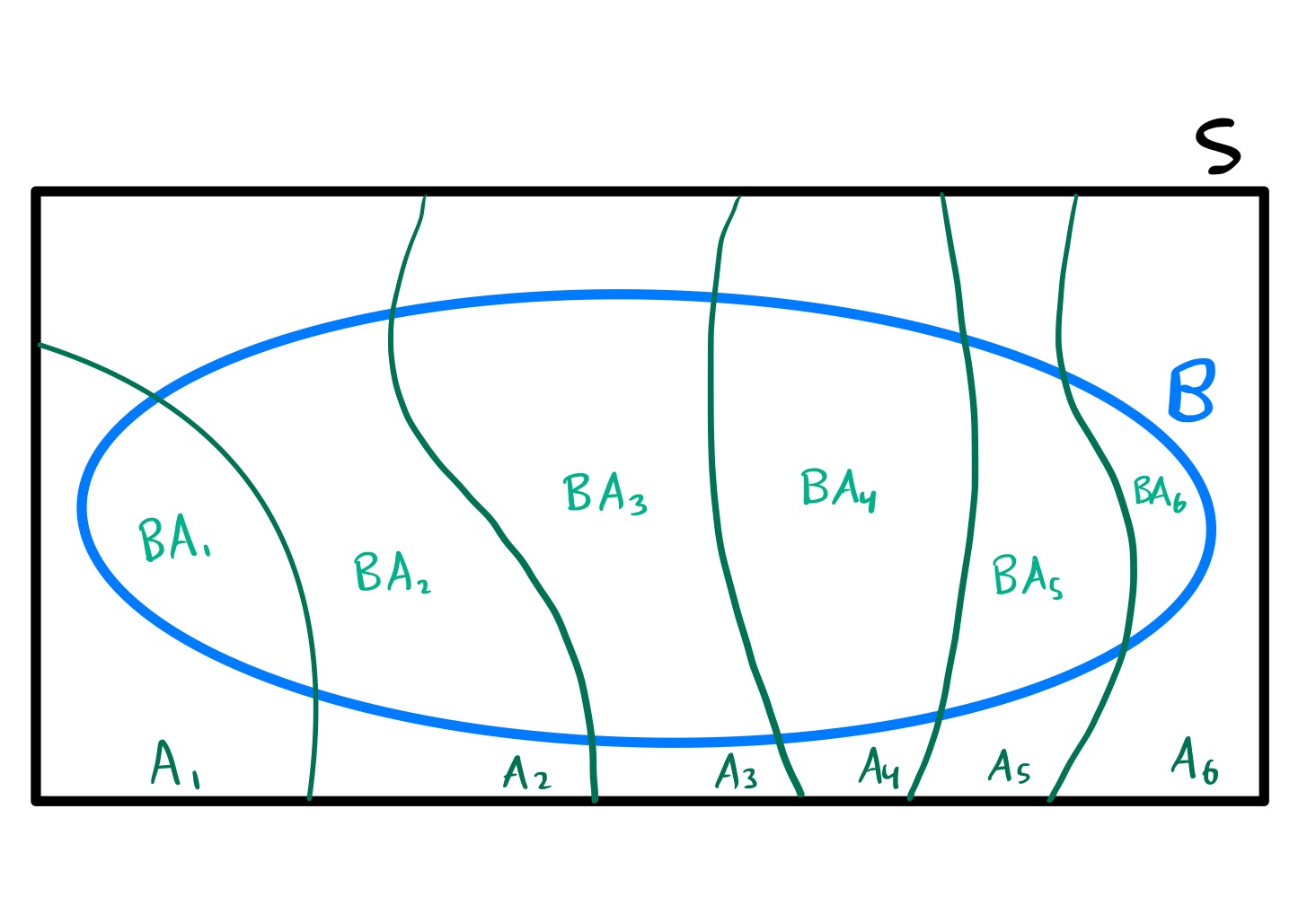
This law can be generalized to any partition of the sample space . A partition is a collection of events which are mutually exclusive and jointly exhaustive:
The generalized formulation of Total Probability for a partition is:
Law of Total Probability: cases
For a partition of the sample space :
By setting with and , we recover the -case Law from the -case version of the Law.
Link to original
Illustration
Practice exercise
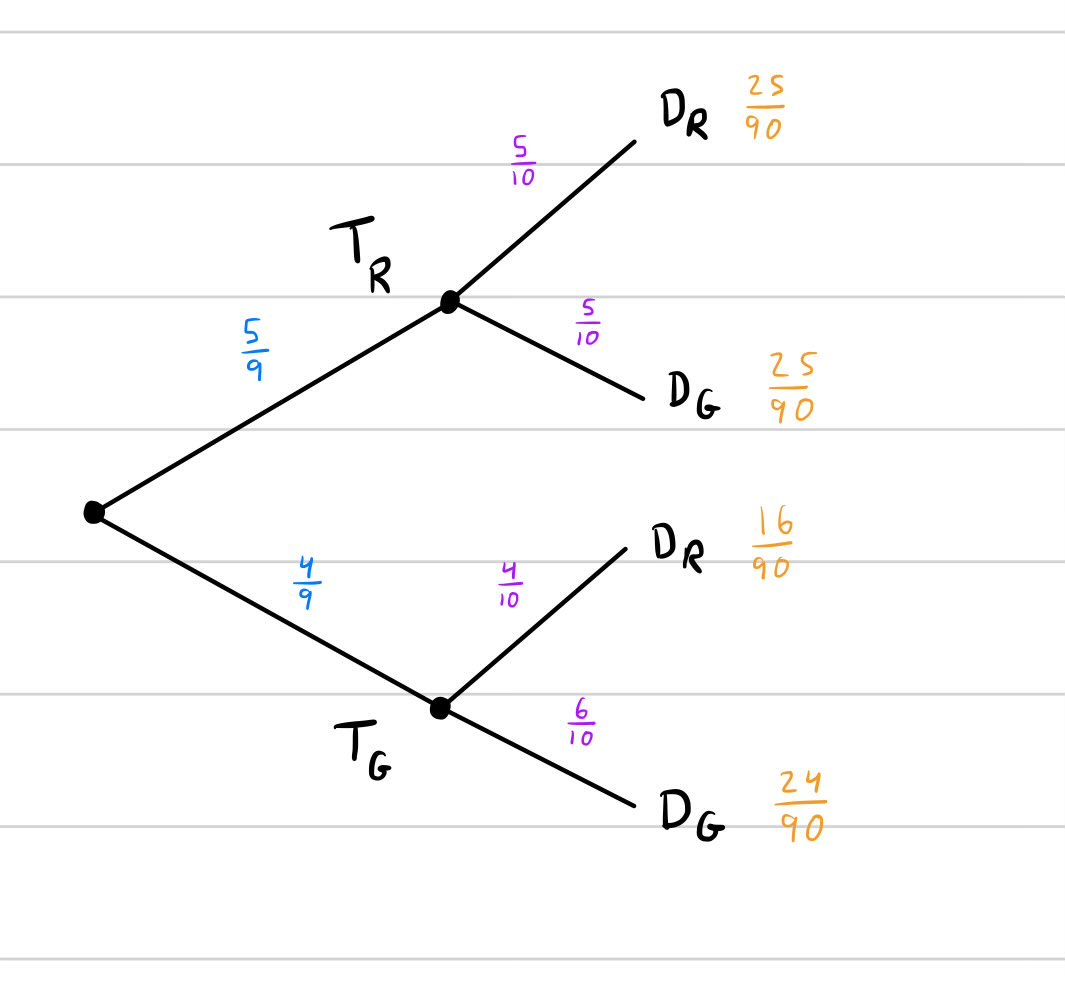
Marble transferred, marble drawn
Setup:
- Bin 1 holds five red and four green marbles.
- Bin 2 holds four red and five green marbles.
Experiment:
- You take a random marble from Bin 1 and put it in Bin 2 and shake Bin 2.
- Then you draw a random marble from Bin 2 and look at it.
What is the probability that the marble you look at is red?
Link to originalSolution
(1) Label events:
- Event : a red marble is transferred.
- Event : a green marble is transferred.
- Event : a red marble is drawn from Bin 2.
- Event : a green marble is drawn from Bin 2.
Answer will be .
(2) Apply Division into Cases:
General formula:
Insert our labels, and and . Obtain:
(3) Plug in data and compute:
- Know .
- Know .
- Know .
- Know .
Therefore:
Bayes’ Theorem
Theory
Theory 1
Bayes’ Theorem
For any events and :
Note: Bayes’ Theorem is sometimes called Bayes’ Rule.
Bayes’ Theorem - Derivation
Start with the observation that , in other words event “ AND ” equals event “ AND ”.
Apply the multiplication rule to each product:
Equate them and rearrange:
The main application of Bayes’ Theorem is to calculate when it is easy to calculate from the problem setup. Often this occurs in multi-stage experiments where event describes outcomes of an intermediate stage.
Note: These lecture notes use alphabetical order , as a mnemonic for temporal or logical order, i.e. that comes first in time, or that is the prior conditional from which it is easy to calculate .
Link to original
Illustration
Example - Bayes’ Theorem - COVID tests
Bayes’ Theorem: COVID tests
Assume that 0.5% of people have COVID. Suppose a COVID test gives a (true) positive on 96% of patients who have COVID, but gives a (false) positive on 2% of patients who do not have COVID. Bob tests positive. What is the probability that Bob has COVID?
Solution
(1) Label events:
- Event : Bob is actually positive for COVID
- Event : Bob is actually negative; note
- Event : Bob tests positive
- Event : Bob tests negative; note
(2) Identify known data:
- Know:
- Know:
- Know: and therefore
We seek:
(3) Translate Bayes’ Theorem:
Set and in Bayes’:
We know all values on the right except
(4) Denominator: apply Total Probability (Division into Cases):
Observe that and are exclusive events, and that:
Therefore:
Plug in data and compute:
(5) Plug in and compute:
Link to originalIntuition - COVID testing
Some people find this low number surprising. In order to repair your intuition, think about it like this: roughly 2.5% of tests are positive, with roughly 2% coming from false positives, and roughly 0.5% from true positives. Only of all the positive results are true ones!
(This rough approximation assumes that .)
If two tests both come back positive, the odds of COVID are now 98%.
If only people with symptoms are tested, so that, say, 20% of those tested have COVID, that is, , then one positive test implies a COVID probability of 92%.
Practice exercise
Inferring bin from marble
There are marbles in bins in a room:
- Bin 1 holds 7 red and 5 green marbles.
- Bin 2 holds 4 red and 3 green marbles.
Your friend goes in the room, shuts the door, and selects a random bin, then draws a random marble. (Equal odds for each bin, then equal odds for each marble in that bin.) He comes out and shows you a red marble.
What is the probability that this red marble was taken from Bin 1?
Link to originalSolution
(1) Label events:
- Event : friend chooses Bin 1.
- Event : friend chooses Bin 2.
- Event : friend draws a red marble.
- Event : friend draws a green marble.
Answer will be .
(2) Identify knowns:
- Know .
- Know .
- Know .
- Know .
- Know .
(3) Apply Bayes’ Theorem for ::
Division into Cases for the denominator:
(3) Plug in data and compute:
Independence
Theory
Theory 1
Two events are independent when information about one of them does not change our probability estimate for the other.
Independence
Events and are independent when these (logically equivalent) equations hold:
Note that the last equation is symmetric in and :
- Check: and
- This symmetric version is the preferred definition of the concept of independence.
Link to originalMultiple-independence
A collection of events is mutually independent when every subcollection satisfies:
A potentially weaker condition for a collection is called pairwise independence, which holds when all 2-member subcollections are independent:
One could also define -member independence, or -member independence. Plain ‘independence’ means any-member independence.
Illustration
Practice exercise
Independence and complements
Prove that these are logically equivalent statements:
- and are independent
- and are independent
- and are independent
Make sure you demonstrate both directions of each equivalency.
Link to originalSolution
(1) Assume and show :
Divide into the cases:
Apply the assumption:
Algebra:
Negation rule:
(2) Assume and show :
Reason the same way as above, but apply the new assumption to break up the second term instead of the first.
(3) Show that and are equivalent:
To do this, simply notice that in the first equivalence we can replace with and with . Use too.
Example - Checking independence by hand
Independence by hand: red and green marbles
A bin contains 4 red and 7 green marbles. Two marbles are drawn.
Let be the event that the first marble is red, and let be the event that the second marble is green.
(a) Show that and are independent if the marbles are drawn with replacement.
(b) Show that and are not independent if the marbles are drawn without replacement.
Solution
(a) With replacement.
Identify knowns:
- Know:
- Know:
Now compute both sides of independence relation:
The right side is .
For , we have ways to get , and total outcomes. So left side is , which equals the right side.
(b) Without replacement. This is a bit harder.
(1) Identify knowns:
Know: and therefore
We seek: and
(2) Find using Total Probability (Division into Cases):
Find RHS factors by counting, then compute:
(3) Find using multiplication rule:
(4) Compare both sides:
Left side: .
Right side:
But so and they are not independent.
Link to original
Tree diagrams
Theory
Theory 1
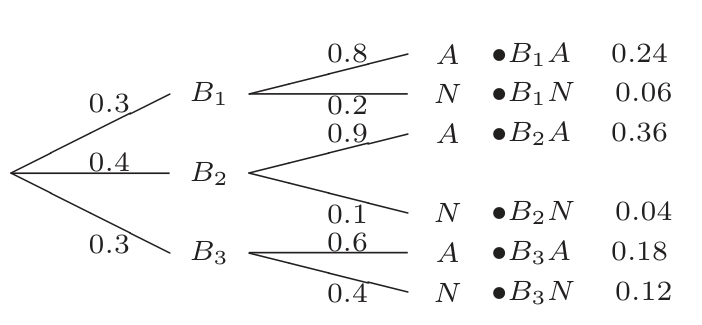
A tree diagram depicts the components of a multi-stage experiment. Nodes represent sources of randomness.
An outcome of the experiment is represented by a complete path taken from the root (left-most node, only one option) to a leaf (right-most node, many options). The branch chosen at a given node represents the outcome of a “sub-experiment.” So a complete path encodes the outcomes of all sub-experiments along the way.
Each branch emanating from a node is labeled with a probability value. This is the probability that the sub-experiment of that node has the outcome of that branch. (In the example, .) This is also the conditional probability of the branch’s right node, given its left node as known.
Therefore, branch values from any given node must sum to 1.
The probability of a given outcome is the product of the probabilities along each branch of the path from the root to that outcome.
For example, for outcome , we have .
Generally, remember that
This overall outcome probability may be written at the final leaf. (Not to be confused with the branch value of the last branch.)
One can also use a tree diagram to remember quickly how to calculate certain probabilities.
For example, what is in the diagram?
- Answer: add up the path probabilities for all paths terminating in . We obtain:
For example, what is ?
Link to original
- Answer: divide the leaf probability of by the total probability of . We obtain:
Illustration
Example - Tree diagrams: Marble transferred, marble drawn
Marble transferred, marble drawn
Setup:
- Bin 1 holds five red and four green marbles.
- Bin 2 holds four red and five green marbles.
Experiment:
- You take a random marble from Bin 1 and put it in Bin 2 and shake Bin 2.
- Then you draw a random marble from Bin 2 and look at it.
Questions:
(a) What is the probability you draw a red marble?
(b) Supposing that you drew a red marble, what is the probability that a red marble was transferred?
Solution
Construct the tree diagram:
Identify sub-experiments, label events, compute probabilities:
(a) Compute :
Add up leaf numbers for at leaf:
(b) Compute :
Conditional probability definition:
Interpretation: value of desired path over value of all possible paths.
Link to original