Differential Equations - Examinable Exercises and Problems
Exercises
Packet 02
Exercise 02A-01
Tricky signs
Check and explain all absolute values and signs (including ) in the previous example.
Exercise 02A-02
Separable equations: basics
Solve the equations:
- (a)
- (b)
Exercise 02A-04
Particular solution
Find the particular solution to
which includes the point .
Exercise 02B-01
Linear equations: basics
Solve the following ODEs, giving a complete family of solutions:
- (a) ,
- (b) .
Exercise 02B-02
Linear equation: particular solution
Find a particular solution of the following ODE which passes through the point :
Exercise 02B-03
Checking exactness
Which of the following ODEs are exact?
- (a)
- (b)
- (c)
- (d)
Exercise 02B-04
Solving an exact equation
Show that the ODE is exact, and solve it:
Packet 03
Exercise 03A-01
Homogeneous equations
For the following differential equations, show that they are homogeneous, and then solve them by substitution and separation:
- (a)
- (b) [not for exam]
- (c)
Exercise 03A-03
Integrating factor: converting to exact
Convert the following to exact equations by finding and applying integrating factors.
- (a)
- (b)
Exercise 03A-05
Solving Bernoulli equations
Solve the Bernoulli equation .
Exercise 03A-06
Swapping roles
Reverse the roles of and to solve: .
Exercise 03B-01
Homogeneous
Solve the following homogeneous equations by substitution of . You should first write the equation using a single quotient and then divide above and below by .
- (a)
- (b)
Exercise 03B-02
Integrating factors, conversion to exact
Solve the following differential equations by finding an integrating factor or .
- (a)
- (b)
Packet 04
[no exercises examinable]
Packet 05
Exercise 05A-02
Bacteria growth on surface of spherical clump
A spherical clump of bacteria is growing in such a way that only the bacteria on its surface can reproduce, because only these are exposed to new food sources in the environment, while these surface bacteria do reproduce with exponential growth. Recall the formulas for volume and surface area of a sphere:
Find a differential equation satisfied by the number of bacteria as a function of time.
Exercise 05B-01
Studying an autonomous equation
Sketch the phase line of the following ODE:
Classify each equilibrium trajectory as stable or unstable. Draw some representative solution trajectories using the qualitative information of your phase line.
Exercise 05B-02
Gompertz equation
Tumor growth is sometimes modeled by the Gompertz equation:
What are the equilibrium lines? Are they stable or unstable? What is the inflection point on a trajectory from the lower to the upper equilibrium?
Now solve the equation explicitly.
Packet 06
Exercise 06A-02
Euler’s method becomes the left-endpoint rule
Show that if the ODE is amenable to solution by direct integration, meaning actually does not depend on , then Euler’s method amounts to the left-endpoint rule for integration of .
Packet 07
Exercise 07B-01
Second-order linear: distinct roots, repeated roots
Find the 2-parameter family of solution curves for the ODEs:
- (a)
- (b)
Packet 09
Exercise 09A-01
Variation of parameters: double repeated root, inhomogeneous
Find a complete set of solutions to the ODE given by .
Exercise 09A-03
Solving inhomogeneous linear ODE
Find a complete set of solutions to the ODE given by .
Exercise 09A-04
Solving inhomogeneous linear ODE
Find a complete set of solutions to the ODE given by .
Exercise 09A-05
Solving inhomogeneous linear ODE
Find a complete set of solutions to the ODE given by , where are constants.
Exercise 09A-06
Superposition and sums of forcing terms
Find a complete set of solutions to the ODE given by .
(Hint: add two particular solutions together, each solving an inhomogeneous equation corresponding to a single one of the forcing terms.)
Exercise 09B-01
Driven undamped harmonic oscillator amplitude
Show that the above ODE has a bona fide (particular) solution given by , where
Exercise 09B-02
Checking ZSR and ZIR
Verify that and are given correctly.
Packet 10
Exercise 10-01
Method of power series: series terminates
Look for a power series solution to . Then solve the equation algebraically using prior methods we have learned, and compare your answers.
Exercise 10-03
Method of power series: one free coefficient
Find a power series solution to . Then solve the equation algebraically using prior methods we have learned, and compare your answers.
Exercise 10-04
Method of power series: missing negative power
Find a power series solution to . Then solve the equation algebraically using prior methods we have learned, and compare your answers.
Packet 13
Exercise 13-01
Complex eigenvalues
Solve the system . First find the complex solutions, then find the real solutions.
Exercise 13-02
Insufficient eigenvectors
Solve the IVP: .
Packet 14
Exercise 14-01
Boundary value problem
- (a) Solve the BVP: .
- (b) Find the eigenvalues and eigenfunctions for the following BVP: .
Note carefully the primes for boundary conditions.
Problems
Problem 02-01
Decide whether the ODE is separable, first-order linear, or exact, and then solve it:
- (a)
- (b)
- (c)
- (d)
- (e)
- (f)
Problem 03-01
Homogeneous; linear quotients
- (a) Solve the homogeneous equation .
- (b) Solve using linear quotients.
Problem 03-02
Reduction
The differential equation is missing both and . It can therefore be solved by reduction in ways. Solve it using both methods, and check that your solutions are equivalent to each other.
Problem 03-03
Swapping roles
Reverse the roles of independent and dependent variables and to solve:
- (a)
- (b)
Problem 03-05
First-order families
The family of curves solving a first-order linear differential equation has the general form . Now suppose we start with a family of curves in this form. Find the differential equation corresponding to this family and show that it is first-order linear.
Problem 04-01
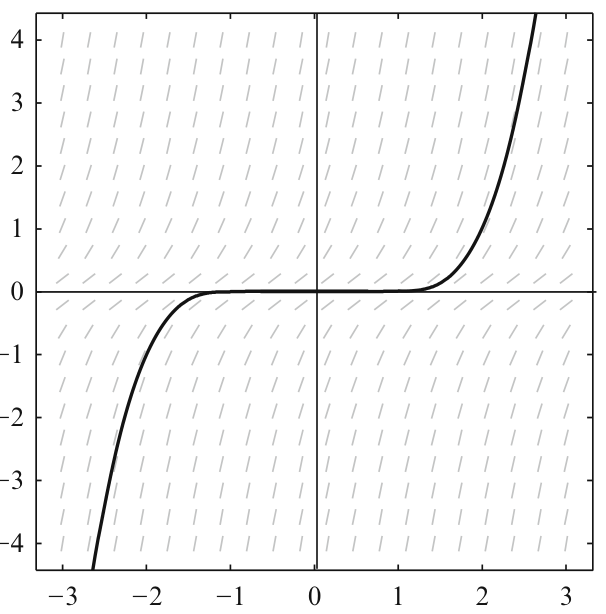
Hopping from the -axis
Consider the IVP: . Analyze the functional solutions to this IVP. Extend your analysis to as well. This Desmos and picture might help you:
https://www.desmos.com/calculator/n8yfpnshxd
Problem 04-02
When does Picard-Lindelöf apply?
Which of the following IVPs satisfy the conditions of the Picard-Lindelöf theorem?
- (a)
- (b)
- (c)
- (d)
Problem 04-04
Picard iterates
- (a) Compute the Picard iterates up to , starting with , for the IVP:
- (b) Compute the Picard iterates up to , starting with , for the IVP:
Problem 05-01
Pursuit with a crosswind
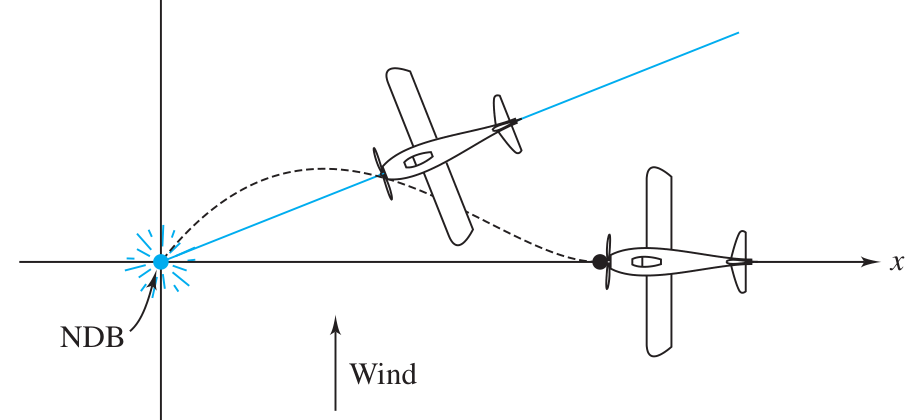
An airplane starts at and flies to the origin , but there is a crosswind. The wind blows in the direction at a constant speed , and the airplane flies with a fixed speed relative to the air around it. The plane always flies with its fuselage pointing towards . Assume . Find the path taken by the plane over the ground. (Hint: recall that .)
Problem 05-03
Coffee cooling
Newton’s Law of Cooling says that an object at temperature , when placed in an ambient environment at temperature , will cool according to the following differential equation:
where is some constant that depends on the properties of the object and environment.
Suppose you have a cup of hot black coffee and some creamer at room temperature. You are going to drink the coffee in 15 minutes, and you want it to be as hot as possible. Do you put the creamer in now, or wait until just before drinking?
(You should assume that the temperature taken on by a mixture of coffee and creamer is the average of their original temperatures, weighted by their original quantities.)
Problem 06-01
Runge-Kutta practice
Find an approximate solution to with using the standard fourth-order Runge-Kutta method described above, up to , with a step size .
Problem 06-04
Backward Euler method
There is a family of procedures called “backward differentiation methods.” The backward Euler method specifies implicitly by the following equation:
It is called backward because the slope used here is the slope of the future step . There are backward versions for all the Adams methods. (The forward Adams methods are also called Adams-Bashforth methods, while the backward versions are called Adams-Moulton methods.)
For this problem, use the backward Euler method to approximate the solution to the IVP up to , with . (See Boyce et al. text for examples if desired.)
Problem 07-01
Solving second-order linear ODEs
Find the complete family of solutions to the following ODEs:
- (a)
- (b)
- (c)
- (d)
Problem 07-02
Solving second-order linear IVPs
Solve the IVP:
- , ,
- , ,
Problem 07-05
Backwards reasoning: find the ODE
Find the ODE that has the following family of solutions: .
Problem 09-01
Superposition and sums of forcing terms
Find a complete set of solutions to the ODE given by .
Problem 09-03
Variation of parameters
Using variation of parameters, find particular solutions to the following ODEs:
- (a)
- (b)
Problem 10-01
Power series solution of second-order ODE
Find the complete family of power series solutions to .
Problem 10-02
Power series solution of second-order ODE
Find the complete family of power series solutions to .
Problem 10-03
Power series solution of second-order ODE
Find the complete family of power series solutions to .
Problem 10-06
Power series: using series multiplication
Find the first 6 terms of a power series solution to the IVP given by , . [Hint: substitute in the power series for .]
Problem 12-01
Writing order linear ODE as D system
Consider the ODE: . Rewrite this ODE as a D system of equations, giving the matrix and the inhomogeneous vector term .
Problem 12-02
Converting system list to system matrix
Find the matrix + forcing vector formulations of the two ODE systems:
- (a)
- (b)
Problem 12-05
Verifying vector solution of ODE system
Show that the given vector function satisfies the given ODE system:
Problem 13-02
Generalized eigenvector
Find the complete family of solutions for the system .
Problem 14-01
Fourier series of triangle wave
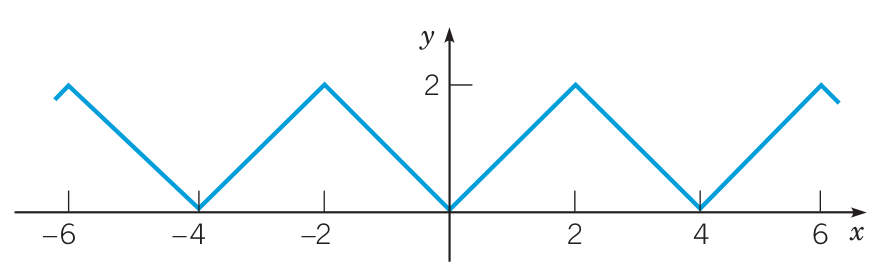
Find the Fourier series of the triangle wave in the figure:
Be sure to account for the period of rather than . (You should change variables so that the wave covers one cycle on the interval in the new variable, and then change back at the very end to express your final answer.)
Problem 14-02
Full Fourier series with rescaling, even and odd parts
Compute the Fourier series for the function defined on the interval .
You should first change to a new independent variable for which that interval corresponds to the interval , and change back at the end.
Problem 14-04
Fourier series can teach us about
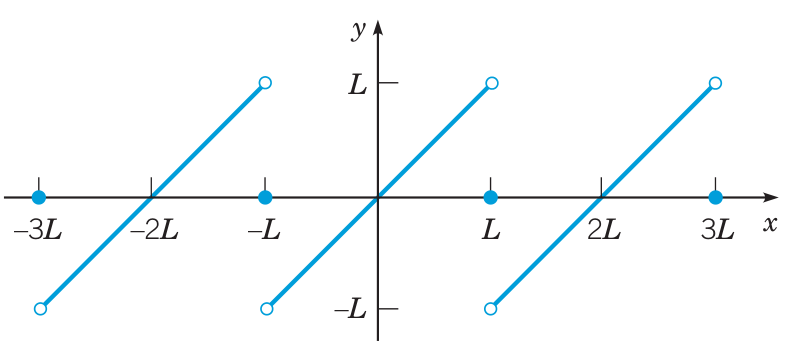
- (a) Compute the Fourier series of the following sawtooth wave with :
- (b) Evaluate your Fourier series at to establish Leibniz’s famous formula:
- (c) Find a similar series expression for using your solution to Problem 14-01.