Introduction
Although calculus was invented without the modern concept of function, the function concept has become an essential element of every branch of modern mathematics, not least the modern presentation of calculus. Within calculus, functions are essential for the idea of integrals (summation of infinitesimals), and they have some utility also for derivatives (division of infinitesimals), although they are not as important to the idea of a derivative since that idea also has a geometric incarnation in the notion of a tangent line.
Functions are designed to provide a common family that includes algebraic functions like , trig functions like , and exponential functions like . In this class we will see how calculus is used to define the natural exponential function . In Calculus II you would also see functions defined in terms of converging infinite series.
Function concept
A function is a specific, determinate rule which assigns to each input value an output value . A function is a kind of transformation or process taking inputs to outputs.
Set notation is useful when describing functions precisely. This notation identifies the sets of conceivable inputs and outputs. A function maps inputs in the domain set to outputs in the codomain set . A plain arrow is written between the sets to indicate this. The action of the function on specific elements can be written . Here the arrow with backstop is used because is a single element (in the domain , of course). And is the output of the function given the input .
The set of real numbers contains all familiar numbers (such as negatives, fractions, and infinite decimals) including ‘transcendental’ numbers like and . The set refers to the positive numbers (excluding zero). The set refers to the negative numbers (including zero).
The codomain contains ‘all conceivable’ outputs, which might include ‘impossible’ outputs. The difference is a matter of how the function terminology is set up by the definition. So it cannot always be inferred from formulas. For example is a formula that could define a function or it could define a function . So you can see that the same formula may be part of the definition of (technically) different functions.
A set is contained in another set, and we write down (for example) , when every element of is also in . In the above example, .
Subsets of larger sets are frequently specified in terms of a rule for their elements. This information can be expressed in modern notation like this:
The left side of ‘’ shows a variable element symbol and the larger set; the right side of ‘’ shows the rule defining the subset.
The range of a function is the set of possible output values. This means it is always a subset of the codomain. Using the notation above, we can denote the range like this: A variable symbol like or may be used to refer to the various elements of a set. In Calculus I these are typically real numbers in , but sometimes it’s important to specify that they do live in a subset such as , for example with the function given by the formula . An independent variable is a symbol used for inputs to the function (in the domain), and a dependent variable is a symbol used for outputs to the function (in the codomain).
The graph of a function is the set of pairs with and and satisfying the rule for every such pair. For real number functions , the graph of a function is a set of points in the Cartesian coordinate plane, often denoted . Specifically it is the points such that . So “graph of a function” does not mean a picture!! It is a specific set of points in the plane.
Vertical line test
The jargon about domain and codomain, and all the set notation, can obscure the basic idea. In calculus, functions are contrasted with formulas and equations. Formulas such as and equations such as do not automatically provide a recipe for “input-to-output.” In the formula, the implied recipe would break for certain inputs. In the equation, the implied recipe (solving for ) might have multiple solutions (e.g. when ), and therefore no specific output.
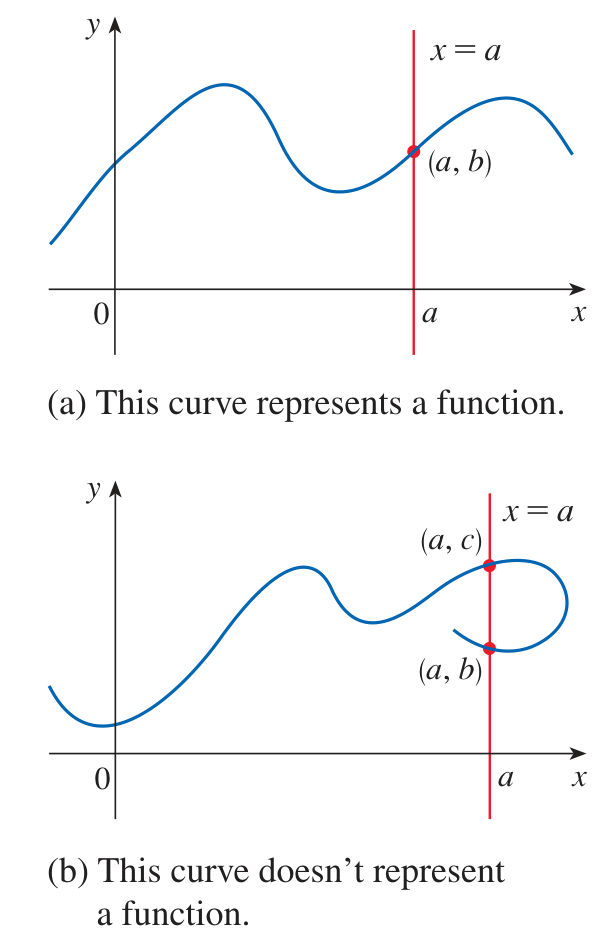
The idea of function requires a recipe that maps every input to only one (specific, determinate) output.
This idea can be see graphically in the vertical line test, which says that a set in is the graph of a function if every vertical line intersects the set in one place (or zero places, where the function isn’t defined).
Piecewise formulas
A function may be defined by a rule that involves several formulas that are applied in different input regions. For example: Sometimes you have to use your brain very carefully when evaluating a piecewise formula.
Even and odd functions
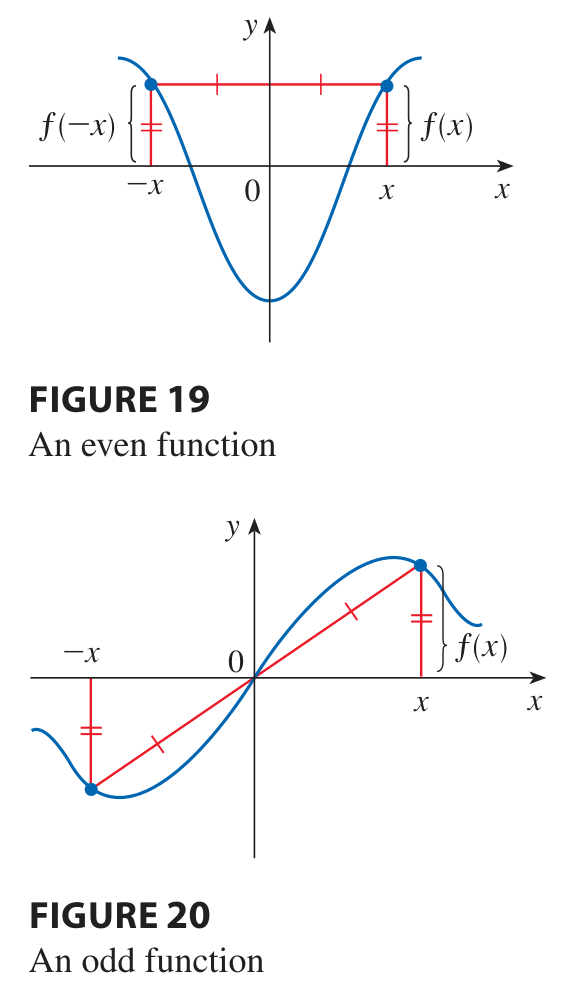
In certain special cases, a function’s rule for negative numbers can be described in terms of its rule for positives.
An even function satisfies , while an odd function satisfies . So, evens kill the minus, odds let the minus pass through. It’s somewhat like even and odd people.
Basic functions
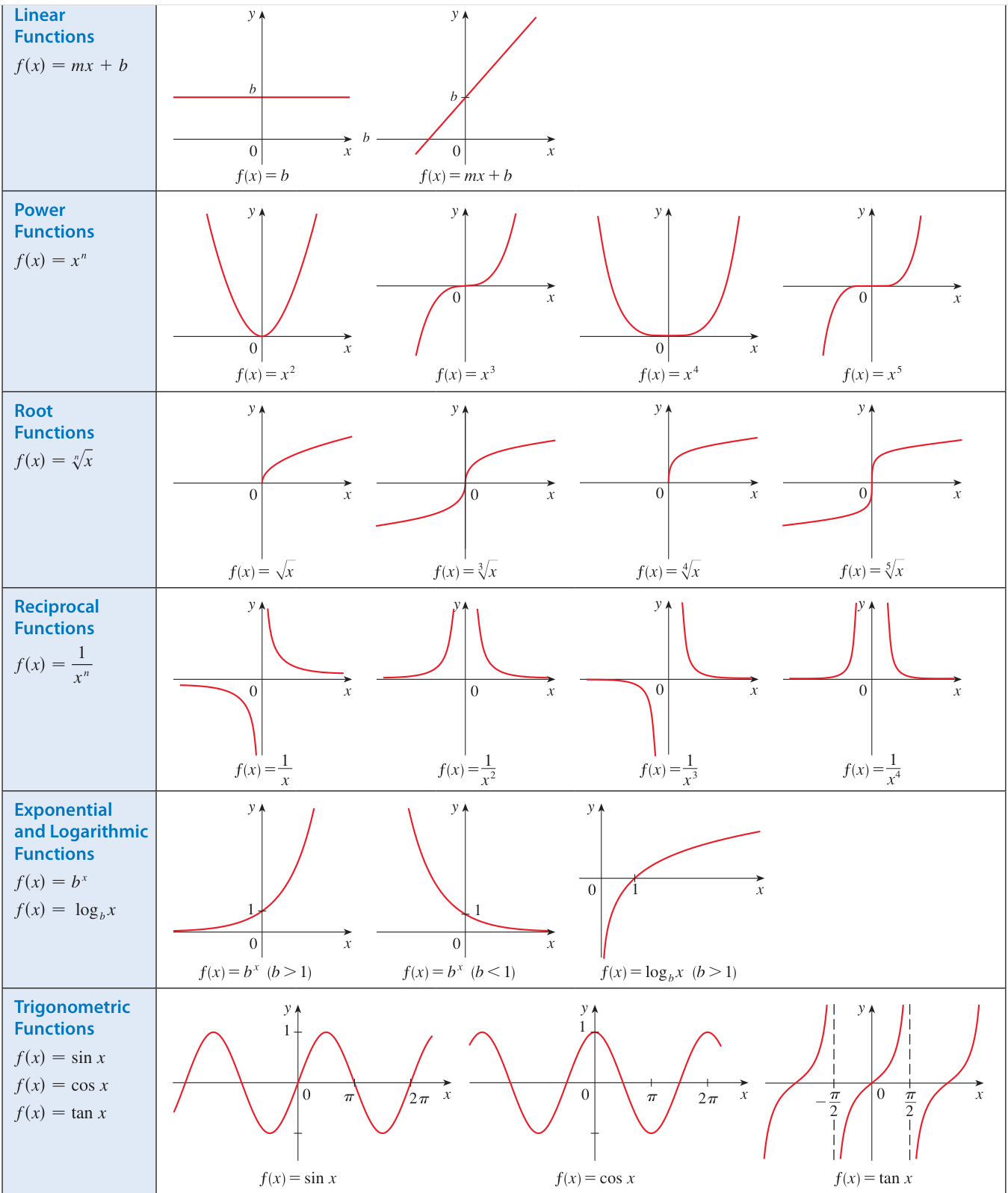
You may want to be reminded about some basic functions.
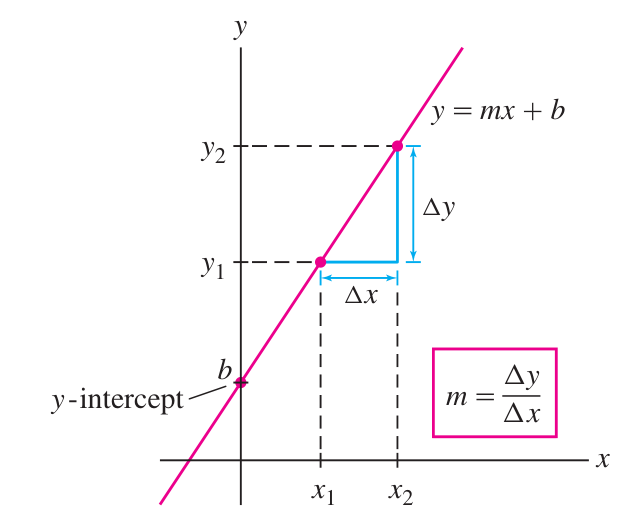
Linear functions have a formula like this called “point-slope form”:
They also have another formula called “point-point form”:
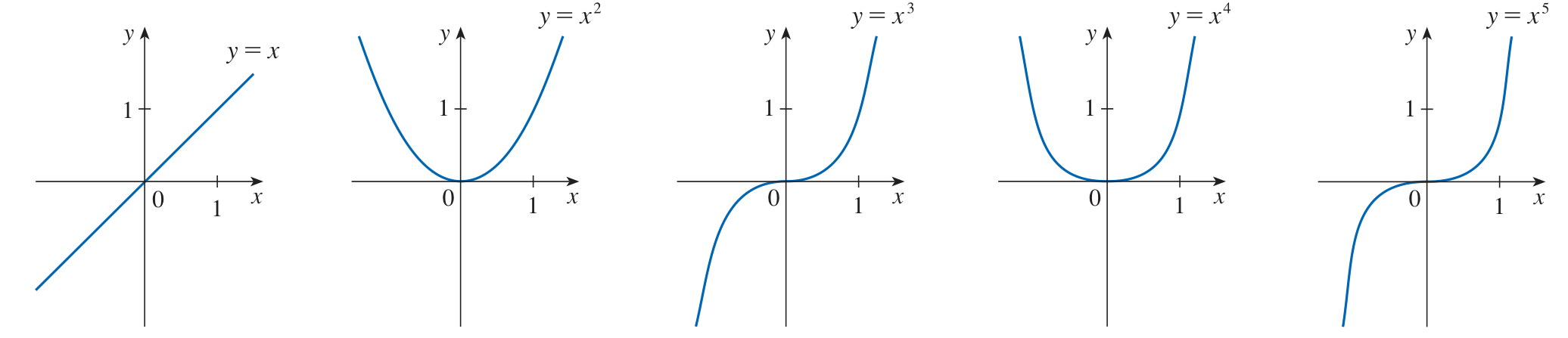
Power functions look like this:
Reciprocal function:
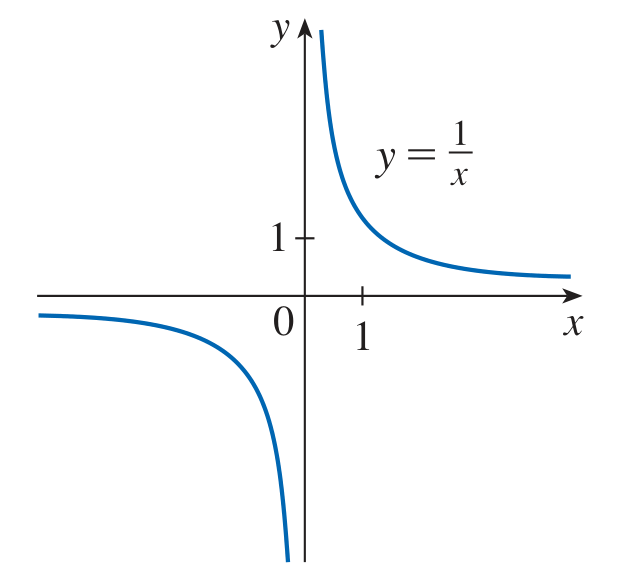
Quadratic polynomials
These are sums of power functions with terms up to . (As cubics have terms up to , quartics up to , and quintics up to .) General formula of a quadratic polynomial:
Sometimes it is convenient to write a quadratic function using vertex form:
This form reveals the vertex at , and describes how steep or shallow the parabolic arch will be.
You can translate between polynomial and vertex forms by completing the square. (Add and subtract the same item so that you get a squared linear term, above.)
Rational functions
These are just polynomials divided by polynomials, . For example .
Trig functions
The basic ingredients are and . Everyone (!) should memorize all the information in these pictures:
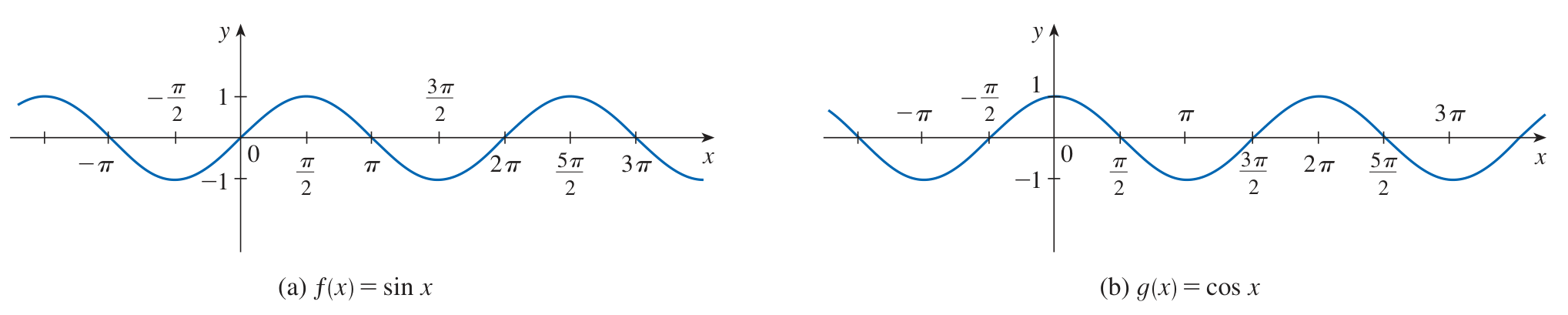
Something implied by the pictures is the periodicity (i.e. repeating pattern) formulas:
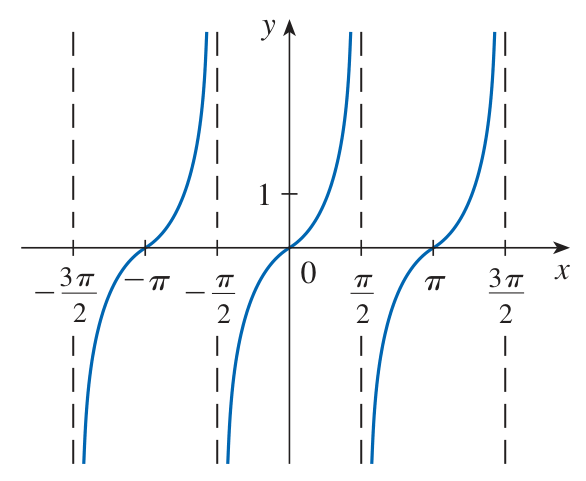
Sometimes the picture is helpful too:
Summary picture:
Simple transformations of functions
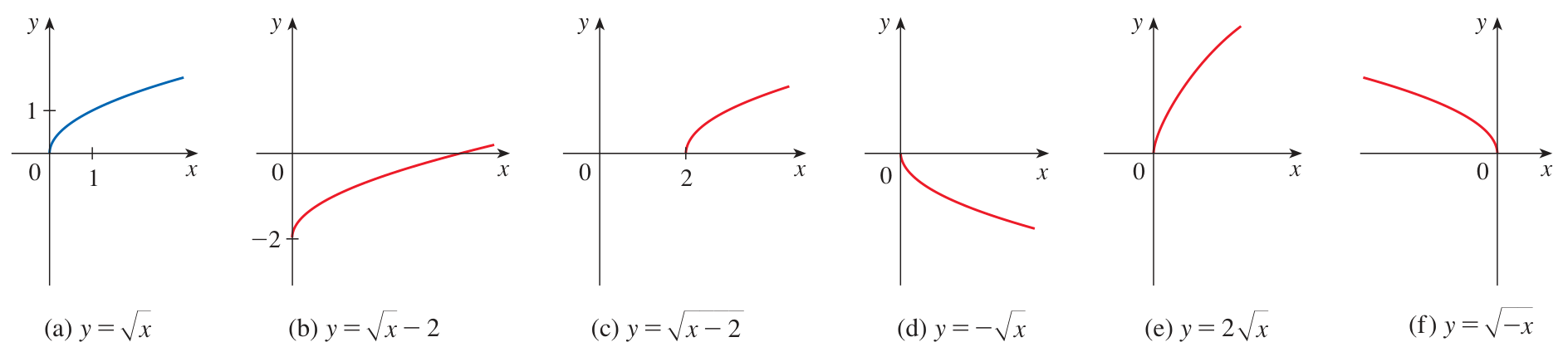
Functions (and their graphs) are easily shifted, stretched, or reflected in a line.
Examples:
Composite function notation
New functions can be made by combining old functions. It is easy to combine functions using an algebraic formula:
Functions can be combined by plugging the output of one into the input of another. This is called function composition. The notation for it is a circle:
One could say function composition is hidden inside many formulas when the algebraic operations are interpreted as functions: