Introduction
Vector spaces often come with additional product operations between vectors.
Dot product
The vector space (any ) comes with an inner product, also called the dot product or scalar product. Every inner product satisfies basic rules:
Algebraic properties
Component definition
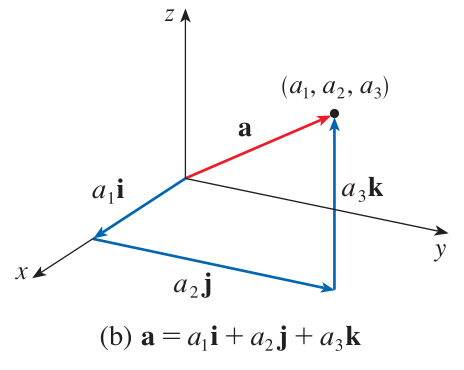
The dot products for and are defined using components:
Norm
The dot product of a vector with itself gives a number called the (norm or length or magnitude) squared:
The terminology is justified by the Pythagorean Theorem in :
Dot product (part 2)
Geometry
The dot product scalar provides information about the geometric relationship of two vectors.
where is the angle between and .
Proof: The rules for dot product imply that:
On the other hand, the Law of Cosines for the triangle with sides gives:
It is worth noticing that the norm determines the dot product:
The formula for has qualitative geometrical consequences:
- If then and are orthogonal (perpendicular)
- If then and form an acute angle
- If then and form an obtuse angle
- If then and are parallel
Dot product (part 3)
Unit vectors
A vector with is called a unit vector.
For example, are unit vectors.
Thinking geometrically, a unit vector carries the information of direction. One could call them ‘direction vectors’ instead.
Any vector can be renormalized to create a new unit vector by dividing out its length:
Some texts, especially in physics, use the notation for this unit vector .
Projection
The dot product is a quantity telling how much one vector aligns with another.
The dot product of two unit vectors is where is the angle between them.
One can use the dot product to find the components of a vector in the standard basis. Say is any vector. Then:
This is because .
More generally, one defines the projection of along (projection along the direction of ) using the dot product:
The scalar coefficient is called the parallel component of along . (Or, sometimes, is called the component.)
The projection points in the direction of , and it says how much of lies in that direction.
Another vector called the perpendicular component is given by subtracting the parallel part:
It is called ‘perpendicular’ because:
Dot product (part 4)
Cauchy-Schwarz inequality
The Cauchy-Schwarz inequality says that for any vectors , , we know:
Dot product (part 5)
The Cauchy-Schwarz inequality is very important in math. There is a version of this inequality in many other settings where it is harder to prove.
Triangle inequality
The Triangle inequality says that for any vectors , , we know:
Cross product
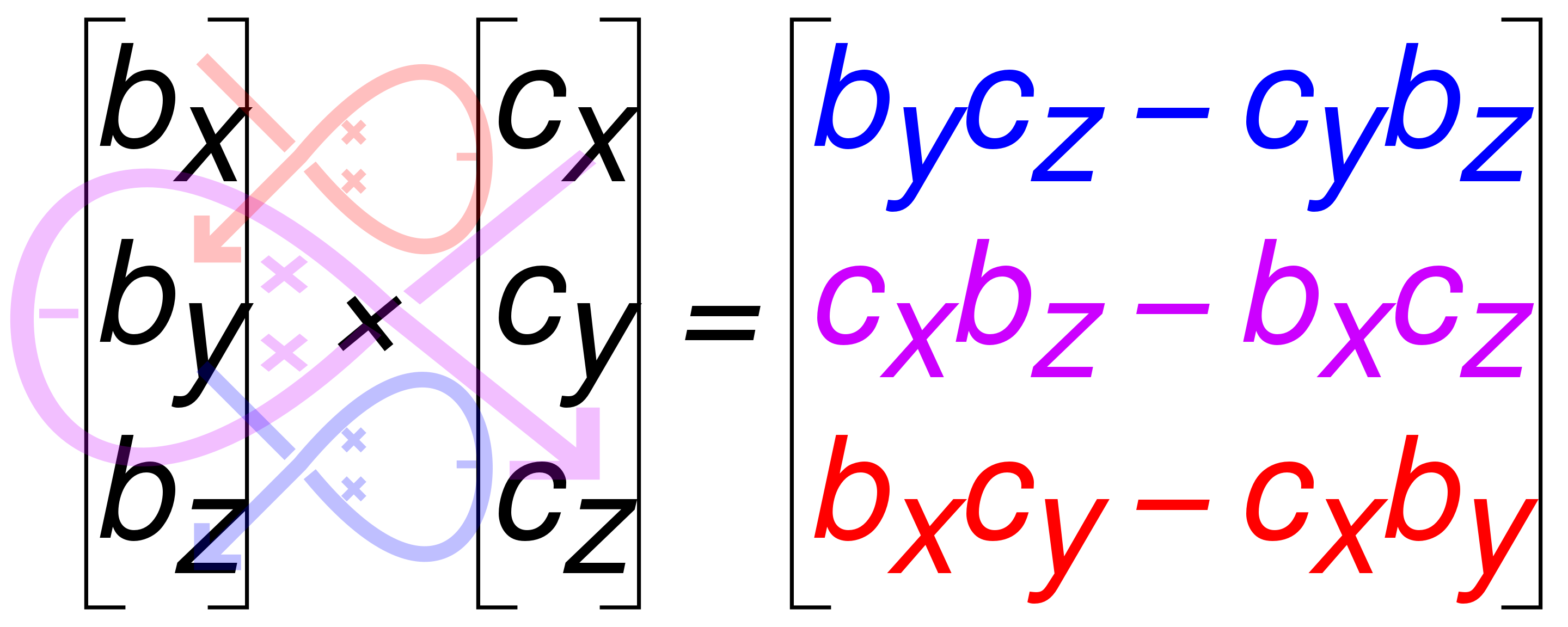
Another product is defined for vectors in called the cross product. It is also called the vector product. The simplest definition is in terms of components:
assuming that and .
There are some mnemonic formulations that can be helpful:
Or:
“Twist the others, minus in the middle.”
Or:
Or:
This is a determinant. The first row of vector entries should be treated as if scalars when taking this determinant.
Cross product (part 2)
Algebraic properties
The cross product is not commutative and not associative. But it does satisfy some relations:
- ( thus )
- ( thus )
- implies for some
Geometry
The norm of the cross product satisfies an angle formula analogous to that of the dot product:
The direction of the cross product is perpendicular to the plane spanned by and it creates a right-handed system when combined with .
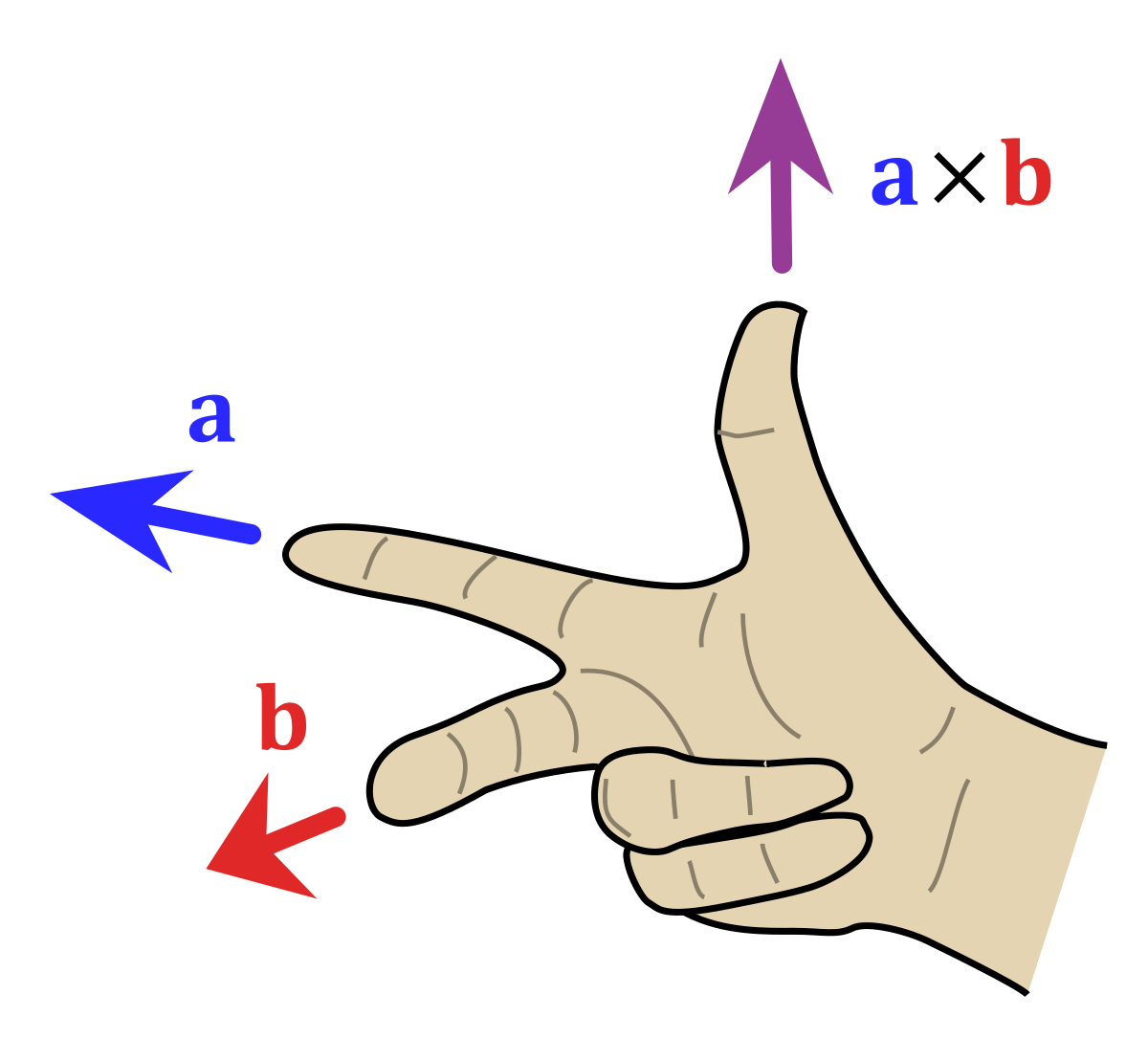
I.e. is right-handed.
The norm of the cross product is also the area of the parallelogram formed by .
Cross product (part 3)
Unit vectors
These products are right-handed. Left-handed products include a minus sign, such as .
Cross product (part 4)
Dot-cross norm identity
The dot product and norm of cross product satisfy a simple relationship:
This identity follows quickly from the angle formulas for dot and cross products.
Triple products
There are some general facts about products taken with three or more vectors.
Dot-cross triple product
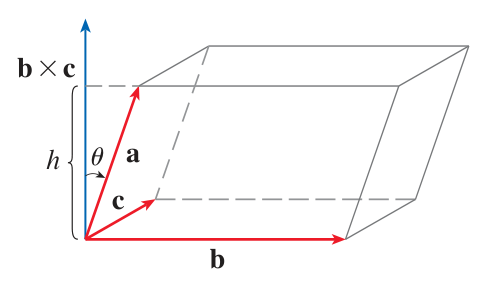
Given vectors , , , consider the scalar quantity . By combining the effect of the dot product with the determinant formula, we have a determinant formula for this scalar:
and this formula immediately implies equalities among possible triple products:
(To figure the signs: right-handed triples are equal, and left-handed triples are equal, and right and left differ by a sign.)
The determinant formula also implies a geometric interpretation of the dot-cross product: is the volume of the parallelepiped spanned by , , .
Cross-cross triple product
Given vectors , , , we can form the triple product . (One should maybe not try to think about this product geometrically. It does arise in electromagnetism.) There is a useful shortcut called the Lagrange triple product identity for computing this product:
The abnormal order on the right (vector then scalar coefficient) facilitates a famous mnemonic: “Bac–Cab”.
Triple products (part 2)
Non-associativity
While the cross product is not associative, the difference has a simple expression using the dot product:
This identity can be proved using the Lagrange triple product identity.