Introduction
A scalar line integral is the integral of a function over the length of a curve.
A line integral sums the values of a scalar function on space multiplied over the length of some curve in space. This would be an ordinary integral if the curve were stretched out onto an -axis and the function values plotted on the -axis.
Line integral with parametrization
Suppose is a function on space with values given by , where are the coordinates of the input point in space. Suppose a curve is the image of a parametric curve given with component functions by , and assume is traversed exactly once by . Then we compute the line integral of over using the formula:
This formula uses our expression for infinitesimal distance traveled:
Rigorous definition idea
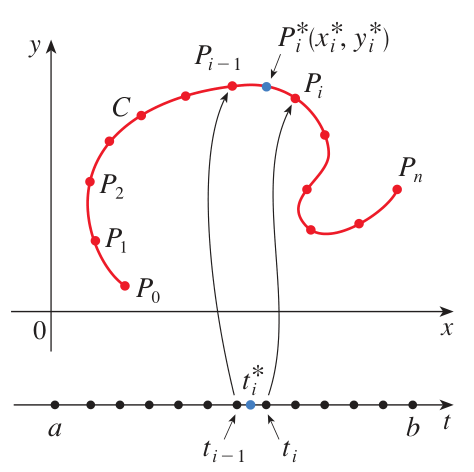
A rigorous definition of the line integral would divide the curve into segments joined at the points , with segment length , then take the Riemann sum:
and finally take the limit as the number of segments goes to infinity.
Line integral with arc length parametrization
If we start with a curve parametrized by arc length, the line integral is very simply given by:
where is a scalar function of points in .
In fact, the line integral is sometimes called the line integral with respect to arc length.
Line integral with respect to , , or
A related construction is the line integral with respect to some coordinate. For example, the line integral of over a curve with respect to is given by the formula:
Sometimes a sum of such integrals is written with shorthand notation as a single integral:
When is traversed by , this shorthand can be remembered with formulas using Leibniz notation: