Rectangular domains
Suppose we are given a function , written in terms of components by for each . Now let the second coordinate remain some arbitrary fixed value . This determines a function of one variable, , for each possible chosen .
We can integrate in just as any other function of :
The resulting quantity depends on the chosen , so we call it a function of , and it also depends on the chosen interval .
Now we can let vary again, and integrate the function :
It is reasonable to notate the composite process with two integration symbols:
There is no reason we couldn’t integrate first, and this raises an obvious question that is answered by Fubini’s Theorem:
Fubini’s Theorem
Provided is continuous on , the order of integration doesn’t affect the result:
Non-rectangular domains
Notice that the first integral places constants and as limits of integration, but is also considered a constant with regard to integration by . So, we can allow the limits to depend upon in a non-trivial fashion: we can let them be functions of the chosen and write: , .
Now let us incorporate these functions in the double integral notation. Instead of using the symbol , we can write , remembering that in the first integral is treated as a constant, on a par with and :
Volume under a surface
Consider the iterated integral , and the picture:
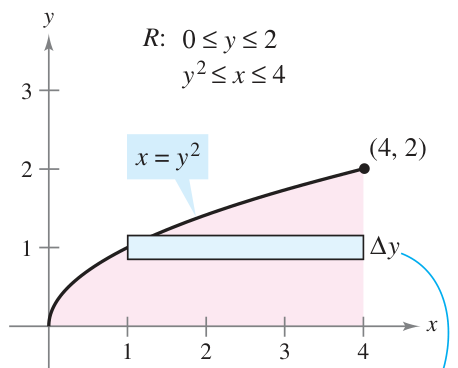
The inner integral produces a function . Given a value of , this function returns the integral over the line segment given by with and set to the given value.
Imagine we set , in this case . Then the inner integral provides the area under the curve over this line segment.
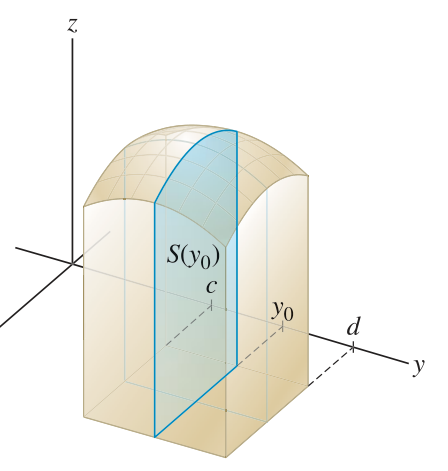
Computing the outer integral then gives the volume of the region between the bounds , , and . It does so by computing the area of the vertical slices as a function of , and then integrating this area as varies over its own domain .
Order of integration
When the inner bounds of integration are functions, in order to change the order of integration we must consider the region over which the integral is taken, and define new functions for the new inner bounds.