Introduction
There is a relation between the concepts of linear approximation, partial derivative, tangent plane, and differentiability. This relation is contained in a function defined in terms of :
Linear approximation function
The linear approximation function includes both partial derivatives and . The set of points satisfying defined by the above equation, namely the graph of , is the tangent plane. Lastly, the function is said to be differentiable when:
with two functions and satisfying as .
If is not differentiable, then the linear approximation may be a bad approximation.
Linear approximation in 2d
Remember that for a function of a single variable, we have the linear approximation:
The tangent line to at is given by , and is considered differentiable when such that as :
Tangent plane via tangent lines
How do we know that the graph of gives the tangent plane?
The tangent vector to the trace at is given by . So the tangent line is given by:
These points satisfy . The graph must be the tangent plane because it is the unique plane such that the tangent lines of the trace curves and lie in this plane.
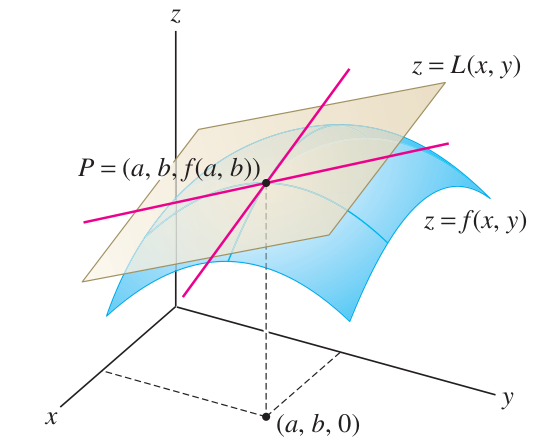
Taylor series and linear approximation
Linear approximation gives the first two terms of the Taylor series of a function, and the remainder term, captured in , must limit to zero when the function is differentiable:
If agrees with its Taylor series, then:
Differentials
Some authors use the mnemonic notation of finite differentials for applications of linear approximation. These are written as , , , , etc., even though they are not infinitesimals. Their usage is according to the following kind of rules:
Differentiability
In 2d, a function is differentiable precisely where its derivative exists. The situation is not so simple in 3d: a function like has both partial derivatives at , but it is not differentiable there! On the other hand, one theorem does help:
Theorem
If a function is given and both partials and exist and are continuous at a point , then is differentiable at .
Differentiability (part 2)
Differentiable, but partials aren’t continuous:
The function is differentiable at since it is approximated by its tangent plane at . The partials are not continuous there! You may check this by computing and . You can also compute , which is not continuous at .