Chain rule over a curve
Suppose is a real-valued function on the plane, and is a parametric curve. There is a recipe to compute the derivative of the composite function :
Chain rule over a curve (part 2)
Derivation of chain rule over a curve
Let’s suppose that some small change produces a change and via the parametrization . By differentiability of , we have:
Divide both sides by , and take the limit as . Notice that and because implies . It follows that we have:
So the sum of products in this chain rule comes from the linear approximation formula, which in turn comes from the tangency of the trace curves.
Chain rule over several parameters
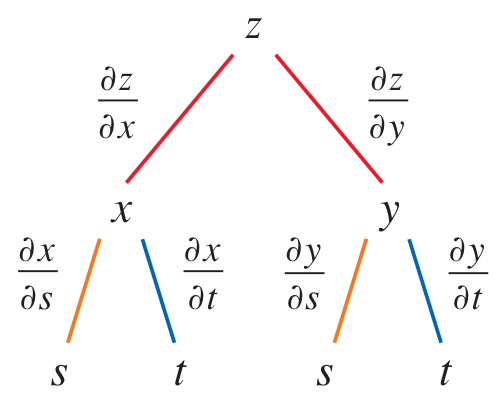
The chain rule over a curve can be used to derive a more general chain rule for the case when the input variables are functions of several parameters. The formulas can be remembered as “sum of all products” (considering all products that make sense).
Suppose is a function, and suppose and are both functions of and . We can “consider” itself to be a function of and via the composition. Then:
These formulas may be derived immediately from the formula for the chain rule over a curve by considering the trace curves: let remain fixed for the first equation, and let remain fixed for the second equation.
Chain rule over several parameters (part 2)
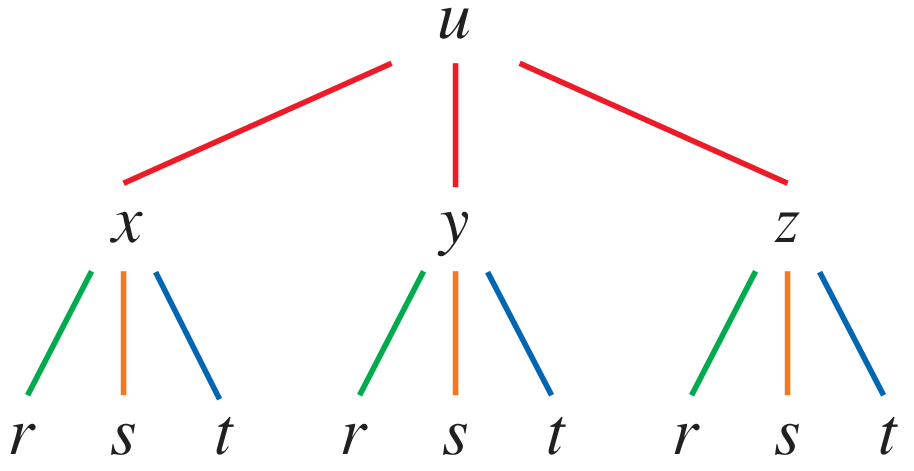
It is easy to generalize the chain rule to an arbitrary number of variables and parameters. Formally, the rule is:
where is a function of many variables, and each is a function of many parameters.
To remember the formula, it sometimes helps to draw a tree. The summation has one term for each path from the output variable down to the relevant input variable: