Introduction
The partial derivative gives the rate of change of with respect to the variable .
Think of as a coordinate that moves the input to the function along a line . The partial gives the rate of change of with respect to this coordinate.
We can move along other lines, at other speeds. Let be any vector in the -plane. Consider the line that starts at and moves along using the parameter . We can take the derivative of with respect to , and the result is called the derivative of with respect to the vector . Here is the defining formula:
where we write for the components of .
Observe that the directional derivatives and with respect to the unit vectors are identical with the partial derivatives and . (Plug in into the limit formula above, for example.)
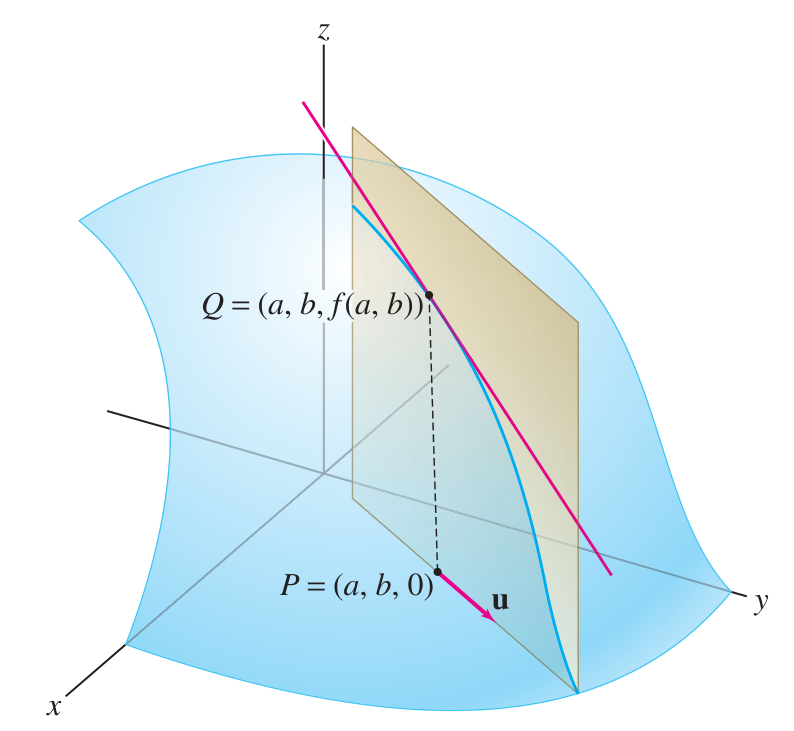
Introduction (part 2)
Lengthening the direction vector
Notice that the derivative of with respect to a vector is twice the derivative of with respect to . This is because the line is the same line as but traversed twice as quickly.
Calculating directional derivatives
We can use the two partial derivatives and to calculate for vectors other than coordinate basis vectors and . Recall . Use the chain rule instead of the limit definition to compute:
Introduction (part 3)
Unit vectors?
Many authors treat directional derivatives as if they only make sense with respect to unit vectors: . If you are interested in the analogue of partial derivative for other directions, you will want to take unit vectors. It may be reasonable to reserve the word ‘directional’ for this case, but it is certainly beneficial to allow the notation to extend to vectors that do not have unit length.