Introduction
In what follows we study a 2D version of the Fundamental Theorem of Calculus called Green’s Theorem. The 1D integral over the -axis is upgraded to a double integral over a 2D region . The derivative is replaced by a new kind of derivative called ‘curl’. The difference taken on the boundary of the 1D interval is upgraded to the line integral taken around the boundary of the 2D region .
Curl as derivative operator
Start with a vector field with vector components , where and are functions of points in space.
From this we create a scalar field called the scalar curl of , written . This field is calculated with the formula:
One way to remember this formula is to create a vector-derivative-operator with components , and then take the cross product “”, applying and to the function components of . (Interpret and as 3D vectors with zero -component.) The result is a vector with only a -component. The subscript indicates that we are just taking the scalar value of that -component.
Curl as measure of circulation
The scalar curl field can be explained as a measure of circulation of the vector field around each point in space.
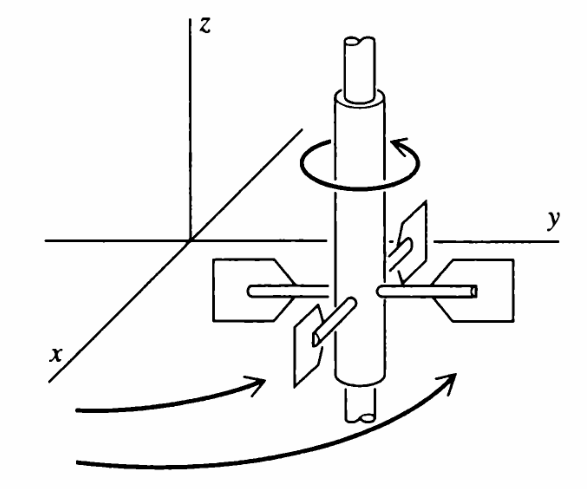
It is good to understand how this works. Below we calculate the circulation of around a small box. In a Problem, you calculate the circulation of around a small circular loop.
Consider a small box with bottom left corner at a point in the plane, and sides of length and . Label the sides with subscripts for left, right, top, bottom as in the picture:
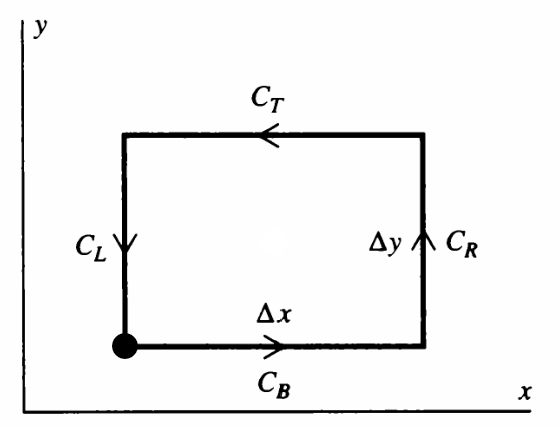
The ‘circulation’ we wish to calculate is the aligned vector line integral around this box:
Break this into four integrals, one over each side of the box. Define parametric curves traversing each side, with for each case:
- For side , take .
- Observe that and .
- For side , take .
- Observe that and .
- For side , take .
- Observe that and .
- For side , take .
- Observe that and .
Notice that on , and the others simplify in a similar way because of the zeros in the vectors.
We are considering small boxes , and we will in fact take a limit as the sides go to zero. It is appropriate to use the linear approximation for each component and on the box, with differentials from the point . This lets us write the circulation integral in terms of and , evaluated at the point ; these appear in the curl formula we are trying to explain. Write for the components of .
- For side , we have .
- For side , we have .
- For side , we have .
- For side , we have .
Now plug everything in and compute four integrals in :
Simplify this by cancelling some terms and combining some others:
Notice that is the area of the box. The bigger the box, the greater the effect of circulation.
The scalar curl is the limit of the ratio of circulation to the enclosed area, for boxes shrinking to zero: