Introduction
Green’s Theorem expresses a relationship between circulation around the boundary and infinitesimal circulation in the interior. (Infinitesimal circulation is the curl times ). It says that adding up all the infinitesimal circulations gives the boundary circulation.
This relationship, considered from another angle, is connected to the idea of path independence. Consider two particle paths travelling between the same start and end points. Write for the first path, parametrized by , and for the second path, parametrized by . Write for the starting point, and for the ending point.
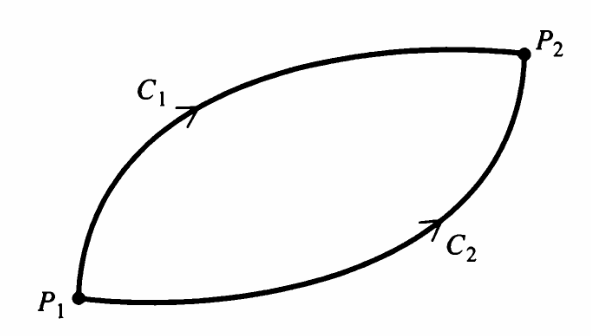
Now consider the question: do the line integrals and have the same value for these two paths?
The vector field is said to be conservative or path independent if the answer is yes, and path dependent or non-conservative if the answer is no.
Consider the question more quantitatively. What is the value of the difference ? In fact, this difference is the same as the sum of line integrals around a closed loop starting and ending at . The complete path is written as :
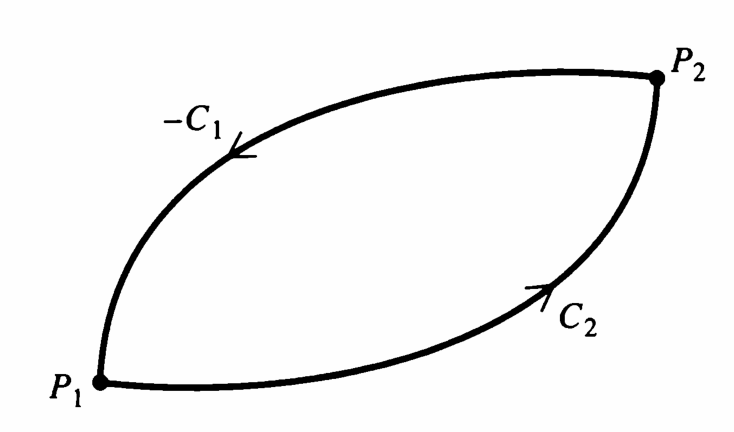
(Here the path is the same path as but traversed in the opposite direction.)
By Green’s Theorem, the integral of over the region between the two paths gives the difference . In particular, if (in some region), then by Green’s Theorem the line integral from to does not depend at all on the path taken! (Provided the path remains in the region where .)
Path independence is also connected to the gradient:
Introduction (part 2)
Simply connected regions
Path independence is equivalent to only for simply connected domains. These are domains without any holes, meaning that any loop can be tightened down to a point in the domain.
If there are holes, then it is possible to construct a field in the part of the domain outside the hole, such that there, but path independence is no longer strictly valid. Paths that wrap around the missing hole can have different line integrals. In fact, the line integral measures the number of times a path wraps around the hole. Two paths that wrap the same number of times differ by some enclosed region outside the hole where , so the line integrals on these paths must agree!