Introduction
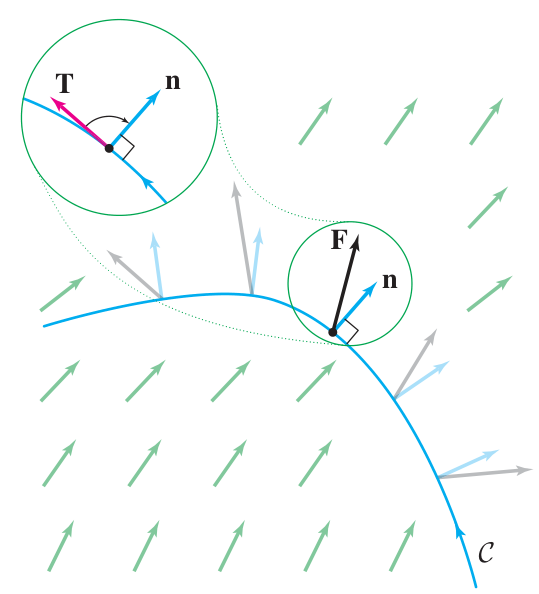
The across vector line integral is the integral of a vector field over a curve according to its alignment with the normal vector to the curve. It measures how much the vector field flows across the curve. It does not depend on the chosen parametrization (i.e. on the speed), but its sign depends on the direction traveled along the curve. It is given for a parametric curve that traverses its image one time, together with a vector field , by the formula:
Here is a scalar, and is after rotating clockwise by . If , then , and . Also .
The integrand is the scalar projection of onto the direction perpendicular to the curve at each point on that curve. (The positive direction means: rotate the orientation of clockwise by .)
The quantity computed by this line integral is sometimes called the flux across the curve.
This line integral is defined for curves in the plane, since the normal vector defined as a clockwise rotation of only makes sense for plane curves. (Rotation around the -axis.) In 3D, one computes the flux across a surface, and the “across vector line integral” is replaced by an “across vector surface integral”. On the other hand, the “aligned vector line integral” does make sense in 3D (or D).