Vector curl
We define a vector version of the curl:
Each component of gives the circulation around a small circle in the plane of the other two components. This data combines the information of circulations in each coordinate plane into a single vector.
Vector curl (part 2)
The direction of is the direction of a normal vector to the plane of strongest rotation. The magnitude of is the strength of rotation in that plane. The right-hand rule applies: the direction of will point along the thumb when the fingers curl in the direction of strongest rotation.
Checking the interpretation
To check these claims, one would have to set up a calculation of the circulation in the plane perpendicular to an arbitrary vector . This would be very technical and tedious. An easier argument, the details of which we also omit, is to show first that the circulation in the plane perpendicular to a sum of vectors equals the sum of circulations in the planes perpendicular to and , respectively. It would follow that the circulation in the plane of is the dot product of with the curl. Then the final claim is established with the same argument that shows that a gradient vector points in the direction of steepest incline.
Stokes’ Theorem
Given a surface with normal vector giving the orientation, apply the right-hand rule with thumb along to find the direction of local rotations on . Place this near a boundary point in to find the compatible orientation of the boundary.
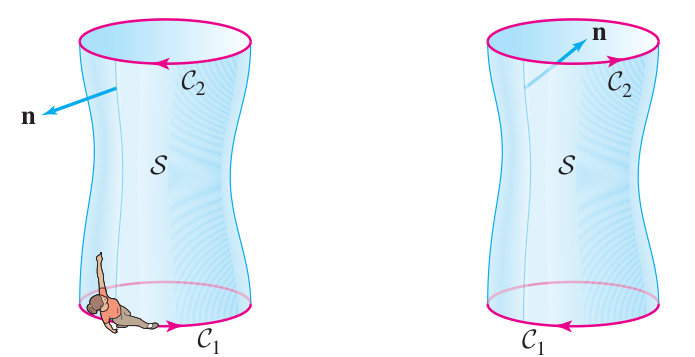
Stokes’ Theorem in 3D
For any surface with boundary (with compatible orientation), we have:
Path independence
The arguments about conservative fields in the plane apply to conservative fields in 3D space. Instead of a region in the plane enclosed between two paths and , we use a surface in space that is bounded by the two paths and .
In any region in space, these conditions are equivalent:
- is path independent,
- for some scalar field .
These conditions imply the following condition:
- .
When the region in space is simply connected, the curl condition also implies the gradient and line integral conditions. If, conversely, the region has some holes in it, then it is possible for the first two conditions to fail even though the curl is zero everywhere (outside the holes).
Same curl? Differ by a gradient field.
When the region is simply connected, if two vector fields and have the same curl, i.e. , then they must differ by a gradient: for some scalar field . This is because , so for some .
Surface independence
We know that is path independent if and only if there is a scalar field such that . This fact about 1D paths can be upgraded to an analogous fact about 2D surfaces, with gradient replaced by curl:
Surface independence for curl fields
Suppose the vector field arises as the curl of another field , so . Then for any two surfaces and which enclose the same boundary curve , the vector surface integrals agree (by Stokes’ Theorem), and can be computed as the line integral of around :
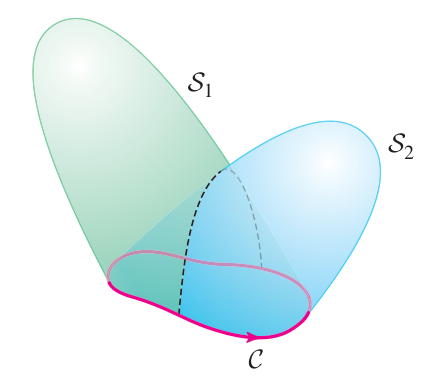
In this situation, the generating vector field is called the vector potential, by analogy to the scalar potential for a gradient field .
An important difference between and , though, is that must be constant when , while need not be constant in a region where .
The vector potential and the idea of surface independence play an important role in the theory of electromagnetism. One of the most famous phenomena in quantum physics, the Aharonov-Bohm Effect, involves a mystical connection between the mysterious vector potential of the magnetic field and an equally mysterious “complex phase” of the quantum wave function. (It is a mystical connection between mysterious entities because the traditional set-up of the physical theories suggests that the vector potential and the phase of the wave function are not physically real, but instead they’re arbitrary mathematical abstractions that partially describe the structures of the electric field and the quantum measurement probabilities, respectively.)