Separable ODE
Separable ODE
Problem: Solve the equation .
Solution: The given equation can be writtenIntegrating both sides, obtain
Applying on both sides:
Applying the exponent sum rule and writing , we get
Here because for any . However, we can allow by removing the absolute values. So that family of functions is the same as this family:
Note that the solution, , is valid but isn’t generated by separation of variables because of the division by that was performed in the first step.
Integral curves
Integral curves
Problem: Solve the separable ODE:
Solution: Rewrite this as:
and integrate both sides to obtain:
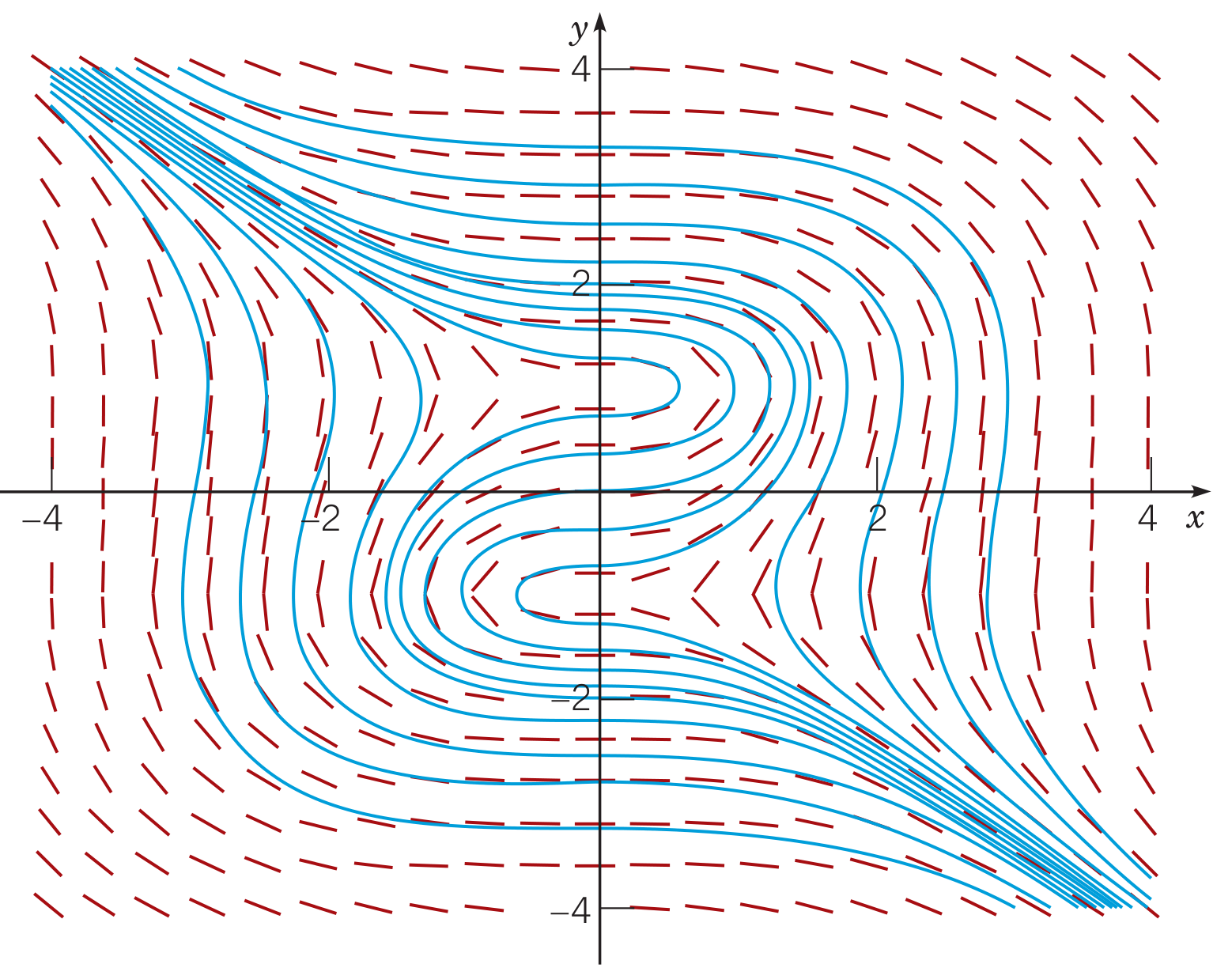
This equation specifies a family of integral curves. For the integral curves, we do not need to solve for in terms of . Here is a depiction:
First-order linear
First-order linear
Problem: Solve the equation:
Solution: First divide by to recover the standard format:
Now the integrating factor we need is . Multiply everything by this factor:
If everywhere, we can drop the absolute value signs obtaining . If everywhere, we would need to introduce minus signs (recall that and when ), obtaining ; but this we can multiply by and obtain the same equation, namely:
Let us solve this and come back later to consider the possibility of changing signs.
The sum on the left is the output of the product rule: . Now integrate in to find a family of solutions:
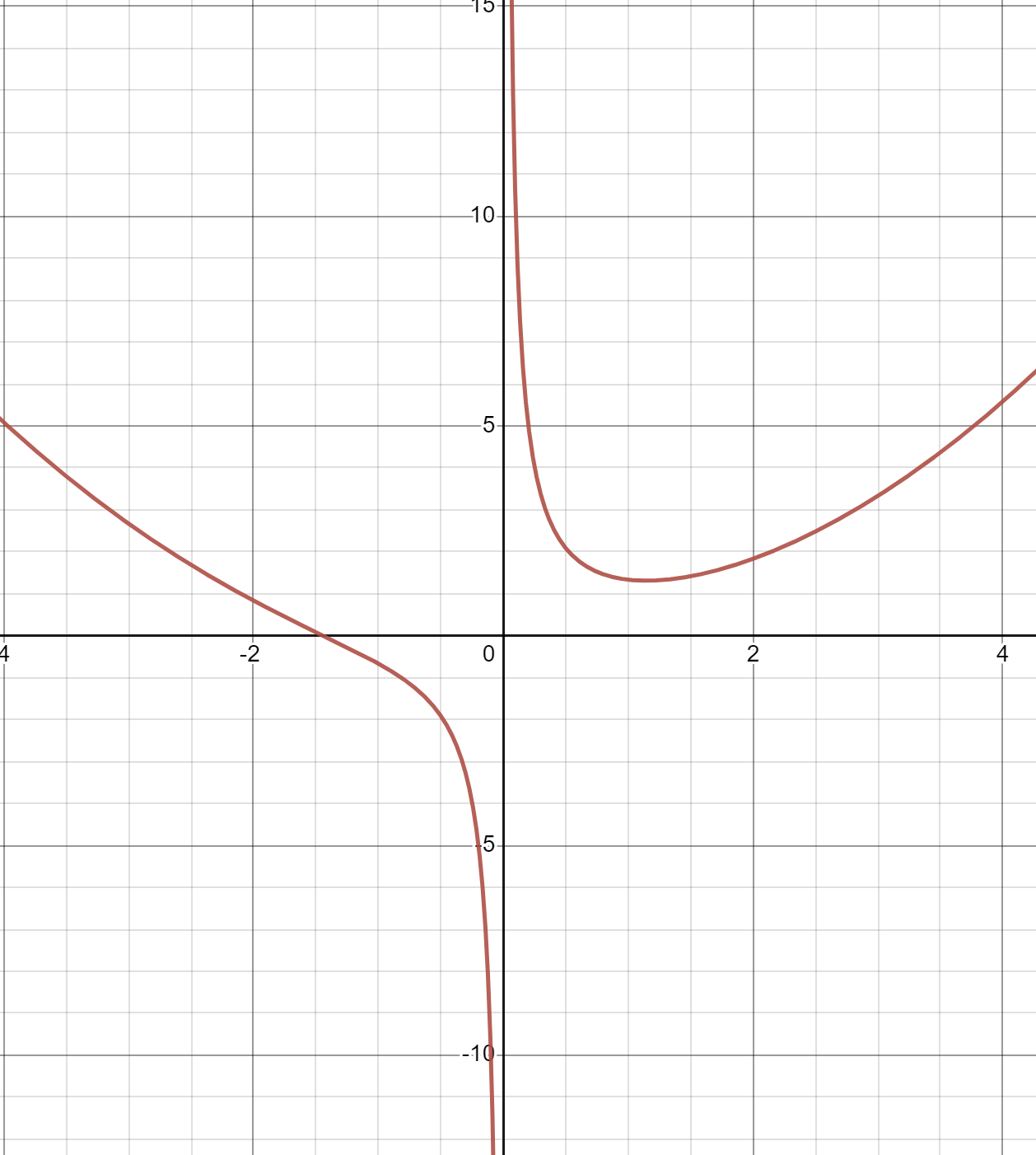
This family, for various values of , is our proposed solution to the ODE.
Now reconsider the absolute values. Suppose . If we take a solution curve with , then the entire curve will satisfy because as . Similarly, if we start with , then as . No solution crosses over . Now if we can say the same thing but with and , respectively, instead. Therefore our analysis using cases and is justified.
Solving an exact equation
Solving an exact equation
Problem: Solve the ODE:
Solution: First we check that :
Now we seek with and . First integrate in :
where the “constant” can be any function of . Now , so and . Therefore our solution family of integral curves is given by:
for .