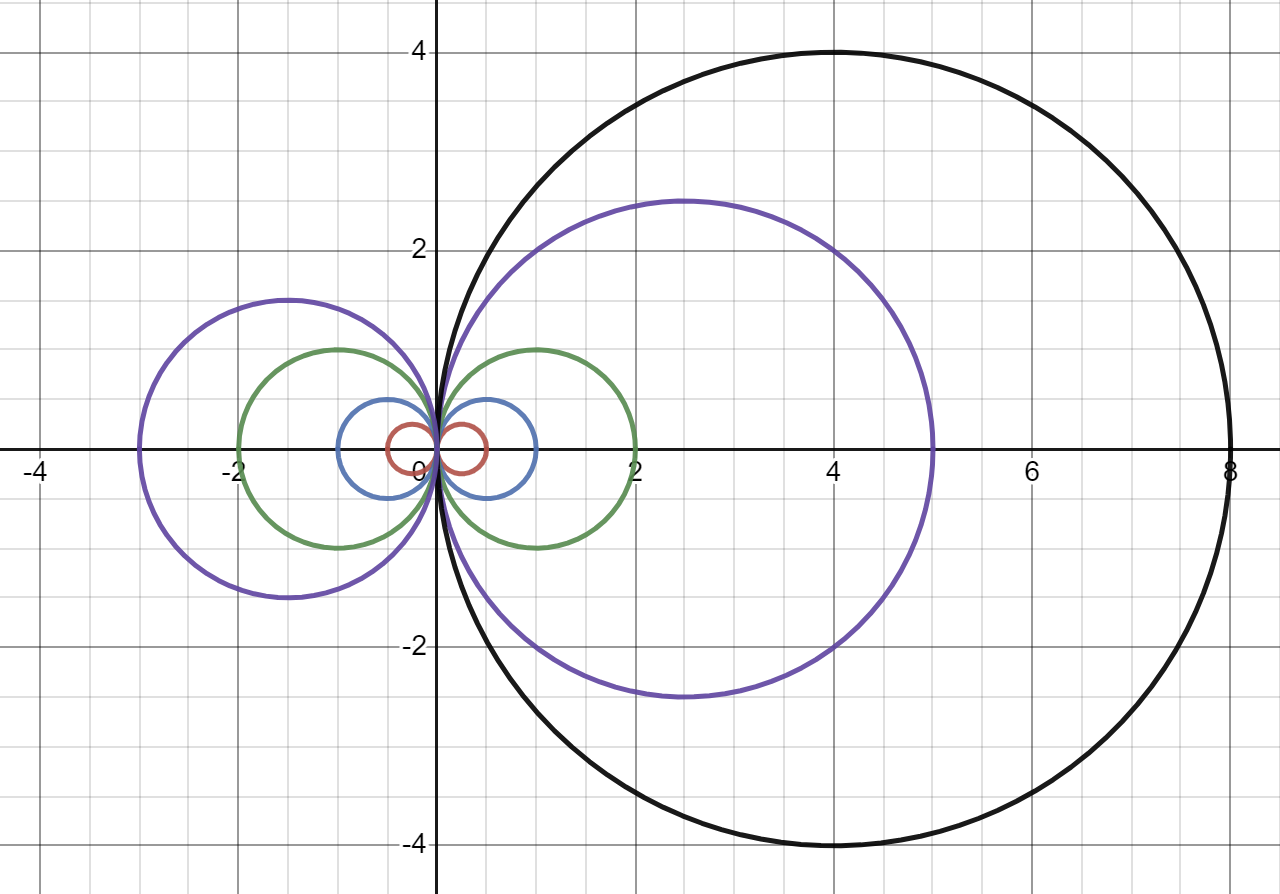
Family of curves x squared plus y squared equals cx
Family of curves
For example, start with the family given by .
Differentiate both sides: . Now plug in from the original equation, and we get the differential equation:Conversely, let us solve this differential equation. Write it as:
This is a homogeneous equation, so we can substitute :
Integrating both sides, applying , and substituting gives:
Now multiply the fraction by and cross multiply to obtain , which is equivalent to assuming . Allowing , we have the original equation.
Circles and rays
Circles and rays
We verify that the family of rays emanating from the origin is the orthogonal family to the family of circles centered at the origin. The family of circles is given by . This corresponds to the differential equation . The orthogonal family is then given by . Separating variables: so and thus for . This is the family of rays.