Fourier series basics
A Fourier series looks like this:
The constants and are called Fourier coefficients. The summand terms and are called Fourier components or frequency components. They represent sinusoidal contributions with frequency .
A Fourier series can be viewed as having two parts, the even part and the odd part:
Even and odd functions
An “even” function satisfies , while an “odd” function satisfies .
- So is even, while is odd
- Sum rule: while
- Product rule: and while
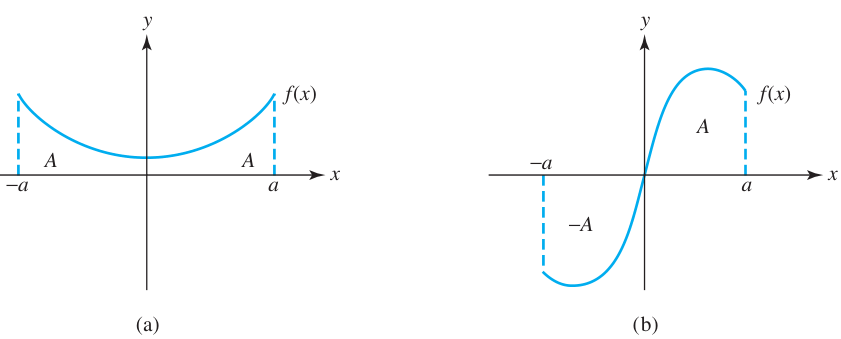
Given any function , we can write it as a sum of even and odd parts. Let , and . Then is even, while is odd, and .
Even and odd parts are uniquely determined
If then is both even and odd. But if and then and necessarily .
Fourier series basics (part 2)
Periodic functions
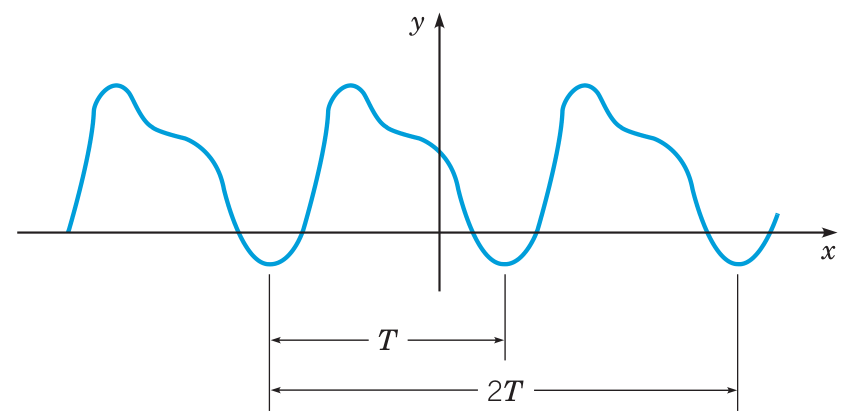
- A periodic function satisfies for some constant period .
- Trig functions are periodic with period . Fourier Series are also periodic, by default with period .
- Periods can be stretched or contracted by changing variables for some . For example if has period , then has period .
- Periodic functions are completely described by their restrictions to a single period cycle. For example and are determined by their values on the interval .
Even and odd periodic extensions
It is sometimes useful to take a function defined on a half interval like and extend it to a function defined on the whole interval , and from there to all of as a periodic function with period .
Even periodic extension:
Odd periodic extension:
Fourier series can be used to approximate many other functions. These functions should be either periodic functions on , or else defined or considered only on a finite interval . (Fourier series can be shifted and scaled to accommodate intervals other than .)
Fourier series convergence
If is a function for which and are both piecewise continuous, then a Fourier series is determined which approximates .
This series converges to the exact values at points where is continuous, and converges to the average of and at points where is discontinuous.
Fourier series also converge in many other cases, for example for all functions of bounded variation, such as any difference of monotone functions.
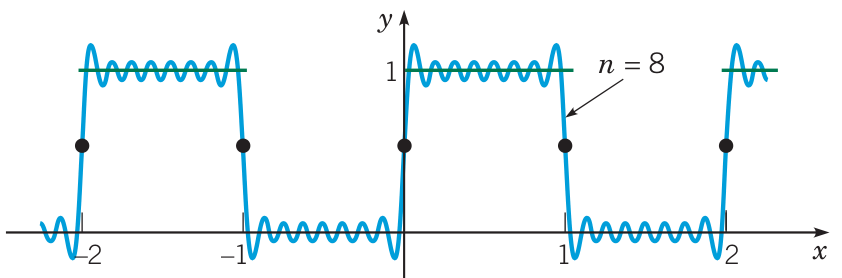
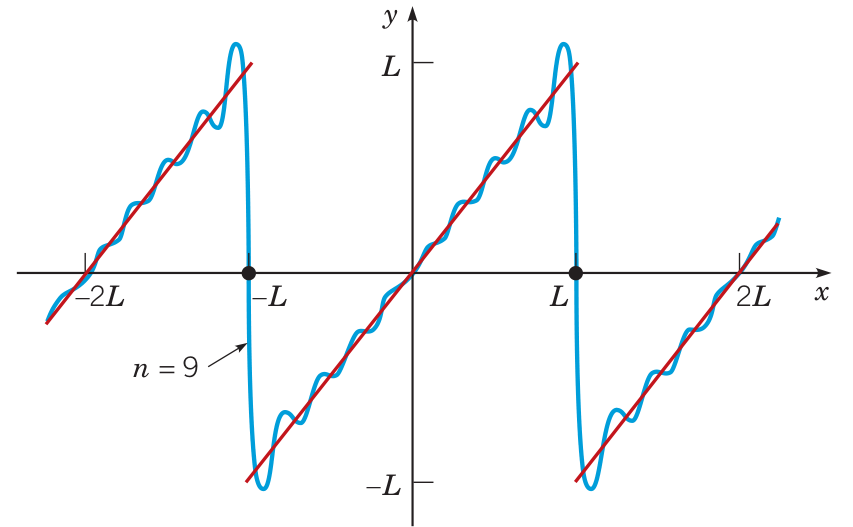
Fourier series are frequently used to reconstruct “signals” in electronics, for example, the square wave or the sawtooth wave:
Try approximating a variety of signals on this Mathlet:
https://mathlets.org/mathlets/fourier-coefficients/
You can turn on the “Distance” number which quantifies the approximation error.
For Signal A, using only Odd terms of the Sine series, I was able to get the error distance to . Can you beat it?
Gibb’s phenomenon
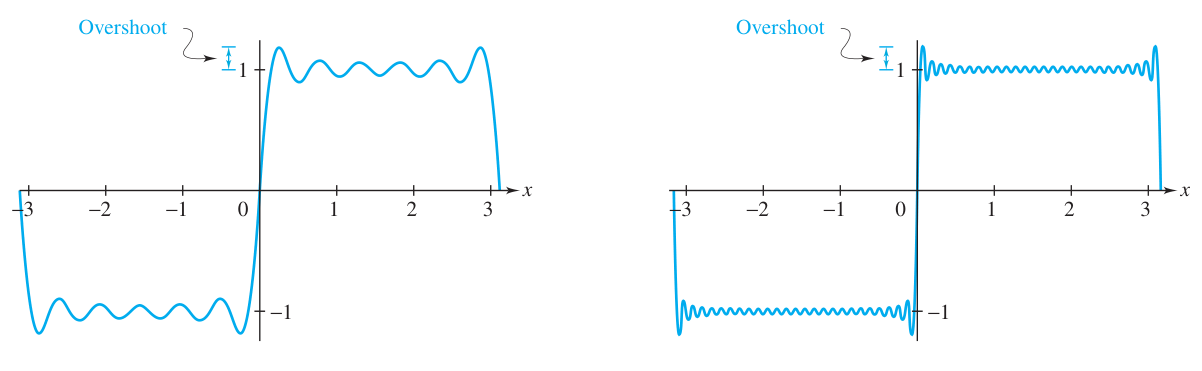
When is not continuous but only piecewise continuous, it can happen that Fourier convergence is not uniform across the interval.
The Gibb’s phenomenon is illustrated at the corners of the square wave. In this case of the Gibb’s phenomenon, overshoot remains at 9% regardless of the number of Fourier components used.
Fourier series - orthogonality relations
The terms of a Fourier series have an orthogonality property that is essential for their study. This property allows one to compute the Fourier coefficients quickly, and to show that Fourier partial sums give good approximations.
Define an inner product on pairs of functions as follows:
This product behaves like a dot product, having linearity in each input as well as symmetry:
- Symmetry:
- Sums:
- Scalars:
Two functions and are said to be orthogonal when . The norm of is defined as .
An important feature of Fourier components is that they constitute an orthogonal set of functions, as summarized in the following facts:
Another way to put this orthogonality: any pair of Fourier components and satisfies
Here and could be any of or for any .
Fourier series - orthogonality relations (part 2)
Using the inner product, we can easily find the Fourier coefficients of a given function that has a Fourier series.
If , then:
For comparison: orthogonal bases and coefficients
These formulas should be compared to the basis representation of a vector using orthogonal projections.
Suppose are orthogonal vectors, and we have a linear combination representation of :
Then by taking the dot product of both sides with , we have:
Comparing to the notation of the Fourier series, and are like the vectors , the fraction is like the fraction , and the dot product is like the inner product or .
The main novelties are: (i) the even and odd components of Fourier series, and , are written separately, and (ii) Fourier components constitute an infinite list of items.