Simple topology - connectedness
Simple topology - connectedness
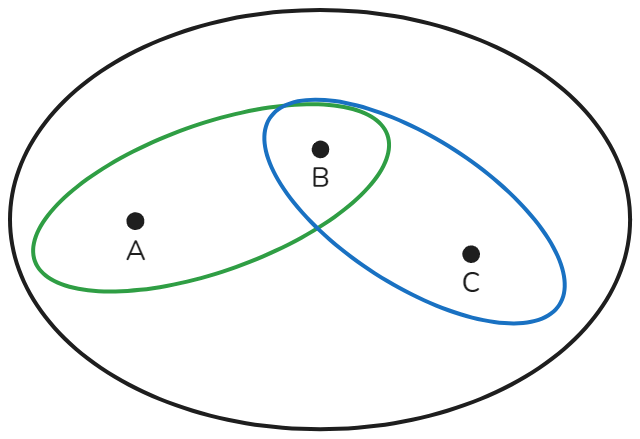
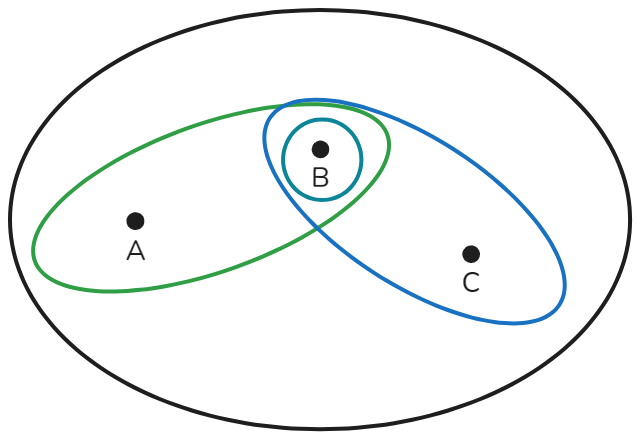
Three points: , with two (nontrivial) open sets.
This is not a topology because the intersection is not open:
This is a topology, and it is connected:
Continuum - real number interval
Continuum - real number interval
The standard topology structure for real numbers is generated by open intervals .
(“Generated”: it is the smallest topology structure containing all such intervals.)
In D, the open sets are generated by open boxes or (equivalently) open balls .
Open in S but not in R2
Open in but not in
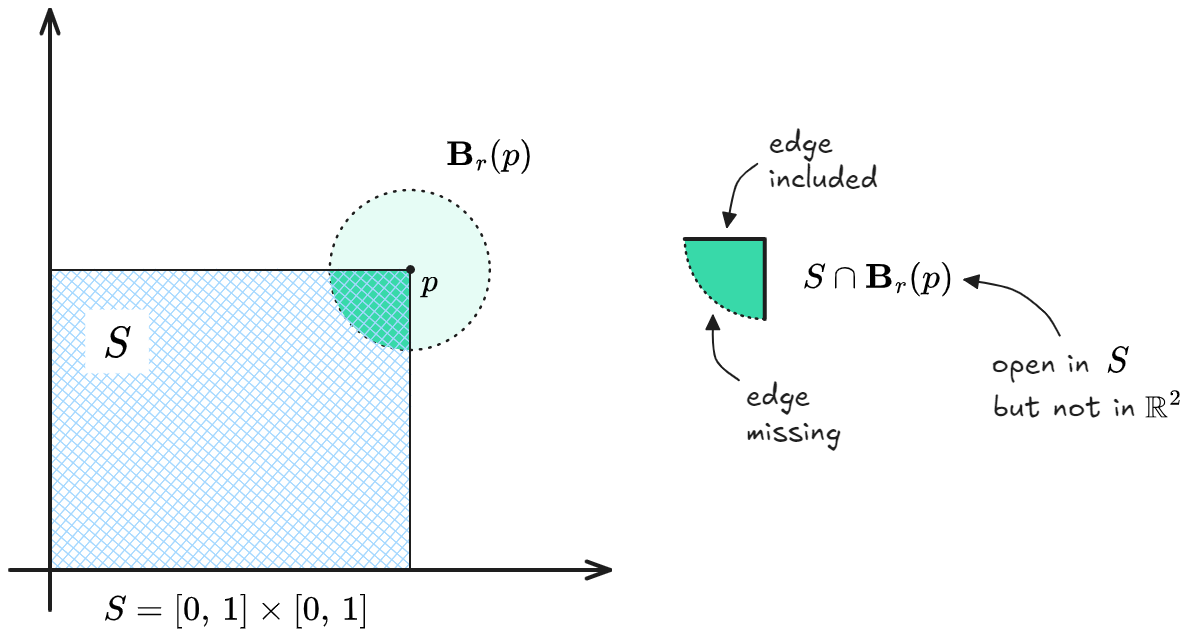
Consider the subspace equipped with the subspace topology inherited from the topology structure on :
An open set in may be given as the intersection with a ball in , but this set is not open in because the top and right edges would be included. No open ball can be found around a point in this edge and contained in .
Open-set continuity agrees with epsilon-delta continuity
Open-set continuity agrees with - continuity
Assume that is continuous according to the topological definition.
- Select any . Let be given.
- The interval is open.
- By the topological definition of continuity, the preimage is open. It contains .
- By the Lemma for metric space continuity, find an open ball around inside .
- This ball is an interval .
- All elements of this interval are mapped into , confirming the - condition.
Assume that is continuous according to the - definition.
- Select any open set. We must show is open.
- Select any . Define .
- Then , and so for some by metric space continuity.
- This is an interval:
- By the - definition of continuity, produce some so that:
- Therefore, whenever , we know .
- So is open (by definition), is contained in , and contains , confirming the topological continuity condition.