Quotients, gluing
Quotient topology
For any partition of of into cells , , there is a quotient topology structure on the set of cells .
The open sets of are the collections of cells whose unions are open in .
A quotient space is therefore given by ‘collapsing’ some sets of points in into single objects , and the open sets come from open sets in that are compatible with the partition, meaning they do not cross partition boundaries, or that they contain only whole cells.
There are many equivalent formulations of this notion, and these two are most common:
- Using an equivalence relation on , whereby the equivalence classes determine cells of the partition. Then the quotient space is written .
- Recall that partitions and equivalence relations are interchangeable notions.
- Using a surjective function , whereby the preimage fibers determine cells of the partition. Then has the quotient topology when open sets are given by where is open in .
Gluing
Two spaces and can be glued along specified subsets and using a bijection by defining the quotient topology where identifies with .
Embedding, limit points, closure, boundary
Embedding
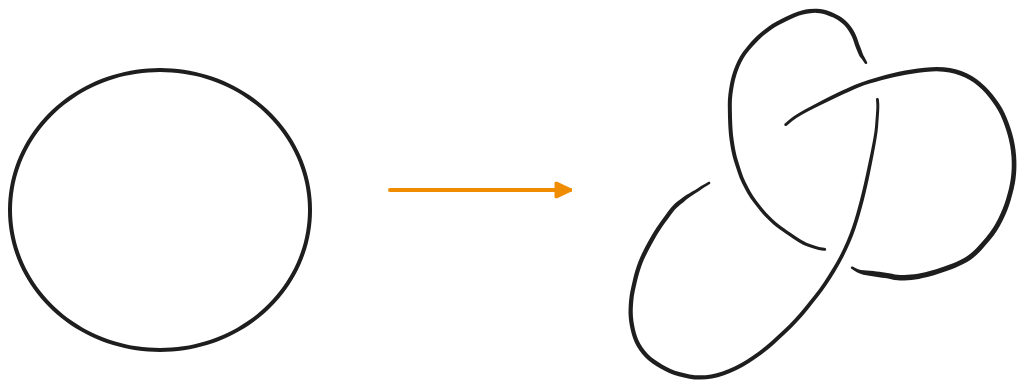
An embedding is a continuous injective map that induces a homeomorphism .
It is important to emphasize that should have the subspace topology inherited from .
For example, a knot in is an embedding .
Embedding, limit points, closure, boundary (part 2)
Limit points
Given a subspace , a point is a limit point of when every open set around touches somewhere besides .
Notes:
- Limit points are sometimes called accumulation points.
- The limit point might be outside !
- In a metric space, this can be reformulated: is a limit point of when there is some sequence such that as . This is written .
- In other words, is “approached” from inside .
Interior and exterior
The interior of a set is the set of points with an open neighborhood contained in .
The exterior of a set is the interior of the complement of .
Closure of a set
The closure of a set is the union of with all limit points of .
- Equivalently: the closure is the complement of the union of all open sets in that don’t touch .
- Equivalently: the closure is the intersection of all closed sets containing .
Boundary of a set
The boundary of a set is the set of points in both and .
- Equivalently: the boundary is the set of points for which every open neighborhood touches both the interior and the exterior of .
- Boundary points are not always in !