Introduction
A simplicial complex is an assembly of simplices, which generalize triangles and tetrahedra. Simplices provide “building block” objects in each dimension that may be glued together to form a complex.
Simplices provide a combinatorial method of representing a large class of topological spaces, since the ‘assembly data’ encoding the gluing of simplices into a complex is combinatorial in nature.
Simplicial homology is a homology theory (topological invariant) that is naturally defined in terms of a given simplicial complex. It is easy to find this homology for a space when a representation as simplicial complex is known.
Simplicial homology is isomorphic to other homology theories.
- Singular homology: abstract ‘naturality’; proving invariance is easier
- Simplicial homology: combinatorial; build complexes by gluing faces ‘directly’; stricter gluing rules
- Delta homology: combinatorial, like simplicial; more relaxed gluing rules
- CW homology: combinatorial, like simplicial but gluing cells (balls) not simplices; build CW complexes inductively; very relaxed gluing rules
For smooth manifolds, we also have:
- De Rham cohomology: uses differential forms “closed but not exact”
Simplices and complexes
:
- A -simplex is a point (a vertex).
:
- A -simplex is a line segment.
:
- A -simplex is a triangle (interior included).
:
- A -simplex is a tetrahedron.
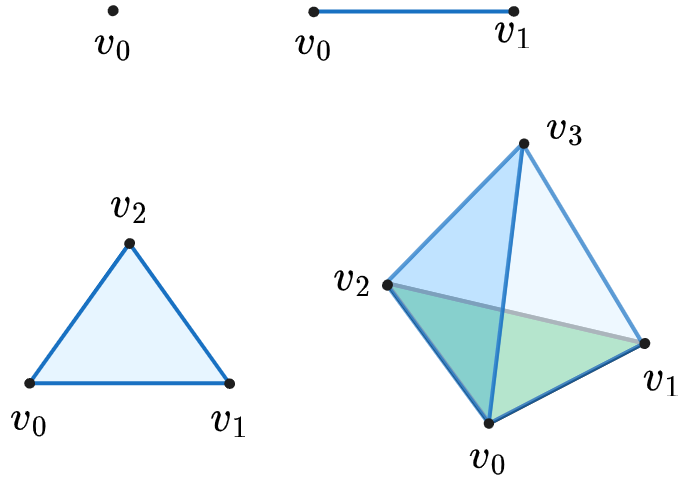
Geometric simplex
Vertices: , required to be affinely independent.
Geometric simplex:
- Thus is the “convex hull” of . In other words: all weighted averages of the vertices.
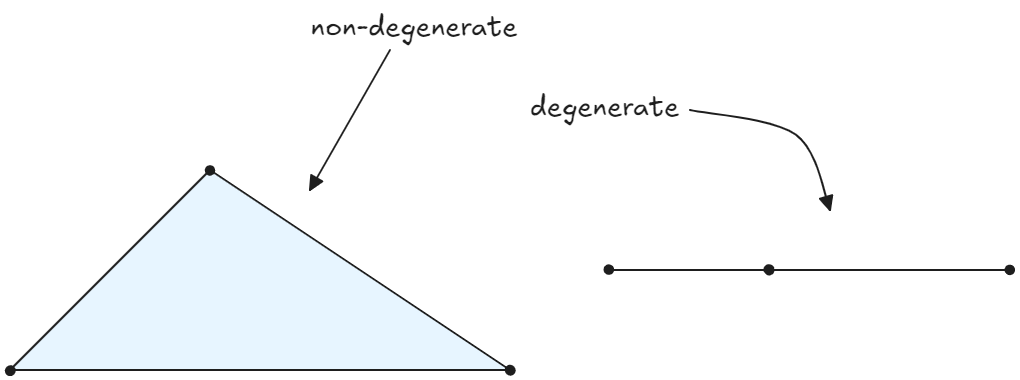
- Affinely independent means: do not lie in any hyperplane (dimension ) of ; equivalently that are linearly independent, or that they generate a vector space of dimension .
- A simplex failing this criterion is called degenerate.
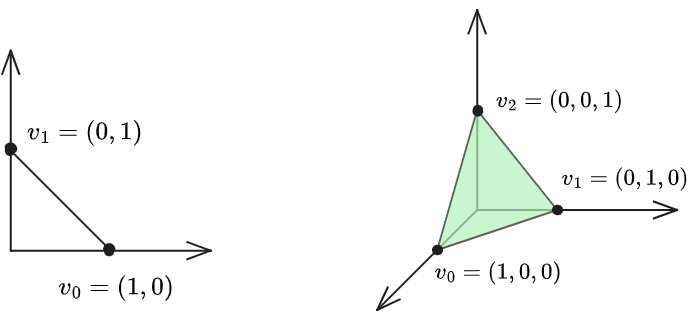
- Standard -simplex : vertices are the unit vectors in .
For example, with the standard simplex is:
This defines the line segment from to .
Similarly, with we find that is parametrized by .
A simplicial complex can be characterized in several ways:
- Combinatorially
- Geometrically
- Topologically
Simplicial complex - Combinatorial
A combinatorial simplical complex with a set of ‘vertices’ is a collection of subsets of , called ‘simplices’, satisfying:
- All faces included: If , then all faces of are in .
(And thus faces of faces, all the way down to vertices.)- Touching only at a face: If , and , then is a face of and a face of .
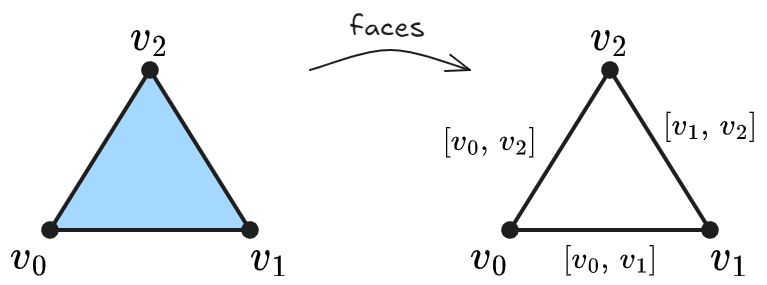
For , the faces of are the subsets of lacking a single vertex of .
A simplicial complex has a topology. This is given by gluing the disjoint union of constituent simplices along the faces that intersect. (The quotient topology.)
If the simplicial complex is given a geometric representation in , then the glued/quotient topology should match the one inherited by the complex as a subspace of .
Illustration - faces, subcomplexes and intersections
For example, given a simplex , the faces are and and :
A simplicial complex with D subcomplex and D subcomplex and D subcomplex .
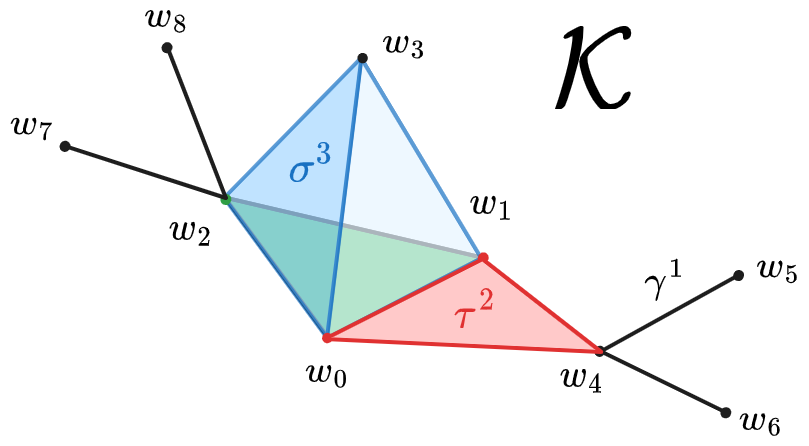
Simplices of dimension are called vertices, simplices of dimension are called edges, and simplices of dimension in an D complex are called faces.
The simplices of top dimension are sometimes called facets (i.e. the biggest ones are called ‘little faces’).
The intersection of two sub-simplices is allowed to be a single face, not two faces (vertices, in this case):
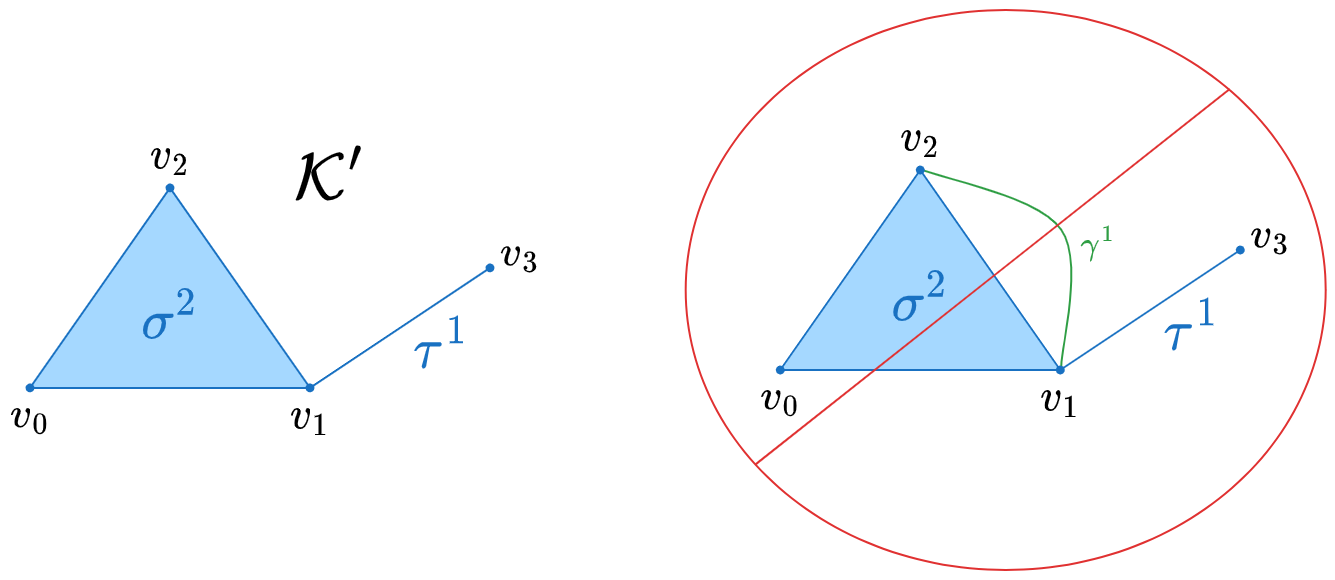
Illustration - graphs and geometric representation
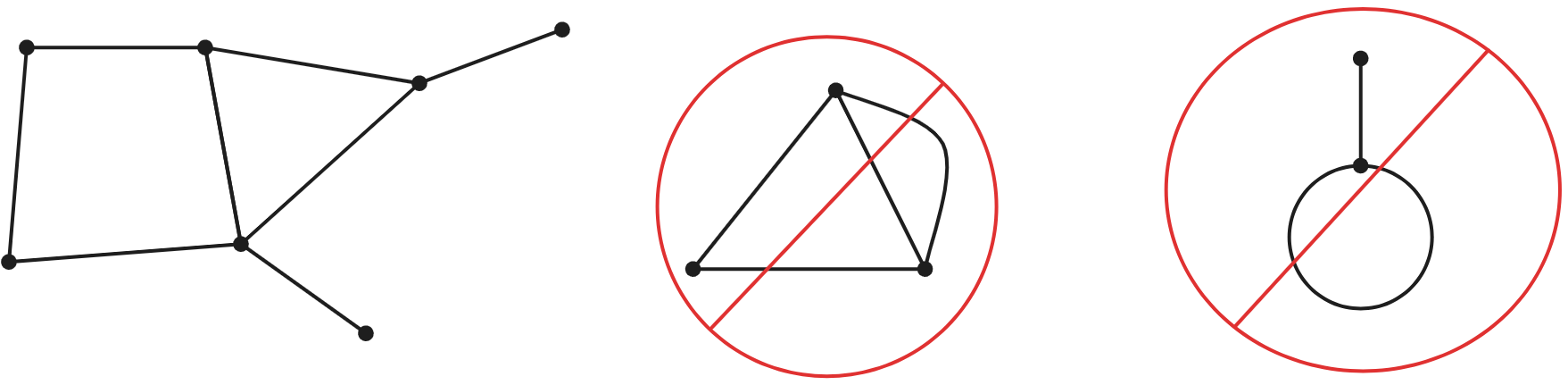
Every finite simple undirected graph is a simplex.
- No “parallel edges”
- No “one-loops”
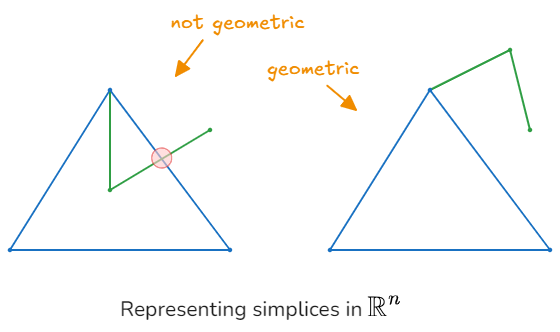
In a geometric representation of a simplicial complex, edges should not cross, etc.
Kuratawki: Graph planarity
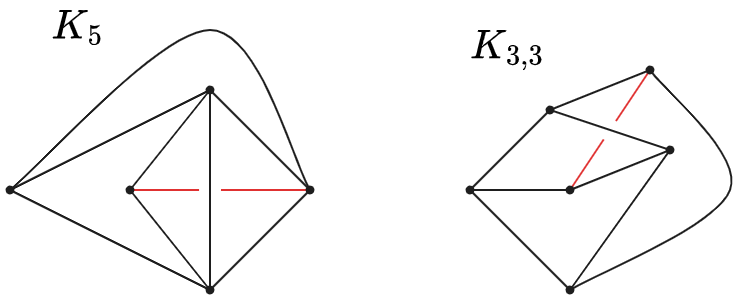
The graph planarity theorem of Kuratowski says that a graph is planar (can be drawn in without self intersection) if and only if it does not contain a copy of or :
Subdivision and triangulation
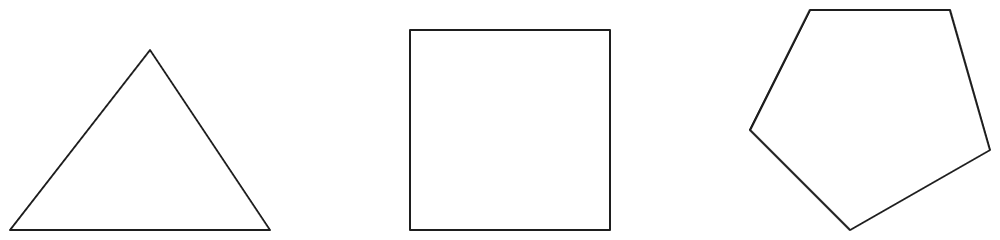
A single topological space (up to homeomorphism) can be represented in many different ways as a simplicial complex:
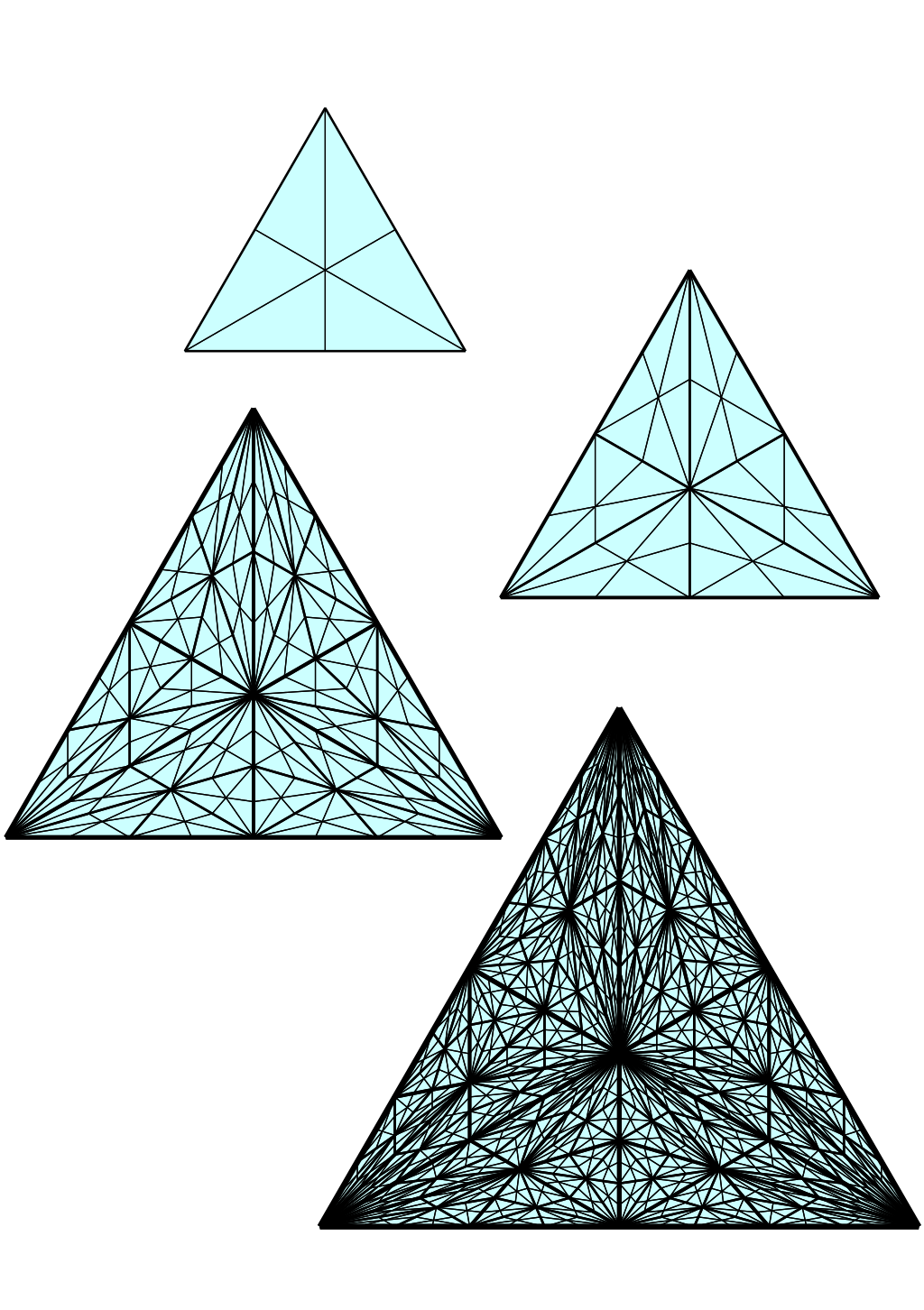
One can perform “barycentric subdivision” upon a given simplicial complex. This produces a simplicial complex that is homeomorphic to the original one, but the edges are shorter and areas of faces smaller.
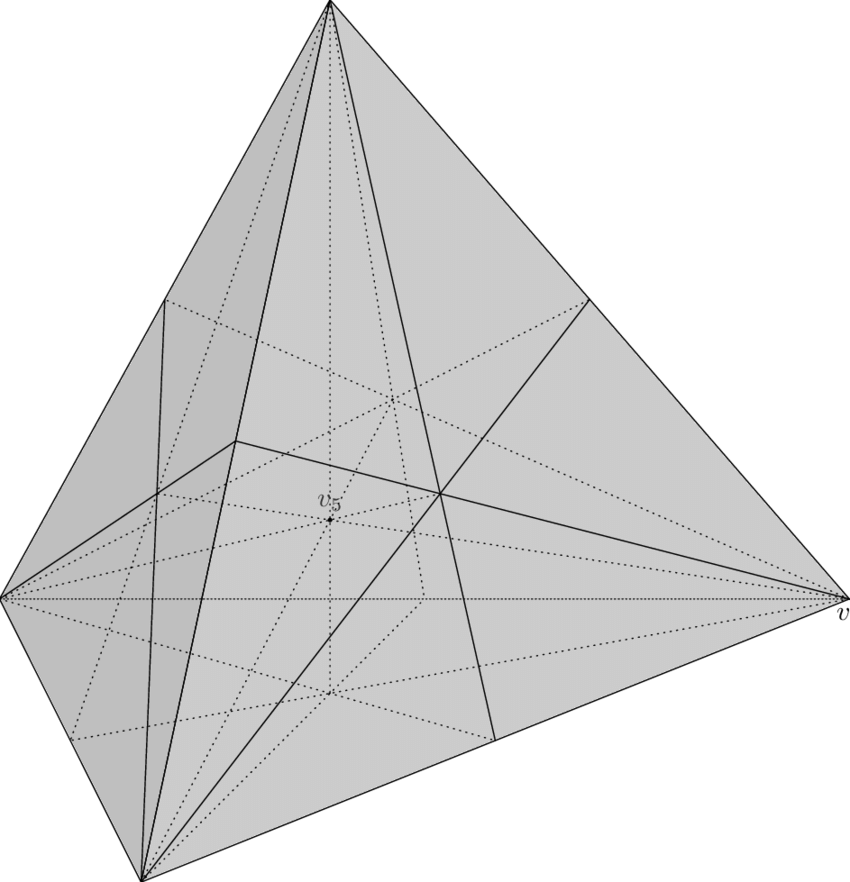
A triangulation is a simplicial complex that is homeomorphic to a given smooth manifold. A triangulated manifold is a simplicial complex together with a homeomorphism to a given smooth manifold.
For example, the tetrahedron obtained by gluing four copies of the standard -simplex is homeomorphic to and is therefore a triangulation of .
Triangulations of spheres
For , all possible triangulation types have been found by Tutte.
For , there is not a known enumeration of triangulation types.