Delta complexes
The -complex structure is a generalization of simplicial complex structure. Instead of gluing simplices from the same by causing them to intersect at faces, one glues simplices from disjoint copies of using a formal quotient topology construction.
This technique allows many common spaces to be represented using fewer simplices. For example, a circle may be given as a -complex by identifying the two vertices of the standard -simplex. The torus may be given using just two -simplices by identifying each of the pairs of sides.
Why not simplicial?
These spaces cannot be formed as simplicial complexes by gluing the given simplices.
They are not literally simplicial complexes because the circle is round and the torus is not a subset of .
They are not homeomorphic to simplicial complexes (with the indicated decompositions) because the circle has a 1-loop while the torus has simplices which intersect in more than one face. (Both are impossible features for the homeomorphism type of simplicial complexes with the given decompositions.)
-Complex - Combinatorial
A combinatorial -complex is a sequence of simplex sets together with attaching maps , for , one for each facet of a simplex in .
Attaching maps join the faces of each simplex to simplices of lower dimension. This works geometrically when the attaching maps preserve adjacency of faces of faces. Preserving adjacency is equivalent to this combinatorial condition:
The adjacency condition may be illustrated with a 2-simplex:
Faces are numbered by removing a vertex in the order of vertices. So is edge 0 of the 2-simplex , and is edge 1, and so on. Thus is face 0 of the 1-simplex , and is face 1, and so on for the other edges.
Now interpret the adjacency condition:
Take as input the 2-simplex.
- With
- The condition says “vertex 0 of edge 1 equals vertex of edge 0.”
- These vertices are the point .
- With
- The condition says “vertex 0 of edge 2 equals vertex of edge 0.”
- These vertices are the point .
- With
- The condition says “vertex 1 of edge 2 equals vertex of edge 1.”
- These vertices are the point .
-Complex - Topological
A -complex is the topological space formed from a combinatorial -complex as the disjoint union of simplices enumerated by elements of , glued together according to the combinatorial attaching maps with canonically defined linear functions interpolating between glued vertices.
where , with is the inclusion of the face of the standard simplex , and is any point in that face.
Simplicial vs. complexes
How best to think about simplicial vs. - complexes?
- Simplicial complex:
- Collection of geometric simplices in the same background space .
- A sub-simplex brought to touch another sub-simplex only in one congruent face, where they are glued.
- -complex:
- Collection of abstract geometric simplices in distinct background spaces (disjoint union).
- Simplices in are attached to the lower-dimensional structure by gluing in the faces of new -simplices, preserving only the adjacency relation.
Underlying space
Given a complex (simplicial complex or -complex), the underlying topological space of is denoted .
-homology
Homology may be defined for -complexes using the same technique as for simplicial complexes.
When a simplicial complex is also a -complex, their homology groups are canonically isomorphic.
Nerve complex
Nerve complex
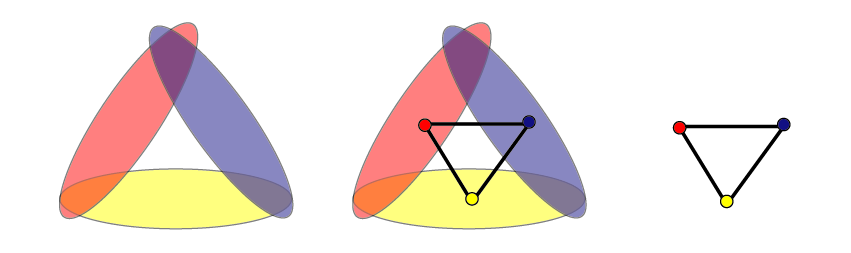
Suppose is a collection of sets indexed by . The nerve complex is the collection of finite subsets such that is nonempty.
That is, the nerve is the complex of indices of finite collections of mutually overlapping subsets from .
Notes:
- The definition does not assume that the are subsets of a topological space. If they are, we do not assume that they are open.
- The nerve complex is a combinatorial complex: the elements are sets of indices, not the subsets themselves.
- Suppose is a subset in the nerve.
- Then all subsets of are also in the nerve.
- I.e. the nerve is closed under taking subsets.
- Therefore: the nerve is a combinatorial simplicial complex.
As a simplicial complex:
- vertices of the nerve correspond to individual sets
- -simplices in the nerve correspond to nonempty subsets having elements
Theorem: Geometric realization
Every combinatorial simplicial complex with vertices can be realized as a geometric simplicial complex in .
In fact, every combinatorial simplicial complex with maximum simplex dimension equal to can be realized as a geometric simplicial complex in .
Čech complex
Čech complex
Suppose is a metric space. Suppose is a finite set of points in .
Fix . Define as the open balls:
The nerve of is called the Čech complex of .
Illustration - Čech complexes of four points
Let be four points in as in the figure.
The Čech complex created using is 1-dimensional – three of the points are linked.
The Čech complex created using is 2-dimensional – the three linked points now span a 2-simplex. The fourth point is also connected.