Homology of a simplex relative to its boundary
Homology of a simplex relative to its boundary
Consider a simple 2-simplex and the simplicial complex that it determines:
Let be the boundary 1-simplex (the edges only from ).
There are no 2-simplices in , so:
All 0- and 1-simplices in are also in , so:
The relative chain complex:
becomes:
It follows that the relative homology is:
Compare this to the homology of a sphere!
Homology of a sphere:
Notice that is homeomorphic to the quotient space .
This comparison of homologies is apt; we just need to explain versus .
Compare this against the quotient of homology groups!
The homology of is:
The homology of , because it is contractible, is:
The quotient of homology groups is:
- Relative homology treats as a single point.
- The quotient of homology annihilates generators (“holes”) in which are also generators (“holes”) in .
- Different results for different constructions!
Some cohomology classes on the 2-torus
Some cohomology classes on the 2-torus
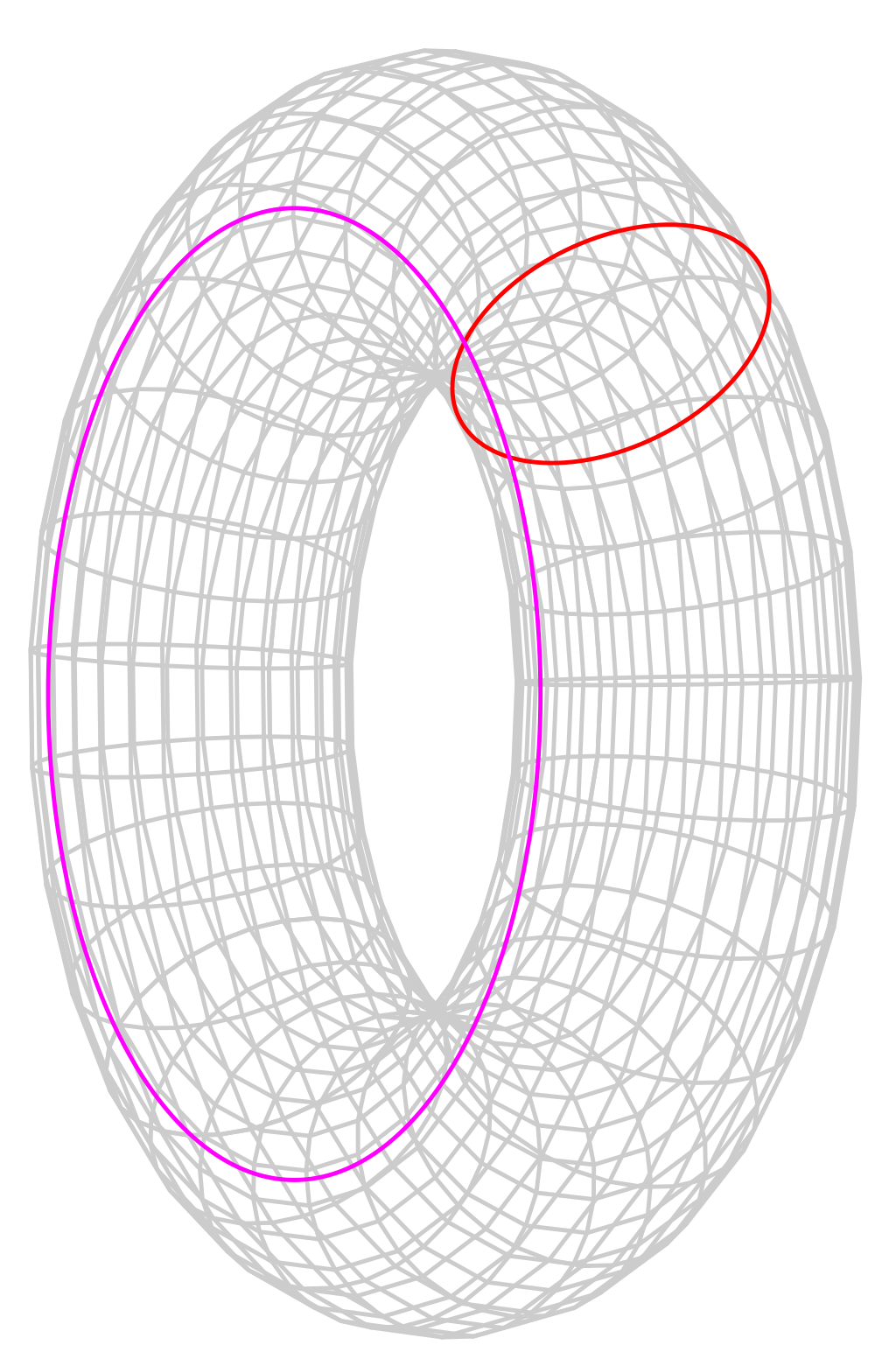
Consider the 2-torus :
The red (poloidal) and pink (toroidal) curves together generate the degree one homology, .
Now recall a simplicial complex representation of the torus:
Let be the cochain which assigns 1 to every edge in the middle column, and zero to all other edges. (So it is 1 on the edges directly below the label, including the diagonals, but excluding all verticals.) Let be the cochain which assigns 1 to every edge in the middle row, and zero to all other edges. (So it is 1 on the edges directly to the right of the label, including the diagonals, but excluding all horizontals.) Accounting now for orientations, let give on edges directed rightwards, and give on edges directed upwards.
One can check directly, going around the boundaries of each 2-simplex, that and : The sum of the numbers on any triangle, accounting for orientations, is zero. So these cochains are both cocycles.
In order to see that and are not boundaries, and thus represent nontrivial homology classes, and also to see that they don’t represent the same homology class, we devise a method of representing coboundaries of 0-cochains.
A 0-cochain is the assignment of integers to each of the vertices. The condition , which means , states that these numbers cannot change as one moves across an edge from vertex to vertex. (Applying to any edge gives . By linearity, . Therefore when the condition holds.)
From this it follows that . The isomorphism is given by sending to the integer it gives on a vertex.
Return now to . A boundary in is a cochain assigning numbers to directed edges such that there is a vertex labeling cochain with . In other words, that it is possible to derive the edge numbers as the differences of a single vertex numbering scheme.
Now one can see that is not a coboundary. Vertex integers must increase by one as one passes across the middle column of edges, and stay fixed going across all other edges. This is impossible because the left-most and right-most edges are identified. Similarly is not a coboundary, and is not a coboundary.
(To witness a contrasting case, let be a 1-cochain giving 1 only on the non-vertical edges in the right-most column. This is shifted to the right. Now is a coboundary: assign 1 on vertices in the middle-right column, and 0 on all other vertices.)
Much more work would be required to show that and have no relations in homology, and that they jointly generate homology.
A cup product on the 2-torus
A cup product on the 2-torus
We study the cup product :
We must provide an ordering of all the vertices of the torus. Order them as in a book: top-to-bottom, then left-to-right.
Let us see how to verify the values on the green and yellow 2-simplices. Label the vertices of the inner square as in the figure; the index ordering is compatible with .
For the green 2-simplex , we have and , so:
For the yellow 2-simplex , we have and , so:
A calculation with more details (illustrating bilinearity) can be performed in terms of the indicator functions. Write:
where is the indicator for the edge in the support of which is in the place from the top (oriented rightwards), and analogously is for the one for in the place from the left (oriented upwards).
Applying bilinearity to expand the cup product:
The edges with indicators and could span one of the 2-simplices only when and . And in fact the pairs can be ruled out as well. The only terms to consider are these six:
- Now is the indicator for and is the indicator for , so because so the total list does not split according to the ordering of .
- Then is the indicator for , so is the indicator for , meaning it returns on the green 2-simplex.
- Then is the indicator for , so .
- Then is the indicator for , so because .
- Then is the indicator for , so because .
- Then as well, also because .
By adding these results, we see that is the indicator for the central 2-simplex, oriented clockwise.
This cochain in is automatically a cocycle because is empty.
Is it a coboundary?
To see that the answer is “no,” we can devise another scheme to represent coboundaries, now for -simplices. We give here only a sketch. Give a 1-cochain which assigns integers to the edges. Draw oriented paths crossing the edges, with the number of paths crossing matching . Then for a triangle counts the total flow of paths into or out from ; it is a ‘sink’ or ‘source’ number describing extra paths originating or terminating inside . The condition would mean that the paths are conserved in , none created or destroyed.
With this perspective, it is obvious that the cochain depicted in the figure cannot be a coboundary. Every 2-cochain which is a coboundary describes a collection of oriented paths that are created or destroyed only in triangles with nonzero assignments, according to that assignment. So would describe a single path terminating in the green triangle, but originating nowhere, since there is no other sink or source.
Another observation is worth making about . It is the generator of .
Note that the full cohomology of is given by:
Here is a fact: All indicator functions on 2-simplices determine the same cohomology class. To see this, take the difference of any two indicators. Draw a simple oriented path out of one of them into the other. This path will define a 1-cochain by assigning on any edge it crosses on the way (according to their mutual orientations), and 0 on all edges it does not cross. The coboundary of this cochain gives on the triangle from which the path emanates, and on the triangle in which the path terminates, and zero on all other triangles. That is exactly the difference of indicator 2-simplices we started with.
Since is generated by indicator 2-simplices, and they are all equivalent, we deduce that it is generated by .
To see that it is in fact infinite and isomorphic to , we must exclude relations among the multiples of . A relation is equivalent to the relation for . But we can exclude any such relation by the reasoning used above: a cochain cannot be a coboundary because it would represent oriented paths terminating in the green 2-simplex, and originating nowhere.
Therefore we have proven that:
The cocycle is called the fundamental cocycle of .
Cohomology ring has topological significance
Cohomology ring has topological significance
Let , the 2-torus.
Let , a 2-sphere with two circles attached at one common point.
The cohomology groups are isomorphic:
However, the cup product operations differ, so the ring structures differ.
- In , the cup product of the two generating cocycles is the fundamental coclass of the 2-torus.
- In , the cup product of the two generating cocycles (dual to the two copies of ), is zero.