Gradient, critical points; Hessian, non-degenerate points
Suppose we are given a smooth function .
The differential matrix of in this case is (the transpose of) the gradient of :
By the definition of regular point, a point is regular for when the gradient vector is not , i.e. when for some coordinate . The point is called critical when it is not regular.
(Note: is smooth by hypothesis, so the components of are everywhere defined, and so critical points are points where .)
The differential of a smooth function is itself a smooth function . We may thus take the differential of the differential, and we obtain the Hessian matrix of second partial derivatives:
The Hessian matrix is always a symmetric square matrix because . This implies that all eigenvalues are real numbers (a case of the Spectral Theorem).
Non-degenerate critical point
A critical point for a function is non-degenerate when is a non-singular matrix.
Equivalently, when:
- All eigenvalues of are nonzero
Index of a critical point
Given a non-degenerate critical point , the index of is the number of negative eigenvalues of .
Isolated critical point
A critical point for a function is isolated when an open neighborhood of can be found such that is the only critical point of in this neighborhood.
Morse functions on manifolds
Morse theory is about the use of a function to study the topology of the manifold in terms of the critical points of . One sets up a function that has nondegenerate critical points with distinct critical values, called a Morse function. To make sense of this setup we need first to define smooth functions .
Smooth function on a manifold
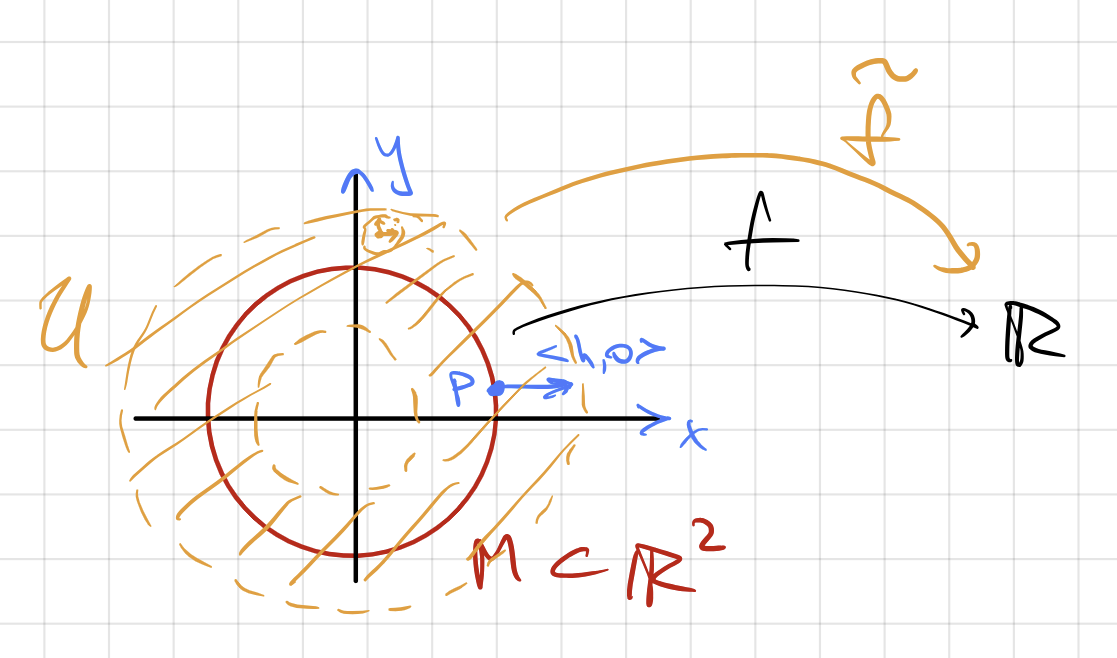
A function on a smooth manifold is smooth if it is the restriction of a smooth function where is an open set in with .
This means: and has continuous partial derivatives of all orders.
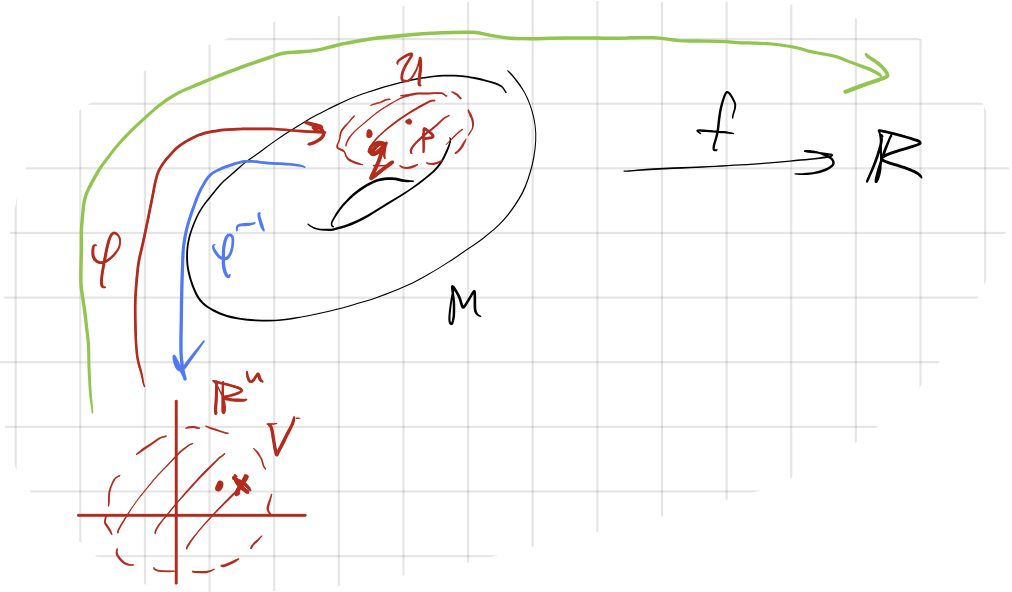
Recall local coordinates:
For any there is a set open in and open in with
a parametrization (diffeomorphism to its image). The -coordinates of images of the inverse give local coordinates on .
Critical and non-degenerate, from a manifold
Let be a smooth function on a smooth -manifold in , and a parametrization of the open neighborhood of . So for .
Choose any . Set .
We say or is regular when and critical when .
We say or is non-degenerate when is a non-singular matrix (and degenerate otherwise).
Notice that this definition of regularity appears to depend on the parametrization . But in fact, the definition is independent of the choice of :
Proposition - Regularity is independent of parametrization
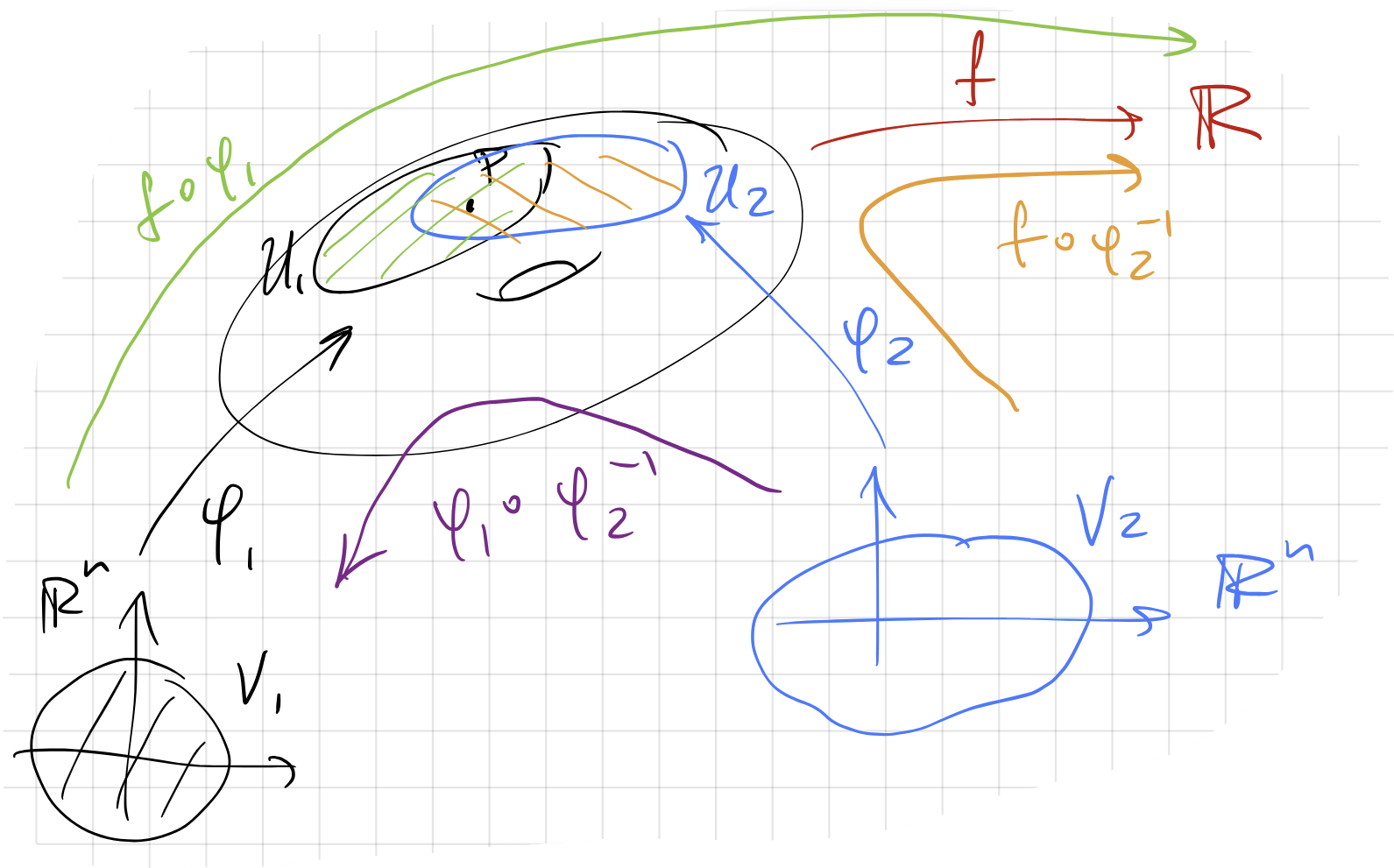
Suppose we are given two parametrizations and of a coordinate patch .
Take an arbitrary and assume it is regular according to .
We show it must be regular according to .
This will complete the proof because if it is critical according to , and not critical according to , then it is regular according to , and the same argument can be run after switching .
Define the ‘transition map’ .
This is a map where and for open balls.
Notice that .
Apply chain rule:
Here is the Jacobi matrix of .
Argue that is invertible:
We have that and are both isomorphisms from to the tangent space of at .
Then is the composition of with the inverse of restricted to the tangent space of at . (Prior to restriction is not even a square matrix.)
Therefore is invertible.
Therefore, at any point:
So a point is regular for if and only if it is regular for .
Why define regularity using parametrizations?
Since the choice of parametrization has no effect on the classification of points as regular or critical, one may wonder why the parametrization is needed at all.
But the concept of regularity does involve the manifold’s embedding, and not just the values of in the ambient space around the manifold.
A point is regular for when there is some first-order infinitesimal deviation of within which causes a first-order deviation in . When is critical, the induced change in is second order at most.
For example, given a smooth function , a level surface is (frequently) an -manifold every point of which is regular for , but no point of which is regular for .
Tangent space
Given a manifold , we define the tangent space to at , written , as the image of in for any parametrization of a neighborhood of .
Comparing gradient functions
Notice:
- is a map from , and has coordinates
- is a map from , and has coordinates, one for each dimension of
In general: is the restriction of to using columns of as a basis.
(Supposing and an extension of to with .)
Morse Lemma
Suppose is a non-degenerate critical point of index of a smooth function .
Then:
for some parametrization whose local coordinates are .
Morse functions
A Morse function is a smooth function from a manifold to which satisfies:
- All critical points of are non-degenerate.
- The values of at its critical points are all distinct.
Morse functions are dense
Morse functions are dense in the space of smooth functions.
There is a small perturbation of any smooth function that is a Morse function.
Morse functions and topology
Given a Morse function for a manifold , define:
- the level set at
- the sublevel set under
By continuously increasing the value of (starting at ), we find that the topology of changes exactly when passes a critical point of .
Sublevel set builds topology
Up to homotopy equivalence, as passes through a critical point of index , the sublevel set changes by the attachment of a -ball along its boundary.
For example:
- Pass a point of index glue on a disk, a lid opening downwards
- Pass a point of index glue on an arc (up to homotopy)
- Pass a point of index create a new disk, a basket opening upwards