Filtering also by density
Filtering also by density
Let us add a density filtration to . Fix and define by:
Now the points in , and the -complex itself, can be filtered by a density minimum:
This bi-filtered complex determines a 2-parameter persistence module:
For large , only points very close to distinct neighbors are included. As decreases, more points are brought in.
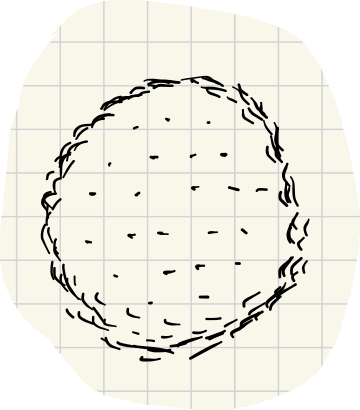
With data like this, the filtration (for middling values) removes points inside the disk because they are too sparse.
Filtering also by distance to a subspace
Filtering also by distance to a subspace
Suppose is an embedded -dimensional subspace of the background space that contains the data:.
Let measure the distance from data points to the image of .
Define . This gives a filtration in terms of the parameter . This filtration could be useful if the complete data set is too big to process all at once. The filtration allows one to process the data in layers.
These filtrations determine inclusions of complexes. For fixed and , we have:
Upon applying homology, for , we have:
And for fixed and , we have:
Upon applying homology, we have:
Finally, these induced maps should commute with each other:
Morse layers
Morse layers
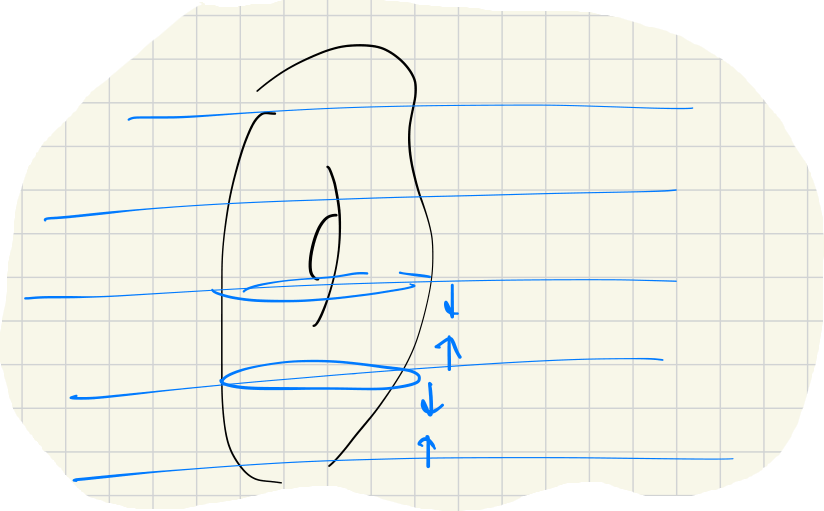
An application of zig-zag filtration arises by dividing the entire space into small layers for which the homology is easier to compute. For example, with a Morse function , we have this zig-zag filtration:
Repeated samples
Repeated samples
Suppose some data is sampled repeatedly and data sets are generated in a sequence:
Then we can form a zig-zag filtration by: