Repeated trials
Multinomial: Soft drinks preferred
Multinomial: Soft drinks preferred
Folks coming to a party prefer Coke (55%), Pepsi (25%), or Dew (20%). If 20 people order drinks in sequence, what is the probability that exactly 12 have Coke and 5 have Pepsi and 3 have Dew?
Solution
The multinomial coefficient gives the number of ways to assign 20 people into bins according to preferences matching the given numbers, and and .
Each such assignment is one sequence of outcomes. All such sequences have probability .
The answer is therefore:
Link to original
Reliability
Reliability: Series, parallel, series
Reliability: Series, parallel, series
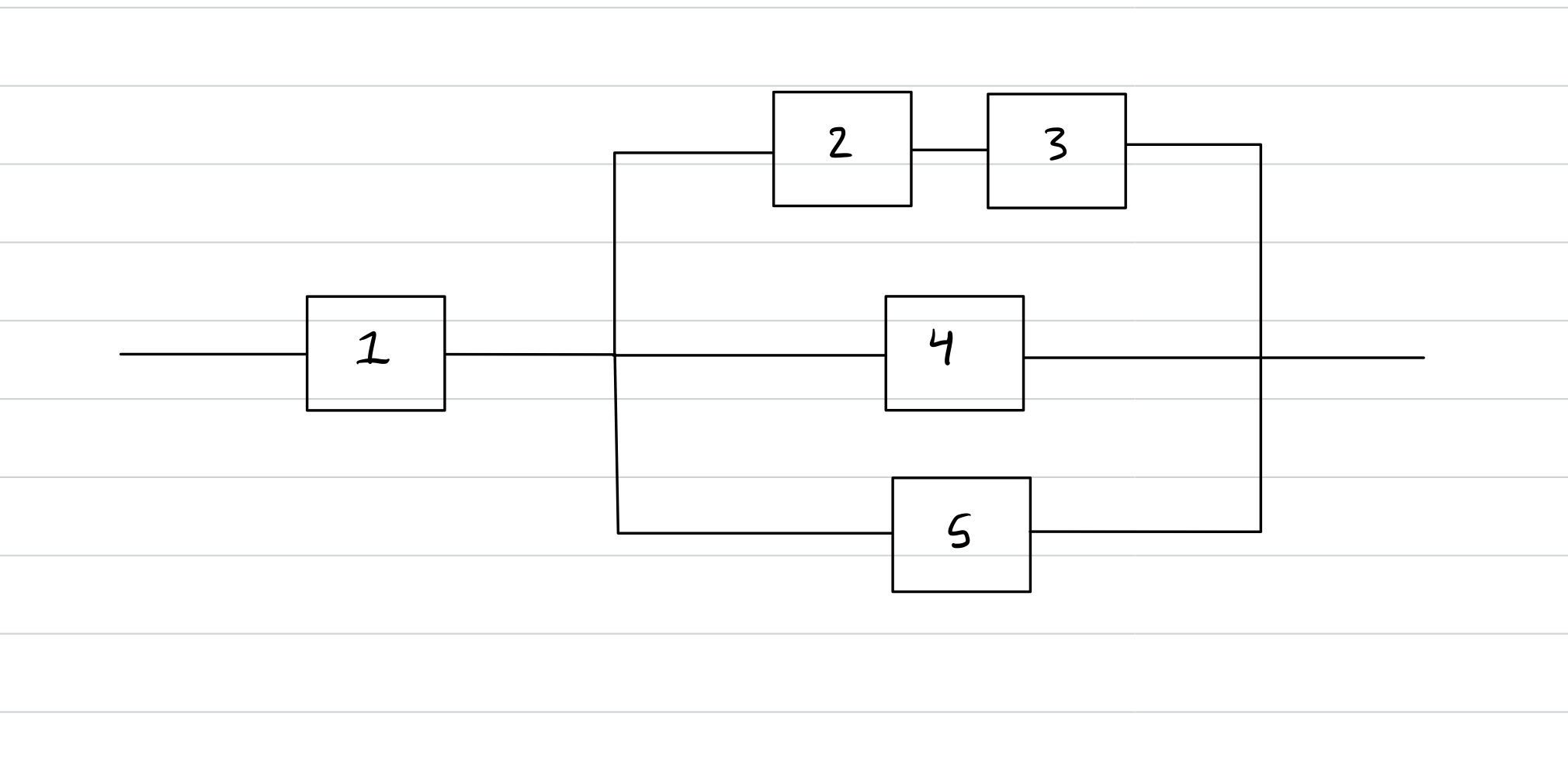
Suppose a process has internal components arranged like this:
Write for the event that component succeeds, and for the event that it fails.
The success probabilities for each component are given in the chart:
1 2 3 4 5 92% 89% 95% 86% 91% Find the probability that the entire system succeeds.
Solution
For intersections, use (independence) and for unions, use .
So and:
Link to original
Discrete random variables
PDF and CDF: Roll 2 dice
PDF and CDF: Roll 2 dice
Roll two dice colored red and green. Let record the number of dots showing on the red die, the number on the green die, and let be a random variable giving the total number of dots showing after the roll, namely .
- Find the PMFs of and of and of .
- Find the CDF of .
- Find .
Solution
(1) Construct sample space:
Denote outcomes with ordered pairs of numbers , where is the number showing on the red die and is the number on the green one.
Therefore are integers satisfying .
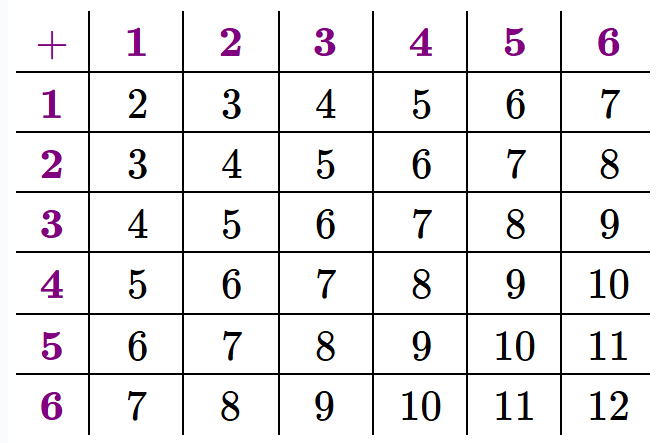
(2) Create chart of outcomes:
(3) Define random variables:
We have and .
Therefore .
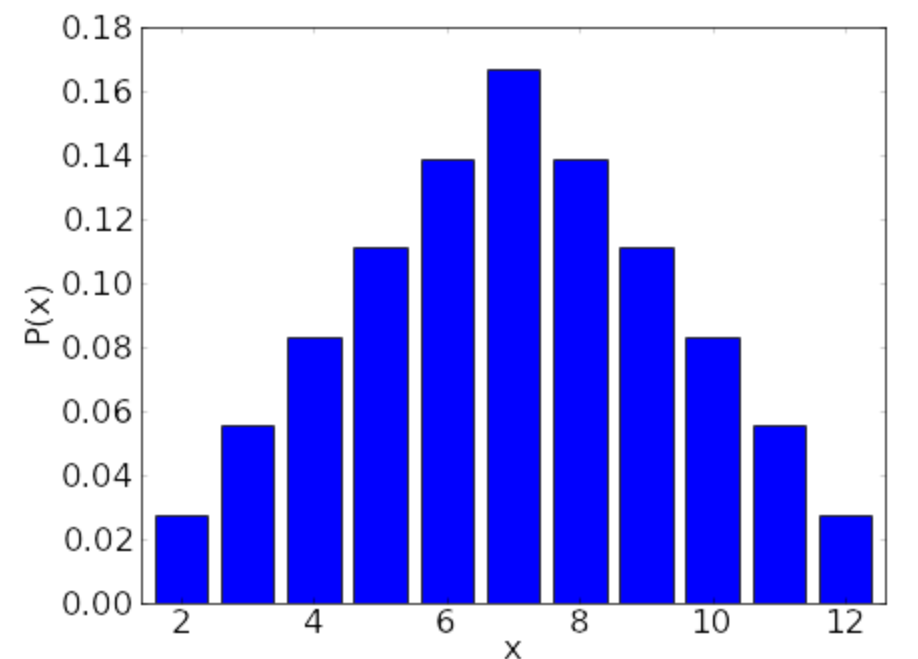
(4) Find PMF of :
Use variable for each possible value of , so . Find :
Therefore for every .
(5) Find PMF of similarly:
(6) Find PMF of :
Count outcomes along diagonal lines in the chart.
2 3 4 5 6 7 8 9 10 11 12
Evaluate: .
(7) Find CDF of :
CDF definition:
Apply definition: add new PMF value at each increment:
Link to original
PMF for total heads count; binomial expansion of 1
PMF for total heads count; binomial expansion of 1
A fair coin is flipped times.
Let be the random variable that counts the total number of heads in each sequence.
The PMF of is given by:
Since the total probability must add to 1, we know this formula must hold:
Is this equation really true?
There is another way to view this equation: it is the binomial expansion where and :
Link to original
Life insurance payouts
Life insurance payouts
A life insurance company has two clients, and , each with a policy that pays $100,000 upon death. Consider events that the older client dies next year, and that the younger dies next year. Suppose and .
Define a random variable measuring the total money paid out next year in units of $1,000. The possible values for are 0, 100, 200. Now calculate:
Link to original