Sums of random variables
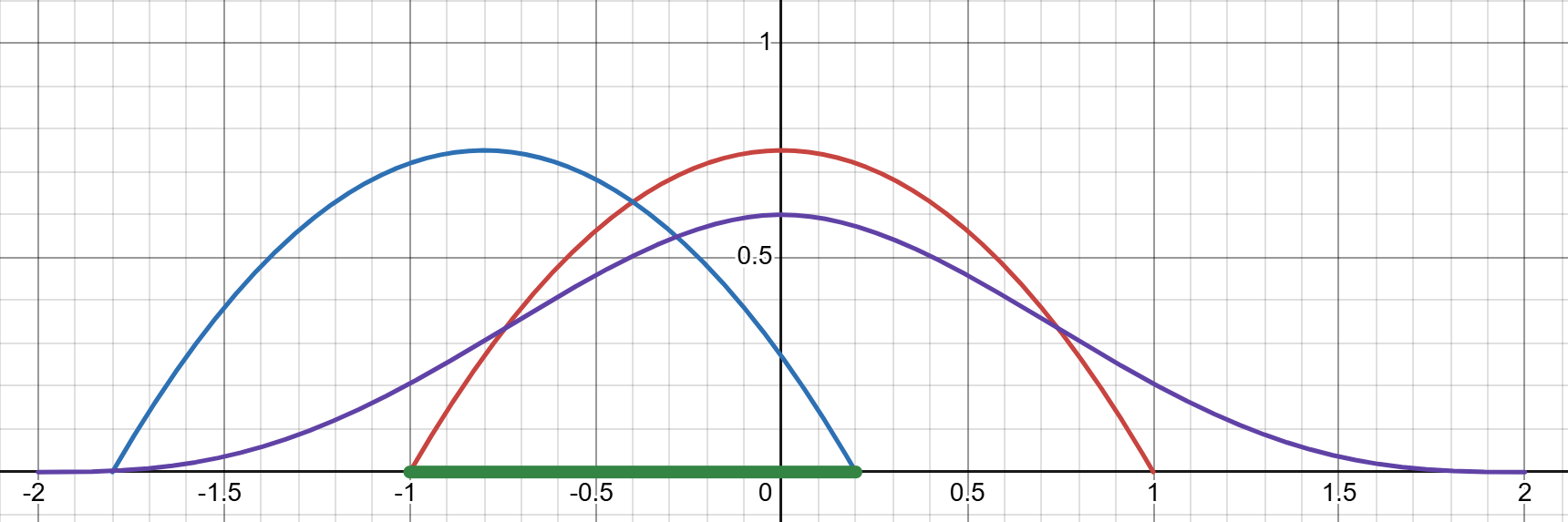
Sum of parabolic random variables
Sum of parabolic random variables
Suppose is an RV with PDF given by:
Let be an independent copy of . So , but is independent of .
Find the PDF of .
Solution
The graph of matches the graph of except (i) flipped in a vertical mirror, (ii) shifted by to the left.
When , the integrand is nonzero only for :
When , the integrand is nonzero only for :
Final result is:
Link to original
Exp plus Exp equals Erlang
Exp plus Exp equals Erlang - With Convolution
Let us verify this formula by direct calculation:
Solution
Let be independent RVs.
Therefore:
Now compute the convolution, assuming :
This is the Erlang PDF:
Link to original
Expectation for two random variables
Expectation of X squared plus Y from joint PMF chart
Expectation of X squared plus Y from joint PMF chart
Suppose the joint PMF of and is given by this chart:
0.2 0.2 0.35 0.1 0.05 0.1 Define . Find the expectation .
Solution
First compute the values of for each pair in the chart:
0 3 1 4 2 5 Now take the sum, weighted by probabilities:
Link to original
Expectation of Y two ways and Expectation of XY from joint density
Expectation of Y two ways and Expectation of XY from joint density
Suppose and are random variables with the following joint density:
(a) Compute using two methods.
(b) Compute .
Solution
(a)
(1) Method One: via marginal PDF :
Then expectation:
(2) Method Two: directly, via two-variable formula:
(b) Directly, via two-variable formula:
Link to original
Covariance from PMF chart
Covariance from PMF chart
Suppose the joint PMF of and is given by this chart:
0.2 0.2 0.35 0.1 0.05 0.1 Find .
Solution
We need and and .
Therefore:
Link to original
Variance of sum of indicators
Variance of sum of indicators
An urn contains 3 red balls and 2 yellow balls.
Suppose 2 balls are drawn without replacement, and counts the number of red balls drawn.
Find .
Solution
Let indicate (one or zero) whether the first ball is red, and indicate whether the second ball is red, so .
Then indicates whether both drawn balls are red; so it is Bernoulli with success probability . Therefore .
We also have .
The variance sum rule gives:
Link to original