Functions on two random variables
01 Theory
Theory 1
PMF of (any) function of two discrete variables
Suppose and are discrete RVs.
The PMF of :
CDF of (continuous) function of two continuous variables
Suppose and are continuous RVs, and is a continuous function.
The CDF of :
If desired, one can then compute the PDF of by differentiating the continuous CDF:
Link to original
02 Illustration
Exercise - PMF of from chart
PMF of XY squared from chart
Suppose the joint PMF of and is given by this chart:
0.2 0.2 0.35 0.1 0.05 0.1 Define .
(a) Find the PMF .
(b) Find the expectation .
Link to original
Example - Max and Min from joint PDF
Max and Min from joint PDF
Suppose the joint PDF of and is given by:
Find the PDF of (a) , and of (b) .
Solution
(a)
(1) Compute CDF of :
Convert to event form:
Integrate PDF over the region, assuming :
(2) Differentiate to find :
:
(b)
(1) Compute CDF of :
Convert to event form:
Integrate PDF over the region:
Therefore:
(2) Differentiate to find :
:
Link to original
Example - PDF of a sum
PDF of sums practice
Suppose is an RV with density:
Suppose is uniform on and independent of .
Find the PDF of . Sketch the graph of this PDF.
Solution
(1) Write the CDF of as a double integral:
The joint density on the unit square is:
There is positive density in the region only for (otherwise ).
- When , there is positive density in the region (only) when .
- When , there is positive density in the region whenever .
(2) Evaluate for :
Here and , so .
Differentiate:
(3) Evaluate for :
Now ranges over . Split by whether the -bound is or :
- : , so
- : , so
(4) Differentiate for the final PDF:
Therefore:
Link to original
Extra - Convolution
Extra Example - PDF of a quotient
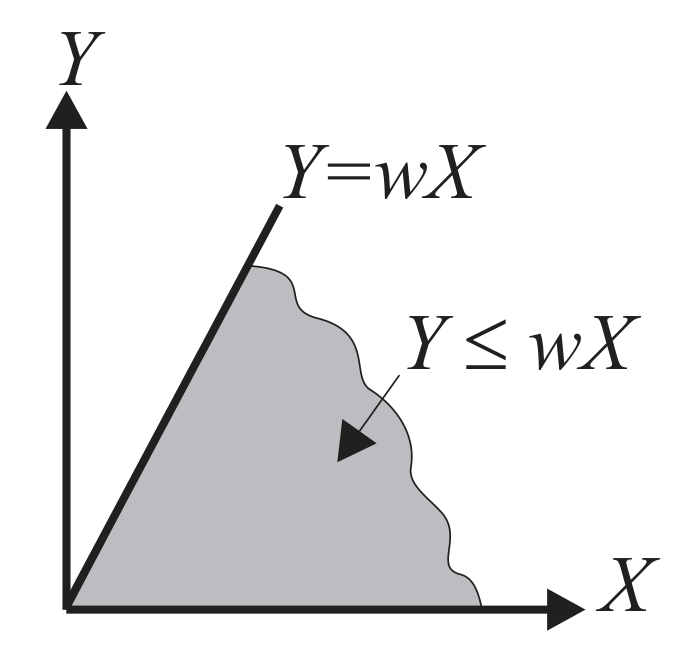
PDF of a quotient
Suppose the joint PDF of and is given by:
Find the PDF of for .
Solution
(1) Find the CDF using logic:
Integrate over this region:
(2) Differentiate to find PDF:
Compute :
Link to original
03 Theory
Theory 6
Recall that in a Poisson process:
- measures continuous wait time until one arrival
- measures continuous wait time until arrival
Since the wait times between arrivals are independent, we expect that the sum of exponential distributions is an Erlang distribution. This is true!
Erlang sum rule
Specify a given Poisson process with arrival rate . Suppose that:
- for any
- or any
- and are independent
Then:
Link to originalExp plus Exp is Erlang
Recall that .
So we could say:
And:
04 Illustration
Example - Exp plus Exp equals Erlang
Exp plus Exp equals Erlang - Without Convolution
Let us verify this formula by direct calculation:
Solution
Let be independent RVs, and let .
Therefore:
(1) Write the CDF as a double integral over the region :
For , the region is , .
(2) Evaluate the inner integral:
(3) Evaluate the outer integral:
(4) Differentiate for the PDF:
This is the density function:
Link to original
Exercise - Erlang induction step
Erlang induction step
Derive the formula:
Observation: By repeatedly applying the above formula, we see that:
Link to original