TDA in pictures
Introduction
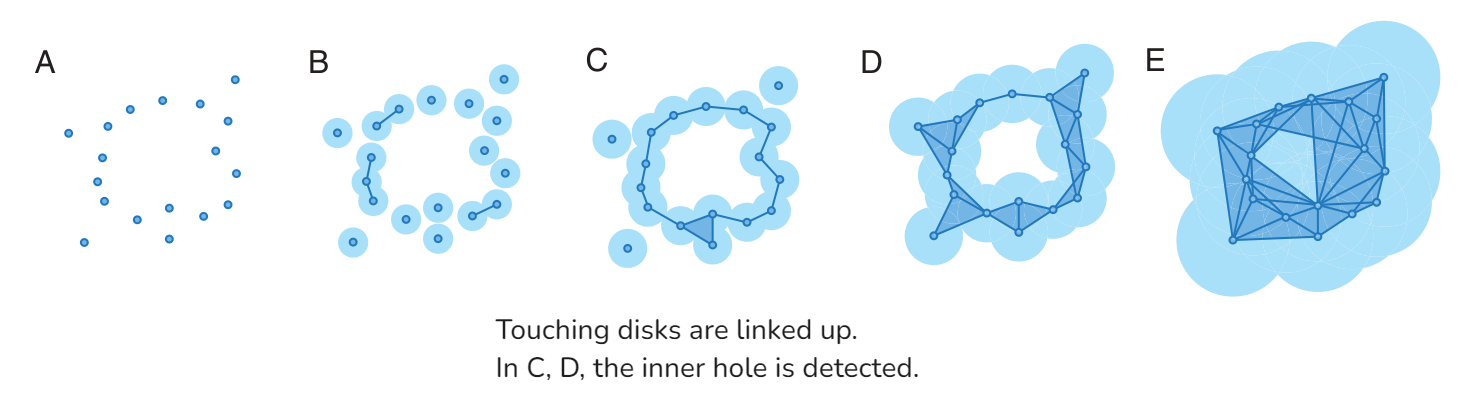
Detecting topological features with a filtration:
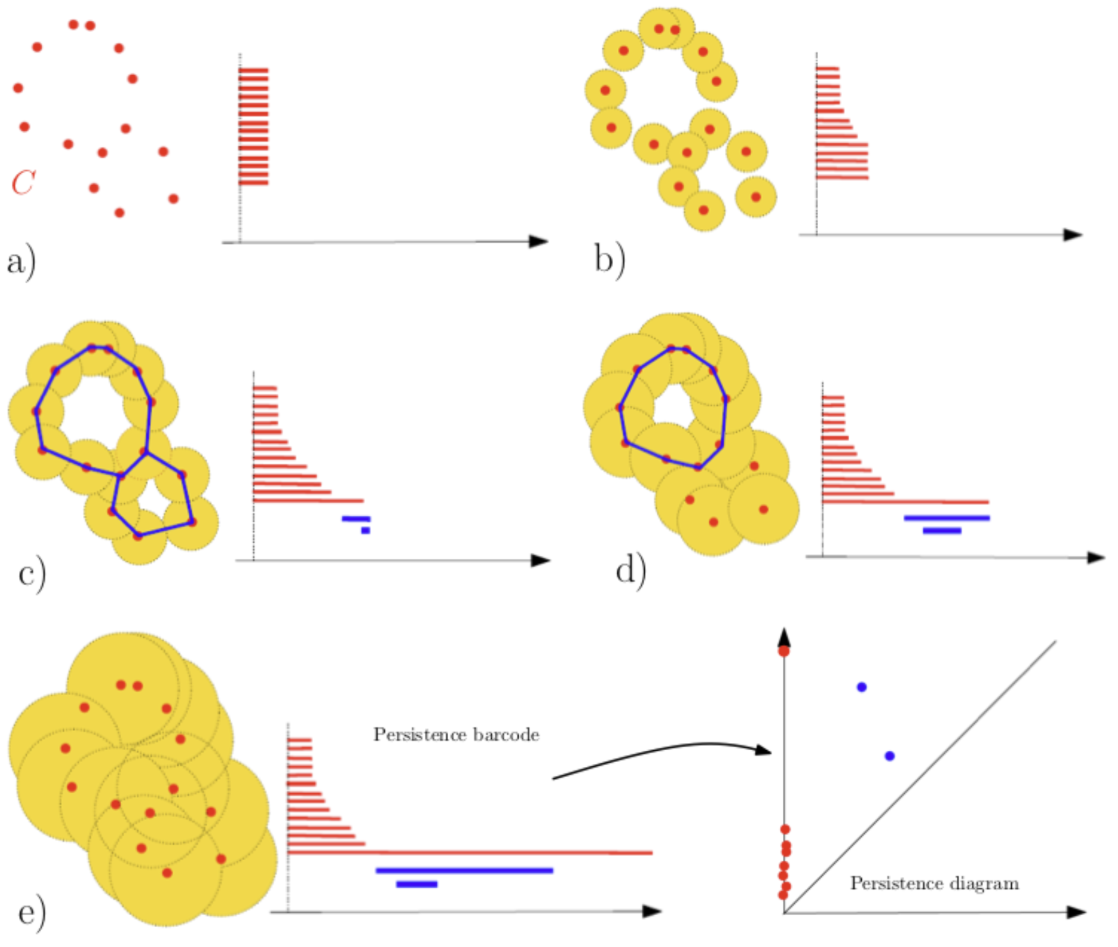
“Barcodes” of persistence homology:
Link to original
Topological spaces: basic notions
Theory - Spaces, subspaces, connectedness
Spaces, subspaces, connectedness
Topological space
A topological space is a set (the ‘space’) together with a topology structure.
A topology structure is a determination of open subsets of .
Formally: open sets are collected together in a set of sets , the topology.
Open sets (in ) must satisfy axioms:
- and are open
- All unions of opens are open
- Finite intersections of opens are open
A set is called closed when is open.
Although these axioms for open sets seem rather obscure, a long history (leading up to and in consequence of the axioms) has shown that the concept of open set they determine accurately formalizes our intuitions about spatial connectedness, and the aspect of proximity that underwrites connectedness.
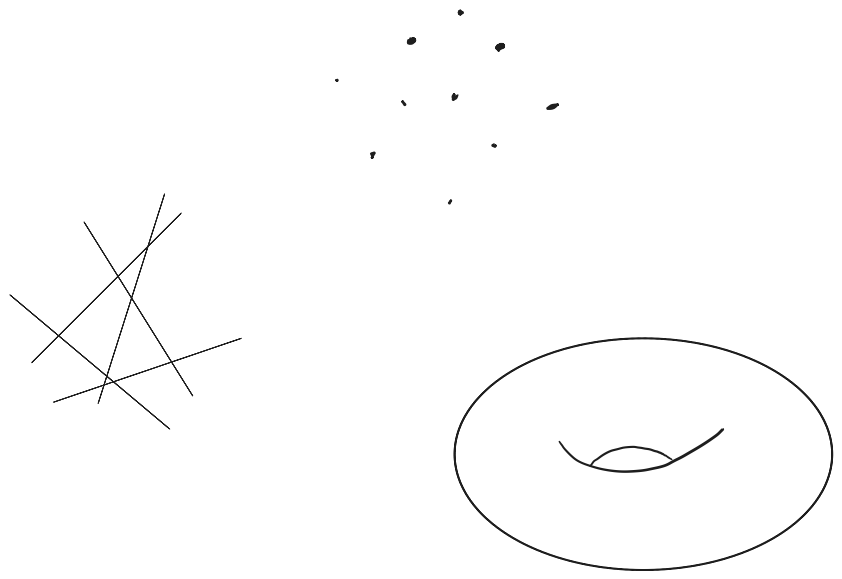
Many geometric sets have natural topology structures:
Some notes:
- The trivial topology has only the minimum of open sets, and .
- The discrete topology has the maximum of open sets, . (All subsets are open.)
- Sometimes a set is simultaneously closed and open, thus ‘clopen’. E.g. and are always clopen.
Subspace topology
For any subset , there is a subspace topology structure on .
The open sets of are the intersections where is open in .
Beware that open sets in a subspace topology might not be open in itself.
Link to originalConnectedness
A topological space is connected when it is impossible to decompose it as a disjoint union of opens:
Illustration
Simple topology - connectedness
Link to originalSimple topology - connectedness
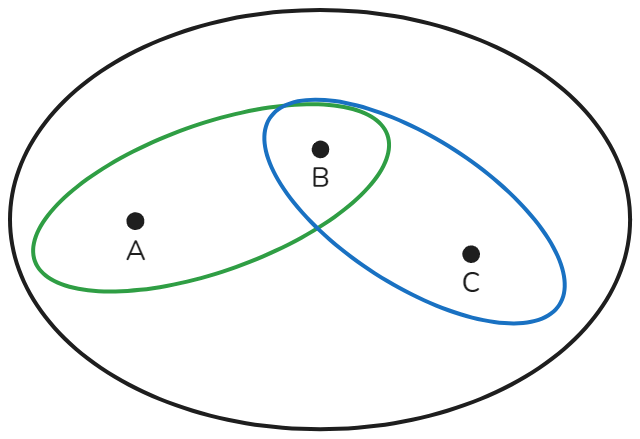
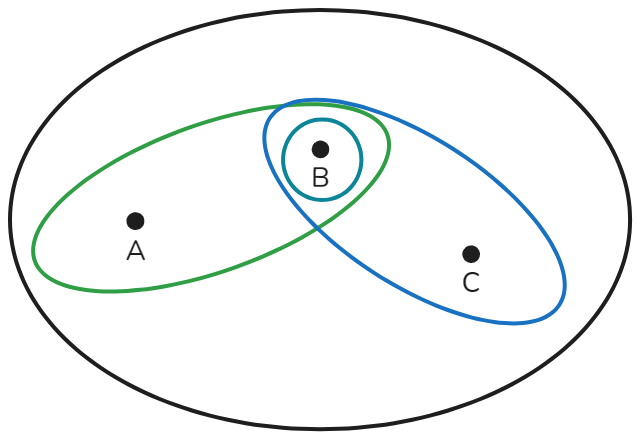
Three points: , with two (nontrivial) open sets.
This is not a topology because the intersection is not open:
This is a topology, and it is connected:
Continuum - real number interval
Link to originalContinuum - real number interval
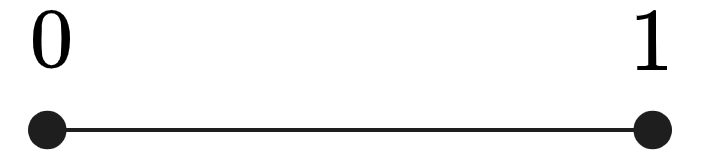
The standard topology structure for real numbers is generated by open intervals .
(“Generated”: it is the smallest topology structure containing all such intervals.)
In D, the open sets are generated by open boxes or (equivalently) open balls .
Open in S but not in R2
Link to originalOpen in but not in
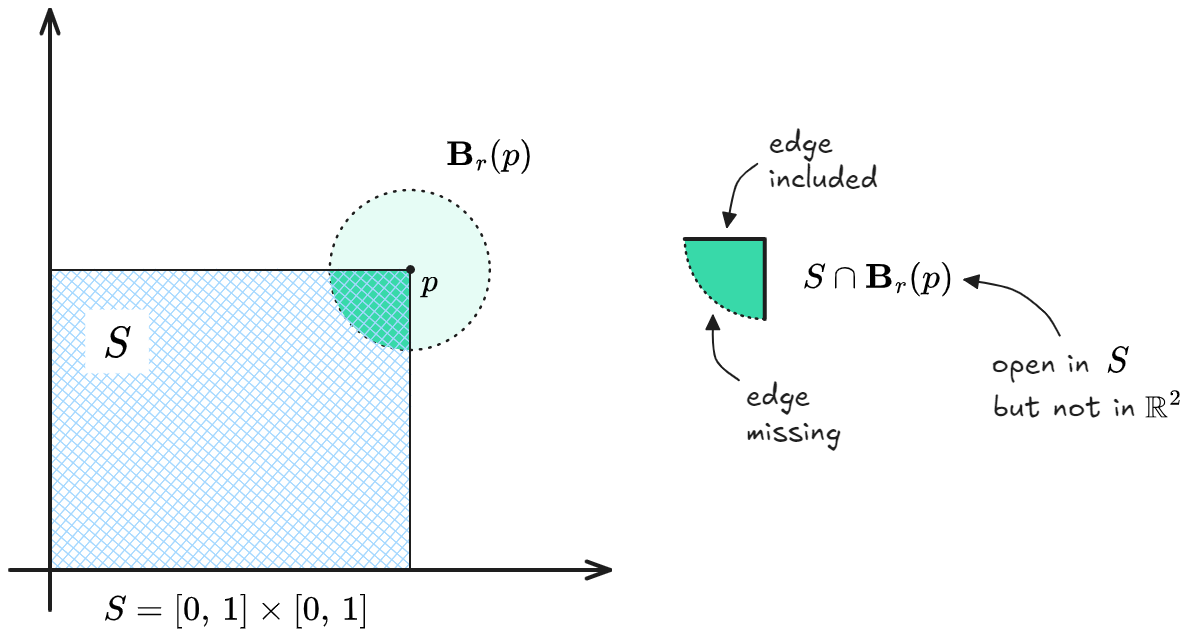
Consider the subspace equipped with the subspace topology inherited from the topology structure on :
An open set in may be given as the intersection with a ball in , but this set is not open in because the top and right edges would be included. No open ball can be found around a point in this edge and contained in .
Theory - Metric, open balls, continuity
Metric, open balls, continuity
Metric space
A metric space is a set (the ‘space’) together with a metric structure.
A metric structure is a determination of distance between points in the set.
Formally: distance is measured by a function satisfying:
Triangle inequality:
and more basic axioms:
- for all
In the distance function is, of course, .
Using any distance function, we can define open balls:
Then we can generate a topology on from these open balls. We are, in effect, using the topology of in the codomain of to induce a topology back on the space .
Metric space topology
Any metric space has a natural metric space topology structure.
The open sets are generated by open balls . That is, open sets are all unions of open balls:
Every structure of metric space automatically has a natural structure of topological space due to the above definition.
A topology structure formalizes only the notion of connectedness, or one might say “touching vs. separated”, while a metric structure adds a quantitative measure of distance. As such it implies notions like “double the distance” or “ the distance.” But a metric structure does imply at least a topology structure, because any points that are separated by some distance are in fact separated.
Topological structures that do not come from metric structures can also be useful and interesting. (E.g. in algebraic geometry.) But the notion of “touching” that they express is rather abstracted from the geometrical one we are accustomed to.
“All unions of open balls”
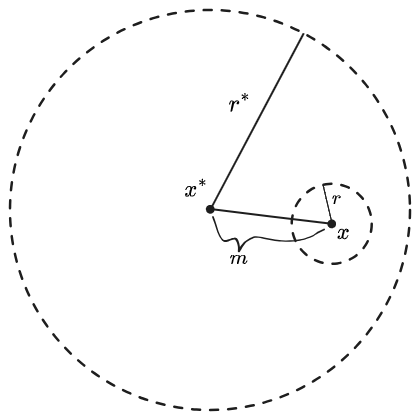
The collection “all unions of open balls” satisfies the axioms of a topology. The first two axioms clearly hold. To check the third axiom, one would have to formalize the concept of ‘generates’, which is applicable to the concept of ‘subbase’. The essential verification is that for any point inside a finite intersection of open balls, there is another open ball around that point which is contained in the intersection. The triangle axiom is needed to confirm this.
LEMMA: open subsets via open balls
In any metric space , a subset is open if and only if:
In words: is open IFF any in has some open ball around it which is contained in .
This lemma provides a functional characterization of open sets in a metric space.
Proof of LEMMA
Assume the Lemma condition holds; try to prove is open.
- For each , write for some open ball over contained in . Then , and is a union of open sets, thus open.
Now assume is open; try to prove the condition holds.
- is necessarily the union of some open balls. (Definition of topology structure given a metric.)
- Select any . By 1., this is in some open ball :
- Find a ball centered at which is inside , thus inside .
- Set
- Definition of ball and implies
- Set
- Triangle Inequality: Every satisfies
- Therefore
Continuous functions
A function between topological spaces is continuous when:
This definition implies that a connected subset cannot be mapped to a disconnected subset by a continuous . Given any disjoint union of opens that ‘disconnects’ the image of , the definition implies that and are disjoint opens covering and disconnecting it. The fact that the definition of continuity appears to go “the wrong way” (implication from codomain to domain ) is related to the logical negation inside “no possible disjoint union of opens” in the definition of connectedness.
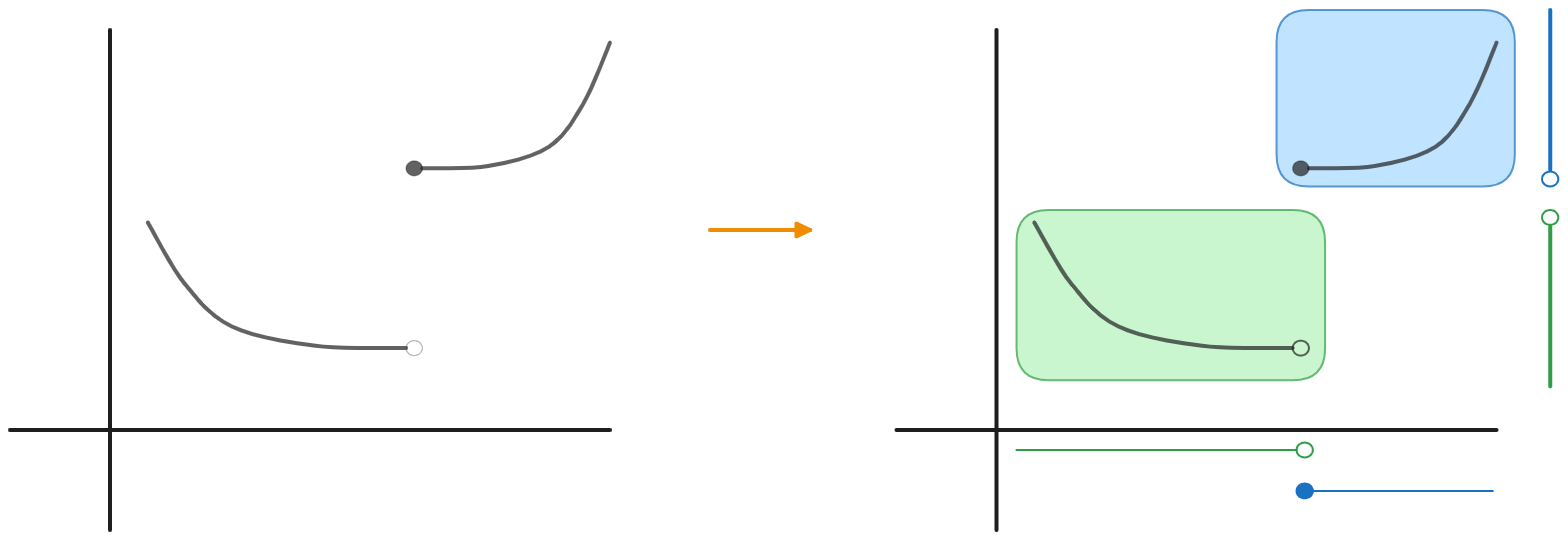
For example, the graph of a function with a jump discontinuity:
The disconnected image of can be separated by open sets in the codomain (vertical axis). The domain is not separated by the preimages – the function is not continuous.
An equivalent definition of continuity can be cast in terms of the metric structure, if the topology comes from a metric:
Continuity and distance
A map of metric spaces is continuous at when:
For all , there exists such that:
Then itself is continuous if it is continuous at every point .
Link to original
Illustration
Illustration - epsilon-delta continuity
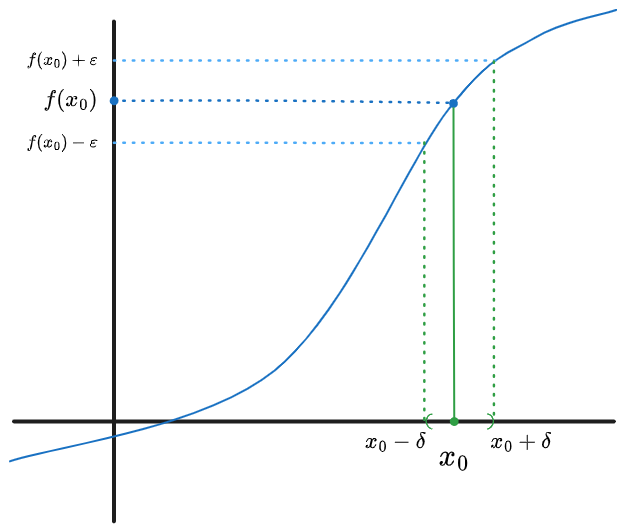
In Calc I we learn that is continuous at when:
Or, in terms of set containment:
Let us compare this to the definition in terms of open sets:
Link to original
Open-set continuity agrees with epsilon-delta continuity
Link to originalOpen-set continuity agrees with - continuity
Assume that is continuous according to the topological definition.
- Select any . Let be given.
- The interval is open.
- By the topological definition of continuity, the preimage is open. It contains .
- By the Lemma for metric space continuity, find an open ball around inside .
- This ball is an interval .
- All elements of this interval are mapped into , confirming the - condition.
Assume that is continuous according to the - definition.
- Select any open set. We must show is open.
- Select any . Define .
- Then , and so for some by metric space continuity.
- This is an interval:
- By the - definition of continuity, produce some so that:
- Therefore, whenever , we know .
- So is open (by definition), is contained in , and contains , confirming the topological continuity condition.
Theory - Compactness, homeomorphism, continuity, homotopy
Compactness, homeomorphism, continuity, homotopy
Compactness
A topological space is compact when every open cover has a finite subcover.
The entire real line is not compact because the open cover has no finite subset which also covers .
The closed interval is compact.
- Let be any open cover of .
- Define :
- Let be the supremum of .
- We show .
- Suppose and seek a contradiction.
- Take some open set in containing , and an open ball around and contained in .
- Move leftwards to . There is a finite cover of from .
- Add to this cover, and get a finite cover of .
- This contradicts the supremum property of . So we know .
- Take some open set in containing , and an open ball .
- There is a finite cover of because .
- Add to this cover to get a finite cover of . QED
Homeomorphism
A homeomorphism is a map between topological spaces, , satisfying:
- is bijective
- is continuous
- is continuous
PROP: ‘Homeomorphism’ simplifies for compact metric spaces
If is a continuous bijection between metric spaces, and and are both compact, then is necessarily a homeomorphism.
Homotopy
A homotopy is a morphism between continuous maps.
Given continuous maps, a homotopy is a continuous function:
We say and are homotopic if any homotopy exists between them.
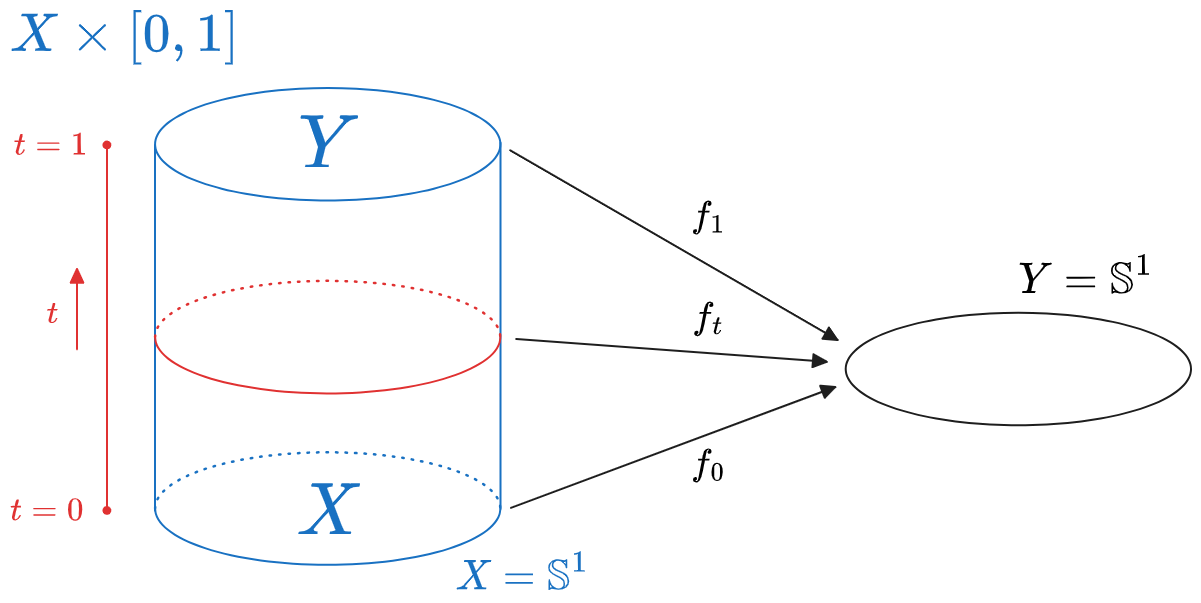
A homotopy is a continuous deformation of into . Define to view it this way.
For example, suppose we have two maps :
The “winding number” is preserved by , meaning that each has the same winding number.
Link to original
Topological spaces: further notions
Theory - Quotients, gluing
Quotients, gluing
Quotient topology
For any partition of of into cells , , there is a quotient topology structure on the set of cells .
The open sets of are the collections of cells whose unions are open in .
A quotient space is therefore given by ‘collapsing’ some sets of points in into single objects , and the open sets come from open sets in that are compatible with the partition, meaning they do not cross partition boundaries, or that they contain only whole cells.
There are many equivalent formulations of this notion, and these two are most common:
- Using an equivalence relation on , whereby the equivalence classes determine cells of the partition. Then the quotient space is written .
- Recall that partitions and equivalence relations are interchangeable notions.
- Using a surjective function , whereby the preimage fibers determine cells of the partition. Then has the quotient topology when open sets are given by where is open in .
Link to originalGluing
Two spaces and can be glued along specified subsets and using a bijection by defining the quotient topology where identifies with .
Illustration
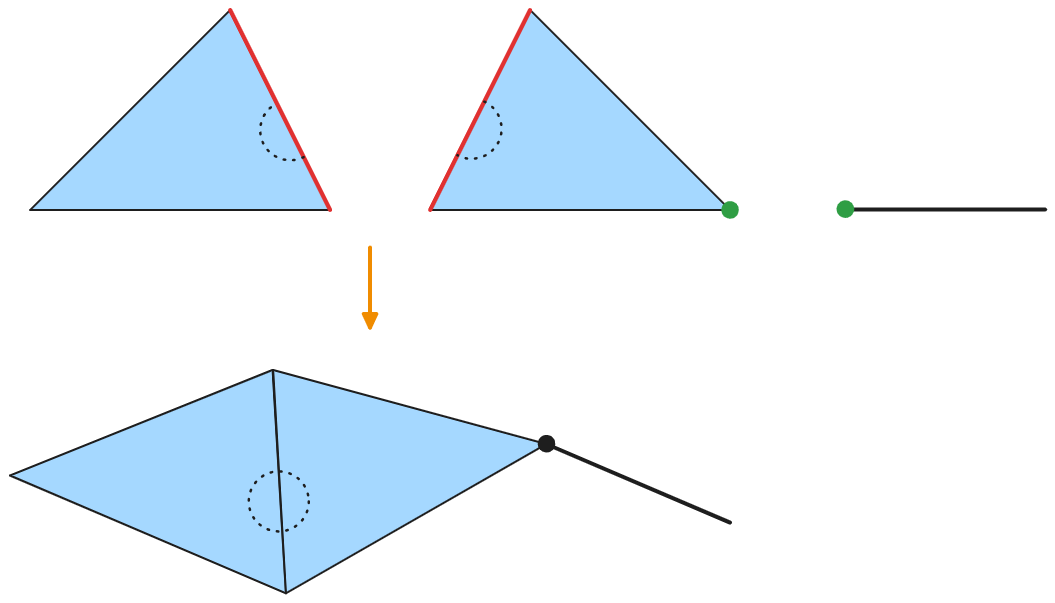
Gluing shapes
Link to originalGluing shapes
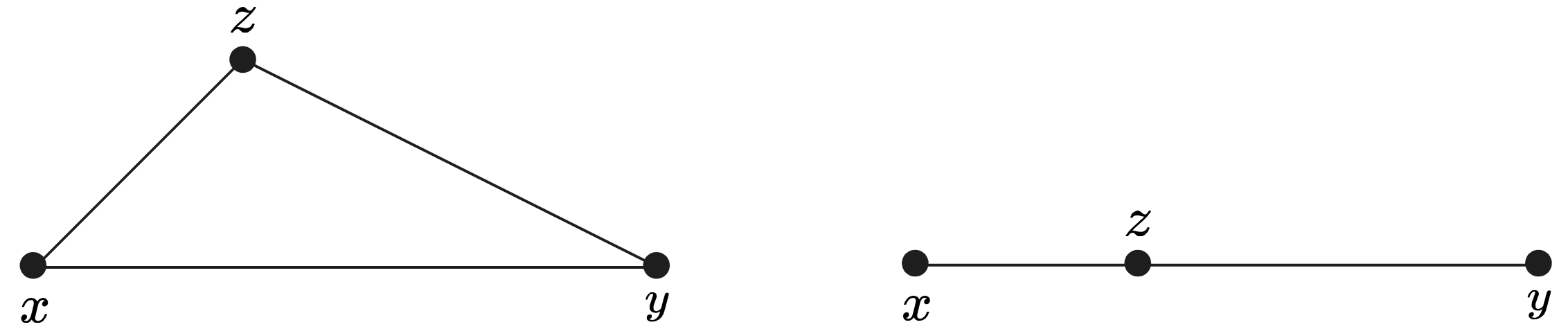
- Glue a pair of triangles along an edge.
- Glue a line segment to a triangle, endpoint to vertex.
Real projective space RPn
Link to originalReal projective space
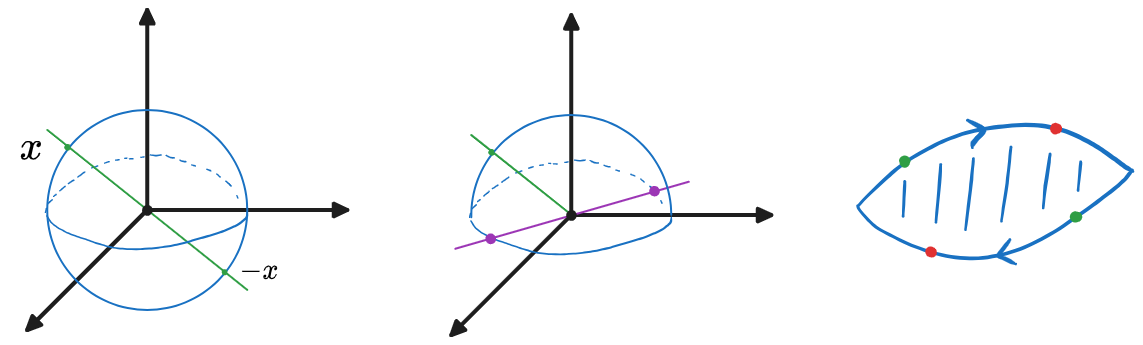
Consider the unit sphere . Antipodal points of are those determining a straight line passing through the origin.
Define as the quotient where equivalence classes of are the pairs of antipodal points.
Define similarly by gluing together antipodal points in .
We can also describe using a disk with antipodally glued boundary:
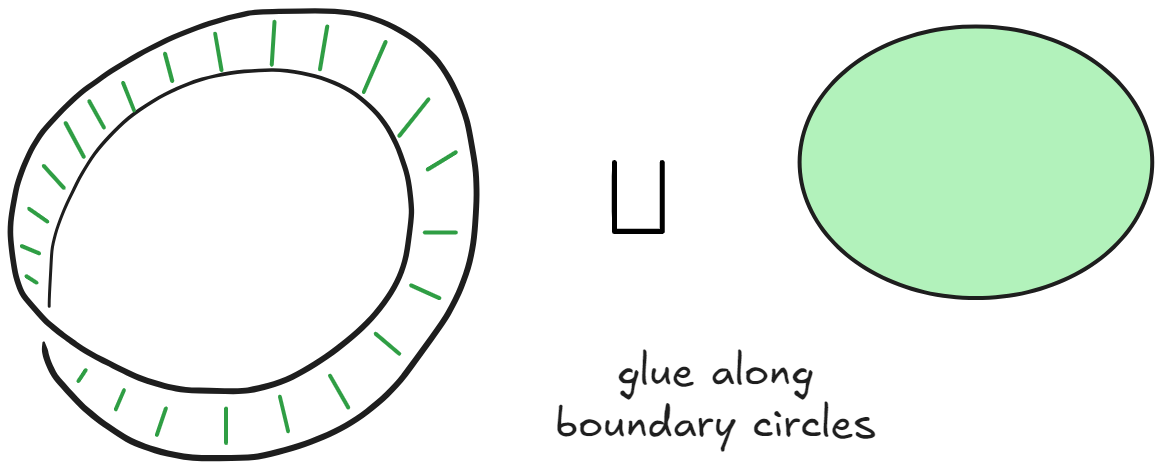
This surface is also derivable by gluing a disk to a Mobius band:
Theory - Embedding, limit points, closure, boundary
Embedding, limit points, closure, boundary
Embedding
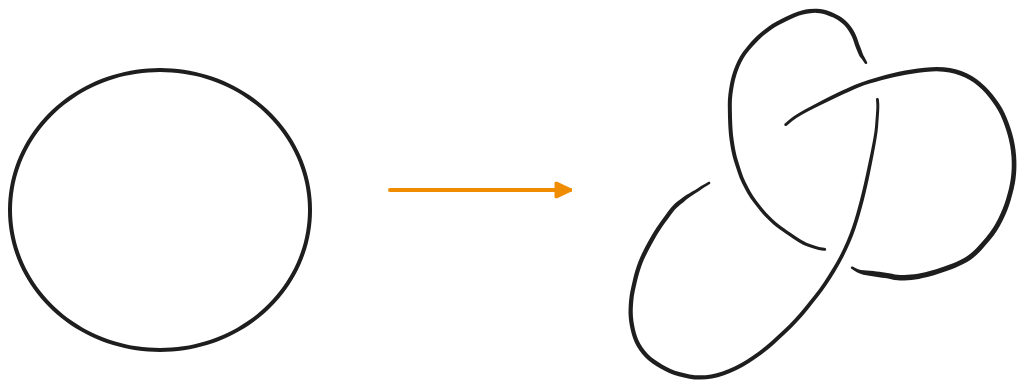
An embedding is a continuous injective map that induces a homeomorphism .
It is important to emphasize that should have the subspace topology inherited from .
For example, a knot in is an embedding .
Link to original
01
Link to originalExercise - Touching upon
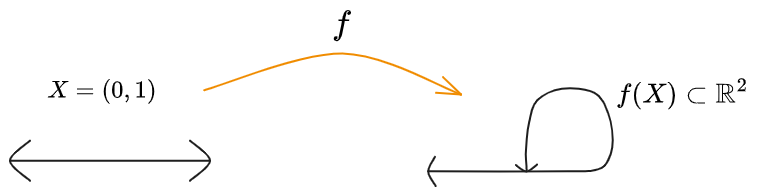
An open interval is mapped into by such that one end has a limit point on the image of the middle.
The map is continuous and bijective. Show that is not continuous.
Embedding, limit points, closure, boundary (part 2)
Limit points
Given a subspace , a point is a limit point of when every open set around touches somewhere besides .
Notes:
- Limit points are sometimes called accumulation points.
- The limit point might be outside !
- In a metric space, this can be reformulated: is a limit point of when there is some sequence such that as . This is written .
- In other words, is “approached” from inside .
Interior and exterior
The interior of a set is the set of points with an open neighborhood contained in .
The exterior of a set is the interior of the complement of .
Closure of a set
The closure of a set is the union of with all limit points of .
- Equivalently: the closure is the complement of the union of all open sets in that don’t touch .
- Equivalently: the closure is the intersection of all closed sets containing .
Boundary of a set
The boundary of a set is the set of points in both and .
Link to original
- Equivalently: the boundary is the set of points for which every open neighborhood touches both the interior and the exterior of .
- Boundary points are not always in !